

- 100 % Datengenauigkeit
- Wissenschaftlicher Support rund um die Uhr
- 0 % Toleranz bei der Produktqualität
Lagerstandorte
- New Jersey, USA
- Tschechien, EU
* Bestand vorbehaltlich Verfügbarkeit.
Dokumentation
Enthält: HPLC, MASS/LC-MS, 1H-NMR, FT-IR, Gehalt, Structure Elucidation Report (SER) sowie zusätzliche analytische Daten je nach Produkt.
67118-31-4
Levetiracetam EP Impurity A
● In Stock
| Katalog-Nr.: | VL1280003 |
|---|---|
| CAS-Nr.: | 67118-31-4 |
| Summenformel: | C8H13NO3 |
| Molare Masse: | 171.19 g/mol |
For laboratory use only: analytical, development and regulatory purposes. Supplied in mg quantities. Not for human or veterinary use.
Angebot für ein Set anfordern
- Angebot für dieses Set anfragen
Alle EP-Verunreinigungen von Levetiracetam
6 ProdukteDie 6 Produkte ansehen
- Levetiracetam EP Impurity A VL1280003
CAS 67118-31-4 - Levetiracetam EP Impurity B VL1280008
CAS 358629-47-7 - Levetiracetam EP Impurity C VL1280009
CAS 142-08-5 - Levetiracetam EP Impurity D VL1280001
CAS 103765-01-1 - Levetiracetam Related Compound B VL1280013
CAS 7682-20-4 - Levetiracetam Related Compound B (Free Base) VE006674
CAS 7324-11-0
- Levetiracetam EP Impurity A VL1280003
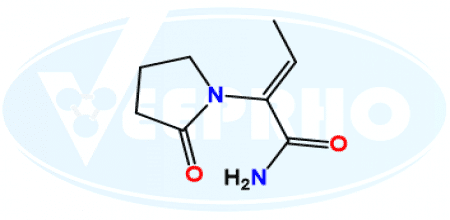
Zusätzliche Informationen zu CAS 67118-31-4
| Wirkstoff | Levetiracetam |
|---|---|
| Produkttyp | Verunreinigungsstandards |
| IUPAC-Name | (2RS)-2-(2-Oxopyrrolidin-1-yl)butanoic acid |
| Name im EP | Levetiracetam EP Impurity A |
| SMILES | CCC(C(=O)O)N1CCCC1=O |
| InChIKey | IODGAONBTQRGGG-UHFFFAOYSA-N |
| CHNS-Verhältnis (%) (berechnet) | C 56.13 · H 7.65 · N 8.18 · S 0.00 |
| Referenzen | - |
| Beschreibung | Levetiracetam EP-Impurity A, auch als Levetiracetam-Carbonsäure-Racemat bezeichnet, ist die racemische, offenkettige Carbonsäure des pyrrolidonhaltigen Wirkstoffs. CAS 67118-31-4, Summenformel C8H13NO3, Molekulargewicht 171,19 g/mol. Die Verbindung entsteht typischerweise als hydrolytischer oder synthetischer Abbauprodukt nach Ringöffnung des 2-Oxopyrrolidin-Gerüsts und gehört nicht zu einer reaktiven genotoxischen Stoffklasse. Aufgrund ihrer hohen Polarität und engen strukturellen Verwandtschaft zum Wirkstoff erfolgt die Bestimmung meist mittels RP-HPLC mit UV-Detektion oder LC-MS/MS; für Spurenprofile in monographischen und Stabilitätsuntersuchungen sind ergänzend LC-HRMS-Verfahren üblich. |
Angebot anfordern
"*" kennzeichnet Pflichtfelder