
- 100 % Datengenauigkeit
- Wissenschaftlicher Support rund um die Uhr
- 0 % Toleranz bei der Produktqualität
Lagerstandorte
- New Jersey, USA
- Tschechien, EUAuf Lager
* Bestand vorbehaltlich Verfügbarkeit.
Dokumentation
Enthält: HPLC, MASS/LC-MS, 1H-NMR, FT-IR, Gehalt, Structure Elucidation Report (SER) sowie zusätzliche analytische Daten je nach Produkt.
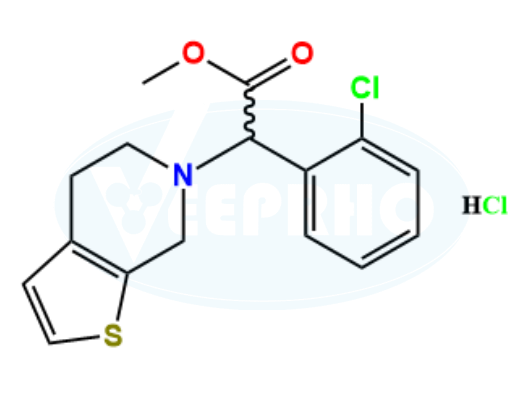
144750-52-7
Clopidogrel Related Compound B (HCl Salt)
● Auf Lager
| Katalog-Nr.: | VL31009 |
|---|---|
| CAS-Nr.: | 144750-52-7 |
| Summenformel: | C16H16ClNO2S.HCl |
| Molare Masse: | 358.28 g/mol (Salt) ; 321.82g/mol (Free Base) |
For laboratory use only: analytical, development and regulatory purposes. Supplied in mg quantities. Not for human or veterinary use.
Angebot für ein Set anfordern
- Angebot für dieses Set anfragen
Alle USP-Verunreinigungen von Clopidogrel
12 ProdukteDie 12 Produkte ansehen
- Amlodipine EP Impurity F (Besylate Salt) VL19006
- Clopidogrel EP Impurity A VL31007
CAS 144457-28-3 - Clopidogrel EP Impurity A (HCl salt) VL31003
CAS 144750-42-5 - Clopidogrel EP Impurity C VL31004
CAS 120202-71-3 - Clopidogrel EP Impurity C (Free Base) VE0021266
CAS 120202-69-9 - Clopidogrel EP Impurity C (Hydrobromide Salt) VE0021267
CAS 1027067-35-1 - Clopidogrel EP Impurity E VE0013633
CAS 444728-13-6 - Clopidogrel Ethyl Ester Sulfate VE0013834
CAS 1332612-57-3 - Clopidogrel R-Enantiomer VE0013634
CAS 444728-15-8 - Clopidogrel Related Compound B (HCl Salt) VL31009
CAS 144750-52-7 - Ticlopidine Pyridinium Bromide Analog VE0013821
- (R)-Clopidogrel Carboxylic Acid VE0013631
CAS 324757-50-8


Zusätzliche Informationen zu CAS 144750-52-7
| Wirkstoff | Clopidogrel |
|---|---|
| Produkttyp | Verunreinigungsstandards |
| IUPAC-Name | Methyl (±)-(o-chlorophenyl)[4, 5-dihydrothieno[2, 3-c]pyridine-6(7H)-yl]acetate hydrochloride |
| Name in der USP | Clopidogrel Related Compound B |
| SMILES | ClC1=CC=CC=C1C(C(OC)=O)N2CC3=C(C=CS3)CC2.Cl |
| InChI | InChI=1S/C16H16ClNO2S.ClH/c1-20-16(19)15(12-4-2-3-5-13(12)17)18-8-6-11-7-9-21-14(11)10-18;/h2-5,7,9,15H,6,8,10H2,1H3;1H |
| InChIKey | SYAKRIYLSOOCKW-UHFFFAOYSA-N |
| CHNS-Verhältnis (%) (berechnet) | C 53.64 · H 4.78 · N 3.91 · S 8.95 |
| Referenzen | Maffrand | Jean-Pierre. “The Story of Clopidogrel and Its Predecessor | Ticlopidine: Could These Major Antiplatelet and Antithrombotic Drugs Be Discovered and Developed Today?â€Â Comptes Rendus Chimie | vol. 15 | no. 8 | Aug. 2012 | pp. 737–43 | https://doi.org/10.1016/j.crci.2012.05.006. |
| Beschreibung | Clopidogrel Related Compound B (HCl-Salz), CAS 144750-52-7, ist das Hydrochlorid einer chlorphenylsubstituierten Thiophenethylamin-Verunreinigung im Syntheseweg von Clopidogrel. Mit der Summenformel C16H16ClNO2S.HCl und einer Molmasse von 358,28 g/mol als Salz beziehungsweise 321,82 g/mol als freie Base wird sie üblicherweise als prozessbedingte Verunreinigung oder als Carryover eines Zwischenprodukts infolge unvollständiger Umsetzung oder Nebenreaktionen während des Aufbaus des Thienopyridin-Intermediats bewertet. Wegen der strukturellen Nähe zum Wirkstoff sind LC-MS/MS oder LC-UV sowie hochauflösende MS und gegebenenfalls NMR für die eindeutige Trennung und Bestimmung erforderlich. |
Angebot anfordern
"*" kennzeichnet Pflichtfelder
Weitere Produkte zu Clopidogrel Verunreinigungen
| Struktur der Verunreinigung | Name der Verunreinigung | Katalog-Nr. |
|---|---|---|
| Clopidogrel EP Impurity A | VL31007 | |
| Clopidogrel EP Impurity A (HCl salt) | VL31003 | |
| Clopidogrel EP Impurity B | VL31002 | |
| Clopidogrel EP Impurity C | VL31004 | |
| Clopidogrel EP Impurity C (Free Base) | VE0021266 | |
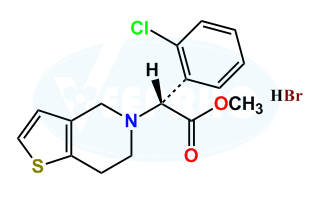 | Clopidogrel EP Impurity C (Hydrobromide Salt) | VE0021267 |
| Clopidogrel EP Impurity D | VL31011 | |
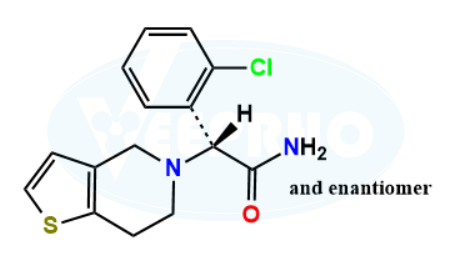 | Clopidogrel EP Impurity E | VE0011532 |
| Clopidogrel EP Impurity E | VE0013633 | |
 | Clopidogrel EP Impurity F (Bisulpate) | VE006553 |
| Clopidogrel EP Impurity F (Free Base) | VE0021265 | |
| N-Nitroso Clopidogrel EP Impurity F | VE0023722 |
Alle verwandten Produkte zeigen N-Nitroso-Clopidogrel-Verunreinigungen (2)