
- 100% accuracy of data
- 24/7 scientific support
- 0% tolerance in quality of product
Mutagenicity assessment (ICH M7)
Potentially mutagenic impurity (ICH M7 Class 1–3).
N-nitroso compound: ICH M7 cohort of concern.Stock Locations
- New Jersey, USA
- Czech Republic, EU
* Stock subject to availability.
Documentation
Includes: HPLC, MASS/LC-MS, 1H NMR, FT-IR, Potency, Structure Elucidation Report (SER), and additional analytical data depending on the product.
3033746-15-2
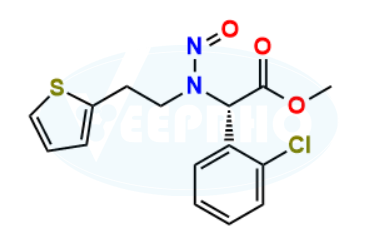
N-Nitroso Clopidogrel EP Impurity F
● In Stock
| Catalogue No.: | VE0023722 |
|---|---|
| CAS No.: | 3033746-15-2 |
| Mol. Formula: | C15H15ClN3O2S |
| Mol. Weight: | 338.81 g/mol |
For laboratory use only: analytical, development and regulatory purposes. Supplied in mg quantities. Not for human or veterinary use.
Request a quote for a set
- Request quote for this set
All nitrosamine impurities of Clopidogrel
4 productsSee the 4 products
- Clopidogrel Nitroso Impurity VE0016716
CAS 2460755-43-3 - N-Nitroso Clopidogrel EP Impurity F VE0023722
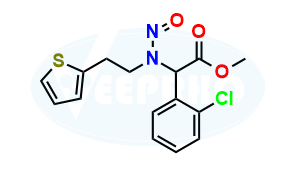
CAS 3033746-15-2 - N-Nitroso Rac-Clopidogrel EP Impurity F (Mixture of Isomers) VE0024618
- 5-Nitroso-5,6,7,7a-tetrahydrothieno[3,2-c]pyridin-2(4H)-one VE0016717
- Clopidogrel Nitroso Impurity VE0016716

Additional information on CAS 3033746-15-2
| Parent drug | Clopidogrel |
|---|---|
| Product type | Impurity standards |
| IUPAC name | (S)-methyl 2-(2-chlorophenyl)-2-(nitroso(2-(thiophen-2-yl)ethyl)amino)acetate |
| SMILES | COC(=O)[C@H](c1ccccc1Cl)N(CCc1cccs1)N=O |
| InChIKey | SYLSQVNCYUJYIW-AWEZNQCLSA-N |
| Description | N-Nitroso Clopidogrel EP Impurity F (CAS 3033746-15-2) is a nitrosamine-related process impurity associated with clopidogrel, an S-nitroso or N-nitroso transformation product consistent with nitrosation chemistry under acidic or nitrosating conditions. With molecular formula C15H15ClN3O2S and molecular weight 338.81 g/mol, it represents a structurally alerting species because N-nitrosamines are generally treated as potentially genotoxic and subject to ICH M7 risk assessment. Trace-level determination commonly requires LC-MS/MS, high-resolution LC-MS, and, where volatile or semi-volatile behavior is relevant, GC-MS methods, supported by selective chromatographic separation and isotopically resolved monitoring. |
Request a Quote
"*" indicates required fields
Other products related to Clopidogrel and Nitroso impurities
| Impurity structure | Name of Impurity | Catalogue No. |
|---|---|---|
| Clopidogrel EP Impurity A | VL31007 | |
| Clopidogrel EP Impurity A (HCl salt) | VL31003 | |
| Clopidogrel EP Impurity B | VL31002 | |
| Clopidogrel EP Impurity C | VL31004 | |
| Clopidogrel EP Impurity C (Free Base) | VE0021266 | |
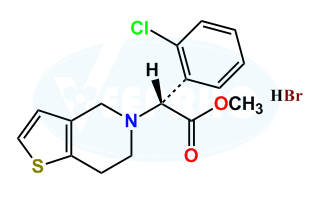 | Clopidogrel EP Impurity C (Hydrobromide Salt) | VE0021267 |
| Clopidogrel EP Impurity D | VL31011 | |
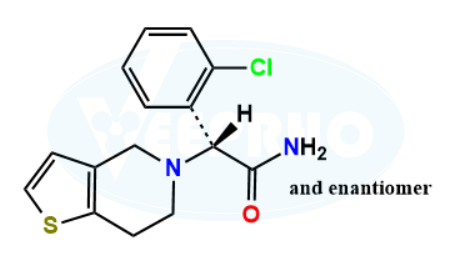 | Clopidogrel EP Impurity E | VE0011532 |
| Clopidogrel EP Impurity E | VE0013633 | |
 | Clopidogrel EP Impurity F (Bisulpate) | VE006553 |
| Clopidogrel EP Impurity F (Free Base) | VE0021265 | |
| Clopidogrel Related Compound B (HCl Salt) | VL31009 |
Show all related products N-Nitroso Clopidogrel impurities (2)