
- 100% accuracy of data
- 24/7 scientific support
- 0% tolerance in quality of product
Stock Locations
- New Jersey, USA
- Czech Republic, EU
* Stock subject to availability.
Documentation
Includes: HPLC, MASS/LC-MS, 1H NMR, FT-IR, Potency, Structure Elucidation Report (SER), and additional analytical data depending on the product.
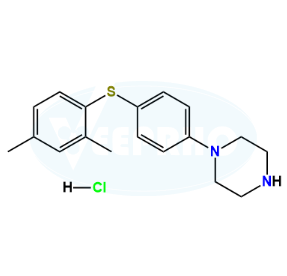
1-(4-((2,4-dimethylphenyl)thio)phenyl)piperazine hydrochloride
● In Stock
| Catalogue No.: | VE0027580 |
|---|---|
| CAS No.: | N/A |
| Mol. Formula: | C18H23ClN2S |
| Mol. Weight: | 334.91 g/mol |
For laboratory use only: analytical, development and regulatory purposes. Supplied in mg quantities. Not for human or veterinary use.
Additional information on 1-(4-((2,4-dimethylphenyl)thio)phenyl)piperazine hydrochloride
| Parent drug | Vortioxetine |
|---|---|
| Product type | Impurity standards |
| IUPAC name | 1-(4-((2,4-dimethylphenyl)thio)phenyl)piperazine hydrochloride |
| SMILES | CC1=CC=C(SC2=CC=C(N3CCNCC3)C=C2)C(C)=C1.[H]Cl |
| InChI | InChI=1S/C18H22N2S.ClH/c1-14-3-8-18(15(2)13-14)21-17-6-4-16(5-7-17)20-11-9-19-10-12-20;/h3-8,13,19H,9-12H2,1-2H3;1H |
| InChIKey | MHSUBFINGMZOHU-UHFFFAOYSA-N |
| CHNS Ratio (%) (calculated) | C 64.55 · H 6.92 · N 8.36 · S 9.57 |
| Description | 1-(4-((2,4-dimethylphenyl)thio)phenyl)piperazine hydrochloride is a piperazine-derived aromatic thioether impurity with molecular formula C18H23ClN2S and molecular weight 334.91 g/mol. The hydrochloride salt form reflects protonation of the basic piperazine nitrogen and may arise as a synthetic intermediate, process-related byproduct, or salt-conversion residue during API manufacture. Its sulfur-linked biaryl structure confers moderate lipophilicity and strong reversed-phase retention. Structural elucidation and trace quantification commonly require LC-MS/MS, high-resolution MS, and orthogonal HPLC with UV detection; GC-MS may support volatile impurity profiling after derivatization. Under regulatory assessment, such non-classical organic impurities are evaluated for identity, specification control, and potential toxicological relevance. |
Request a Quote
"*" indicates required fields
Other products related to Vortioxetine impurities
| Impurity structure | Name of Impurity | Catalogue No. |
|---|---|---|
| Vortioxetine Related Compound A | VE0028877 | |
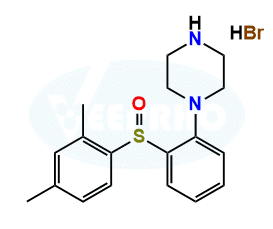 | 1-(2-((2,4-dimethylphenyl)sulfinyl)phenyl)piperazine hydrobromide | VE0016997 |
| 1-(2-((2,4-dimethylphenyl)sulfonyl)phenyl)-4-nitrosopiperazine | VE0028949 | |
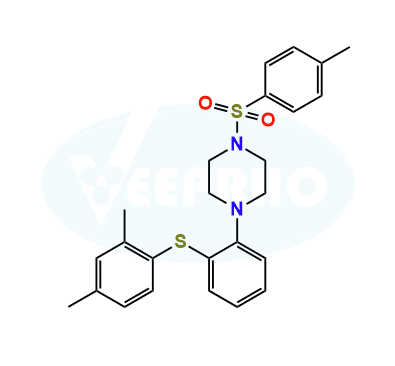 | 1-(2-((2,4-dimethylphenyl)thio)phenyl)-4-tosylpiperazine | VE0016995 |
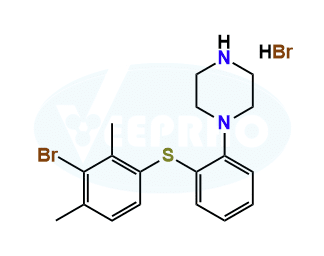 | 1-(2-((3-bromo-2,4-dimethylphenyl)thio)phenyl)piperazine hydrobromide | VE0016999 |
| 1-(4-((2,4-dimethylphenyl)thio)phenyl)-4-nitrosopiperazine | VE0010504 | |
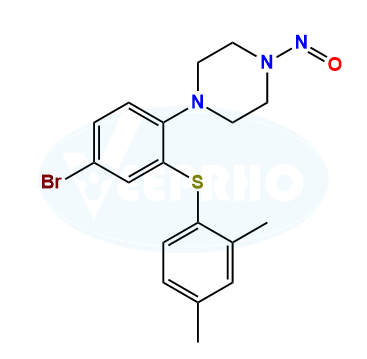 | 1-(4-bromo-2-((2,4-dimethylphenyl)thio)phenyl)-4-nitrosopiperazine | VE0023858 |
| 1,2-Di-p-tolyldisulfane | VE0016996 | |
| N-acetyl Vortioxetine Impurity | VL3530003 | |
| N-formyl Vortioxetine | VL3530002 | |
| N-Nitroso Vortioxetine | VE009743 | |
| N-Nitroso Vortioxetine Bromo Impurity | VE0010503 |
Show all related products N-Nitroso Vortioxetine impurities (5)