

- 100% accuracy of data
- 24/7 scientific support
- 0% tolerance in quality of product
Stock Locations
- New Jersey, USA
- Czech Republic, EU
* Stock subject to availability.
Documentation
Includes: HPLC, MASS/LC-MS, 1H NMR, FT-IR, Potency, Structure Elucidation Report (SER), and additional analytical data depending on the product.
2135576-73-5
N-formyl Vortioxetine
● In Stock
| Catalogue No.: | VL3530002 |
|---|---|
| CAS No.: | 2135576-73-5 |
| Mol. Formula: | C19H22N2OS |
| Mol. Weight: | 326.46 |
For laboratory use only: analytical, development and regulatory purposes. Supplied in mg quantities. Not for human or veterinary use.
Additional information on CAS 2135576-73-5
| Parent drug | Vortioxetine |
|---|---|
| Product type | Impurity standards |
| IUPAC name | 4-[2-[(2,4-dimethylphenyl)thio]phenyl]-1-Piperazinecarboxaldehyde |
| SMILES | Cc1ccc(Sc2ccccc2N2CCN(C=O)CC2)c(C)c1 |
| InChIKey | FUZFFGZOBQDQED-UHFFFAOYSA-N |
| CHNS Ratio (%) (calculated) | C 69.90 · H 6.79 · N 8.58 · S 9.82 |
| References | ortioxetine for Cognitive Enhancement in Major Depression: From Animal Models to Clinical Research By Djamila Bennabi | Emmanuel Haffen | Vincent Van Waes Container: Frontiers in Psychiatry Year: 2019 Volume: 10 DOI: 10.3389/fpsyt.2019.00771 URL: https://www.ncbi.nlm.nih.gov/pmc/articles/PMC6851880/ |
| Description | N-Formyl vortioxetine, CAS 2135576-73-5, is a defined process-related impurity of the multimodal antidepressant vortioxetine formed by N-formylation of the secondary amine center during synthesis or exposure to reactive carbonyl species. With molecular formula C19H22N2OS and molecular weight 326.46, it retains the benzo[b]thiophene-linked piperazine scaffold while introducing a formamido functionality that alters polarity and chromatographic behavior. Characterization typically requires LC-MS/MS for mass confirmation and impurity profiling, with LC-UV or high-resolution LC-MS used for quantitative assessment. Although not a nitrosamine, its presence is relevant under impurity control frameworks and ICH M7 principles where structurally derived trace impurities are evaluated. |
Request a Quote
"*" indicates required fields
Other products related to Vortioxetine impurities
| Impurity structure | Name of Impurity | Catalogue No. |
|---|---|---|
| Vortioxetine Related Compound A | VE0028877 | |
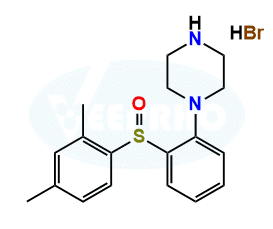 | 1-(2-((2,4-dimethylphenyl)sulfinyl)phenyl)piperazine hydrobromide | VE0016997 |
| 1-(2-((2,4-dimethylphenyl)sulfonyl)phenyl)-4-nitrosopiperazine | VE0028949 | |
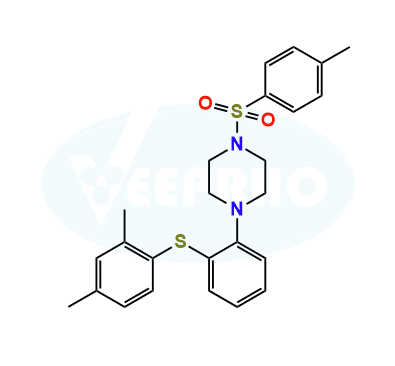 | 1-(2-((2,4-dimethylphenyl)thio)phenyl)-4-tosylpiperazine | VE0016995 |
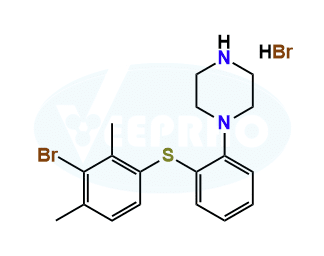 | 1-(2-((3-bromo-2,4-dimethylphenyl)thio)phenyl)piperazine hydrobromide | VE0016999 |
| 1-(4-((2,4-dimethylphenyl)thio)phenyl)-4-nitrosopiperazine | VE0010504 | |
| 1-(4-((2,4-dimethylphenyl)thio)phenyl)piperazine hydrochloride | VE0027580 | |
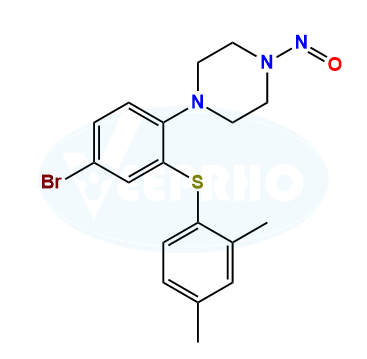 | 1-(4-bromo-2-((2,4-dimethylphenyl)thio)phenyl)-4-nitrosopiperazine | VE0023858 |
| 1,2-Di-p-tolyldisulfane | VE0016996 | |
| N-acetyl Vortioxetine Impurity | VL3530003 | |
| N-Nitroso Vortioxetine | VE009743 | |
| N-Nitroso Vortioxetine Bromo Impurity | VE0010503 |
Show all related products N-Nitroso Vortioxetine impurities (5)