
- 100% accuracy of data
- 24/7 scientific support
- 0% tolerance in quality of product
Stock Locations
- New Jersey, USA
- Czech Republic, EU
* Stock subject to availability.
Documentation
Includes: HPLC, MASS/LC-MS, 1H NMR, FT-IR, Potency, Structure Elucidation Report (SER), and additional analytical data depending on the product.
103-19-5
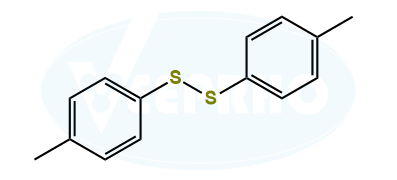
1,2-Di-p-tolyldisulfane
● In Stock
| Catalogue No.: | VE0016996 |
|---|---|
| CAS No.: | 103-19-5 |
| Mol. Formula: | C14H14S2 |
| Mol. Weight: | 246.39 g/mol |
For laboratory use only: analytical, development and regulatory purposes. Supplied in mg quantities. Not for human or veterinary use.
Additional information on CAS 103-19-5
| Parent drug | Vortioxetine |
|---|---|
| Product type | Impurity standards |
| IUPAC name | 1,2-Di-p-tolyldisulfane |
| Other Synonyms | Di-p-tolyl disulfide; Disulfide, bis(4-methylphenyl); Diptolyl disulfide; 1-Methyl-4-[(4-methylphenyl)disulfanyl]benzene |
| SMILES | CC1=CC=C(SSC2=CC=C(C)C=C2)C=C1 |
| InChI | InChI=1S/C14H14S2/c1-11-3-7-13(8-4-11)15-16-14-9-5-12(2)6-10-14/h3-10H,1-2H3 |
| InChIKey | TZOVOULUMXXLOJ-UHFFFAOYSA-N |
| CHNS Ratio (%) (calculated) | C 68.25 · H 5.73 · N 0.00 · S 26.02 |
| Shipping condition | Ambient Temperature |
| References | - |
| Description | 1,2-Di-p-tolyldisulfane (CAS 103-19-5) is a sulfur-containing organic impurity characterized by a disulfide linkage between two para-methylphenyl rings. Typically appearing as a pale yellow to amber oily solid with low volatility, this impurity is soluble in common organic solvents such as toluene, dichloromethane and chloroform and negligibly soluble in water. Analytical detection and quantification are performed by GC-MS, HPLC with UV or MS detection, and 1H/13C NMR, with MS fragmentation confirming the disulfide motif. The compound is stable under neutral conditions but can undergo reductive cleavage to thiols or oxidative reactions under harsh conditions, and even trace levels can cause sulfur contamination, catalyst deactivation, chromatographic interference and product discoloration, so trace-level monitoring and storage under inert, cool, light-protected conditions are recommended. |
Request a Quote
"*" indicates required fields
Other products related to Vortioxetine impurities
| Impurity structure | Name of Impurity | Catalogue No. |
|---|---|---|
| Vortioxetine Related Compound A | VE0028877 | |
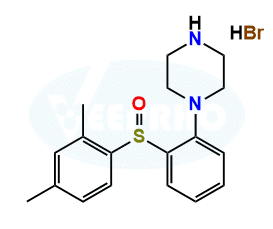 | 1-(2-((2,4-dimethylphenyl)sulfinyl)phenyl)piperazine hydrobromide | VE0016997 |
| 1-(2-((2,4-dimethylphenyl)sulfonyl)phenyl)-4-nitrosopiperazine | VE0028949 | |
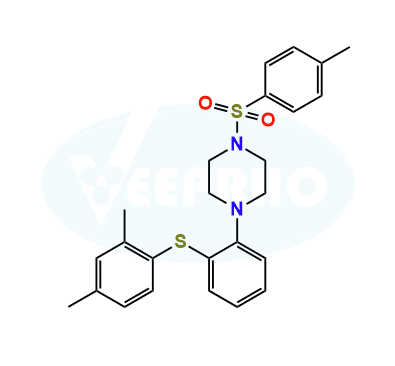 | 1-(2-((2,4-dimethylphenyl)thio)phenyl)-4-tosylpiperazine | VE0016995 |
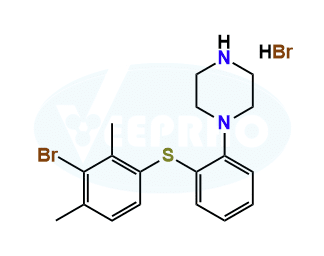 | 1-(2-((3-bromo-2,4-dimethylphenyl)thio)phenyl)piperazine hydrobromide | VE0016999 |
| 1-(4-((2,4-dimethylphenyl)thio)phenyl)-4-nitrosopiperazine | VE0010504 | |
| 1-(4-((2,4-dimethylphenyl)thio)phenyl)piperazine hydrochloride | VE0027580 | |
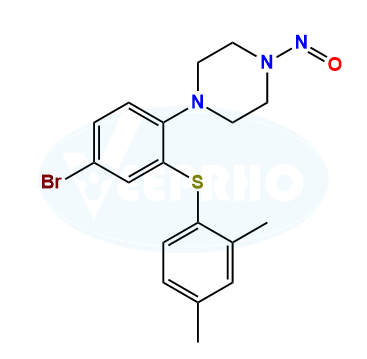 | 1-(4-bromo-2-((2,4-dimethylphenyl)thio)phenyl)-4-nitrosopiperazine | VE0023858 |
| N-acetyl Vortioxetine Impurity | VL3530003 | |
| N-formyl Vortioxetine | VL3530002 | |
| N-Nitroso Vortioxetine | VE009743 | |
| N-Nitroso Vortioxetine Bromo Impurity | VE0010503 |
Show all related products N-Nitroso Vortioxetine impurities (5)