
- 100% accuracy of data
- 24/7 scientific support
- 0% tolerance in quality of product
Stock Locations
- New Jersey, USA
- Czech Republic, EU
* Stock subject to availability.
Documentation
Includes: HPLC, MASS/LC-MS, 1H NMR, FT-IR, Potency, Structure Elucidation Report (SER), and additional analytical data depending on the product.
213767-22-7
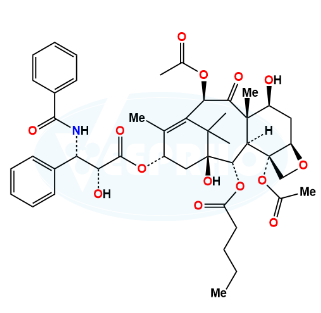
2-Debenzoyl Paclitaxel 2-Pentanoate
● In Stock
| Catalogue No.: | VE0028030 |
|---|---|
| CAS No.: | 213767-22-7 |
| Mol. Formula: | C45H55NO14 |
| Mol. Weight: | 833.92 g/mol |
For laboratory use only: analytical, development and regulatory purposes. Supplied in mg quantities. Not for human or veterinary use.
Additional information on CAS 213767-22-7
| Parent drug | Paclitaxel |
|---|---|
| Product type | Impurity standards |
| IUPAC name | (2aR,4S,4aS,6R,9S,11S,12S,12aR,12bS)-9-(((2R,3S)-3-benzamido-2-hydroxy-3-phenylpropanoyl)oxy)-4,11-dihydroxy-4a,8,13,13-tetramethyl-5-oxo-12-(pentanoyloxy)-2a,3,4,4a,5,6,9,10,11,12,12a,12b-dodecahydro-1H-7,11-methanocyclodeca[3,4]benzo[1,2-b]oxete-6,12b-diyl diacetate |
| SMILES | O=C(N[C@H]([C@@H](O)C(O[C@@H]1C(C)=C([C@@H](OC(C)=O)C([C@@]2(C)[C@](C(CO3)(OC(C)=O)C3C[C@@H]2O)([H])[C@@H]4OC(CCCC)=O)=O)C(C)(C)[C@]4(O)C1)=O)C5=CC=CC=C5)C6=CC=CC=C6 |
| InChI | InChI=1S/C45H55NO14/c1-8-9-20-32(50)59-39-37-43(7,30(49)21-31-44(37,23-56-31)60-26(4)48)38(52)36(57-25(3)47)33-24(2)29(22-45(39,55)42(33,5)6)58-41(54)35(51)34(27-16-12-10-13-17-27)46-40(53)28-18-14-11-15-19-28/h10-19,29-31,34-37,39,49,51,55H,8-9,20-23H2,1-7H3,(H,46,53)/t29-,30-,31+,34-,35+,36+,37-,39-,43?,44-,45+/m0/s1 |
| InChIKey | YYPPXYNBYNRARE-UOGVPESPSA-N |
| CHNS Ratio (%) (calculated) | C 64.81 · H 6.65 · N 1.68 · S 0.00 |
| Description | 2-Debenzoyl Paclitaxel 2-Pentanoate (CAS 213767-22-7) is a process-related impurity encountered in paclitaxel derivative syntheses and stability studies, requiring targeted analytical characterization to safeguard product quality. This impurity arises from benzoyl cleavage and acyl migration pathways and is routinely monitored by HPLC with UV detection, LC-MS for accurate mass confirmation, and NMR for structural assignment. Its presence can affect impurity profile assessments and stability conclusions, so trace-level quantification and qualification are performed following ICH guidelines. Control strategies include optimized reaction conditions, chromatographic purification, and use of isolated reference material to establish retention time and spectral fingerprints for reliable routine testing. |
Request a Quote
"*" indicates required fields