
- 100% accuracy of data
- 24/7 scientific support
- 0% tolerance in quality of product
Mutagenicity assessment (ICH M7)
Potentially mutagenic impurity (ICH M7 Class 1–3).
N-nitroso compound: ICH M7 cohort of concern.Stock Locations
- New Jersey, USA
- Czech Republic, EU
* Stock subject to availability.
Documentation
Includes: HPLC, MASS/LC-MS, 1H NMR, FT-IR, Potency, Structure Elucidation Report (SER), and additional analytical data depending on the product.
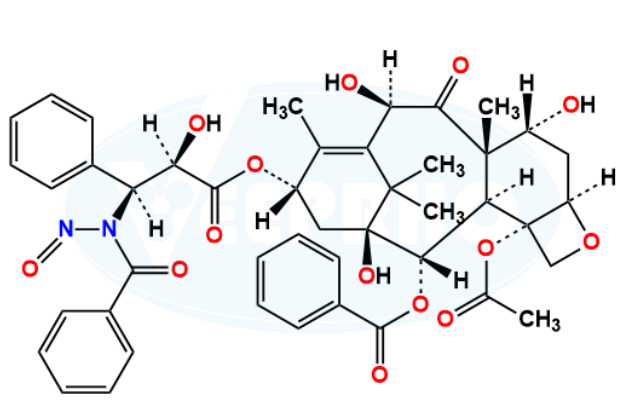
N-Nitroso Paclitaxel EP Impurity H
● Under Development
| Catalogue No.: | VE0027916 |
|---|---|
| CAS No.: | N/A |
| Mol. Formula: | C45H48N2O14 |
| Mol. Weight: | 840.47 g/mol |
For laboratory use only: analytical, development and regulatory purposes. Supplied in mg quantities. Not for human or veterinary use.
Request a quote for a set
- Request quote for this set
All nitrosamine impurities of Paclitaxel
17 productsSee the 17 products
- N-Nitroso Paclitaxel VE0027910
CAS 1053697-17-8 - N-Nitroso Paclitaxel EP Impurity A VE0027912
- N-Nitroso Paclitaxel EP Impurity B VE0027913
- N-Nitroso Paclitaxel EP Impurity C VE0027917
- N-Nitroso Paclitaxel EP Impurity D VE0027920
- N-Nitroso Paclitaxel EP Impurity E VE0027911
- N-Nitroso Paclitaxel EP Impurity G VE0027914
- N-Nitroso Paclitaxel EP Impurity H VE0027916
- N-Nitroso Paclitaxel EP Impurity I VE0027919
- N-Nitroso Paclitaxel EP Impurity J VE0027921
- N-Nitroso Paclitaxel EP Impurity K VE0027924
- N-Nitroso Paclitaxel EP Impurity L VE0027915
- N-Nitroso Paclitaxel EP Impurity M VE0027918
- N-Nitroso Paclitaxel EP Impurity O VE0027922
- N-Nitroso Paclitaxel EP Impurity P VE0027939
- N-Nitroso Paclitaxel EP Impurity Q VE0027941
- N-Nitroso Paclitaxel EP Impurity R VE0027942
- N-Nitroso Paclitaxel VE0027910


Additional information on N-Nitroso Paclitaxel EP Impurity H
| Parent drug | Paclitaxel |
|---|---|
| Product type | Impurity standards, Nitroso impurities |
| SMILES | O=C(O[C@@]1([H])C[C@]([C@](OC(C2=CC=CC=C2)=O)([H])[C@@]3([H])[C@@]4(C)[C@]([H])(O)C[C@]5([H])[C@@]3(OC(C)=O)CO5)(O)C(C)(C)C([C@@]([H])(O)C4=O)=C1C)[C@]([H])(O)[C@](N(N=O)C(C6=CC=CC=C6)=O)([H])C7=CC=CC=C7 |
| InChI | InChI=1S/C45H48N2O14/c1-24-29(59-41(55)35(51)33(26-15-9-6-10-16-26)47(46-57)39(53)27-17-11-7-12-18-27)22-45(56)38(60-40(54)28-19-13-8-14-20-28)36-43(5,37(52)34(50)32(24)42(45,3)4)30(49)21-31-44(36,23-58-31)61-25(2)48/h6-20,29-31,33-36,38,49-51,56H,21-23H2,1-5H3/t29-,30+,31+,33-,34+,35+,36-,38-,43+,44-,45+/m0/s1 |
| InChIKey | RYDBWONYRPZMFS-DIYBZAJCSA-N |
| CHNS Ratio (%) (calculated) | C 64.28 · H 5.75 · N 3.33 · S 0.00 |
| Description | N-Nitroso Paclitaxel EP Impurity H is a nitrosamine-type degradation product identified during paclitaxel synthesis and stability testing, presenting a potential genotoxic impurity risk. It can arise from nitrosation of amino precursors in the presence of nitrosating agents, acidic conditions or nitrite contaminants. Characterization relies on high-sensitivity techniques such as LC-MS/MS for quantitation and HRMS plus NMR for structural confirmation, supported by forced-degradation studies to map formation pathways and retention behavior. Control strategies follow current regulatory practice and ICH M7 guidance, including raw material nitrite control, process parameter optimization, validated cleaning, and tight specification limits to mitigate patient exposure. |
Request a Quote
"*" indicates required fields