
- 100% accuracy of data
- 24/7 scientific support
- 0% tolerance in quality of product
Mutagenicity assessment (ICH M7)
Potentially mutagenic impurity (ICH M7 Class 1–3).
Computational (in silico) assessmentStock Locations
- New Jersey, USA
- Czech Republic, EUIn stock
* Stock subject to availability.
Documentation
Includes: HPLC, MASS/LC-MS, 1H NMR, FT-IR, Potency, Structure Elucidation Report (SER), and additional analytical data depending on the product.
249285-50-5
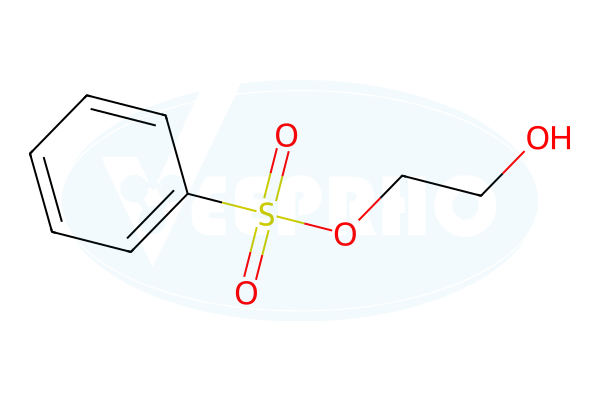
2-Hydroxyethyl Benzenesulfonate
● In Stock
| Catalogue No.: | VE009917 |
|---|---|
| CAS No.: | 249285-50-5 |
| Mol. Formula: | C8H10O4S |
| Mol. Weight: | 202.23 g/mol |
For laboratory use only: analytical, development and regulatory purposes. Supplied in mg quantities. Not for human or veterinary use.
Additional information on CAS 249285-50-5
| Parent drug | Amlodipine |
|---|---|
| Product type | Impurity standards |
| IUPAC name | 1,2-Ethanediol Monobenzenesulfonate |
| Other Synonyms | 1,2-Ethanediol Monobenzenesulfonate |
| SMILES | OCCOS(C1=CC=CC=C1)(=O)=O |
| InChI | InChI=1S/C8H10O4S/c9-6-7-12-13(10,11)8-4-2-1-3-5-8/h1-5,9H,6-7H2 |
| InChIKey | BJFRCYIYQLHUDS-UHFFFAOYSA-N |
| CHNS Ratio (%) (calculated) | C 47.52 · H 4.98 · N 0.00 · S 15.85 |
| References | - |
| Description | 2-Hydroxyethyl Benzenesulfonate (CAS 249285-50-5), also designated 1,2-Ethanediol Monobenzenesulfonate, is a sulfonate ester impurity with molecular formula C8H10O4S and molecular weight 202.23 g/mol. It may arise from incomplete sulfonation, transesterification, or hydroxyalkyl side reactions during aromatic sulfonyl chemistry. The structure contains a benzenesulfonate moiety linked to a primary alcohol, giving a polar, ionizable analyte distinct from neutral organic impurities. Because of its low volatility and potential co-elution in complex matrices, characterization typically relies on LC-MS/MS and, where needed, high-resolution MS with orthogonal LC separation; NMR may support structural confirmation. Regulatory assessment should consider impurity specification and process-related origin. |
Request a Quote
"*" indicates required fields
Other products related to Amlodipine impurities
| Impurity structure | Name of Impurity | Catalogue No. |
|---|---|---|
| Amlodipine EP Impurity A | VL19004 | |
| Amlodipine EP Impurity B | VL19002 | |
| Amlodipine EP Impurity C | VL19030 | |
| Amlodipine EP Impurity D (Besylate Salt) | VL19001 | |
| Amlodipine EP Impurity D (Free Base) | VL19023 | |
| Amlodipine EP Impurity D (Fumarate salt) | VL19024 | |
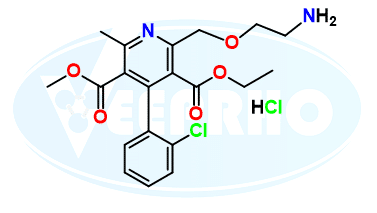 | Amlodipine EP Impurity D (HCl Salt) | VE0012177 |
| Amlodipine EP Impurity D (Mesylate salt) | VE006056 | |
| Amlodipine EP Impurity D (Oxalate Salt) | VL19015 | |
| Amlodipine EP Impurity E | VL19005 | |
 | Amlodipine EP Impurity E (Oxalate Salt) | VE006552 |
| Amlodipine EP Impurity F | VL19026 |
Show all related products N-Nitroso Amlodipine impurities (13)