

- 100% accuracy of data
- 24/7 scientific support
- 0% tolerance in quality of product
Stock Locations
- New Jersey, USA
- Czech Republic, EU
* Stock subject to availability.
Documentation
Includes: HPLC, MASS/LC-MS, 1H NMR, FT-IR, Potency, Structure Elucidation Report (SER), and additional analytical data depending on the product.
2733700-89-3
Amlodipine EP Impurity D (Besylate Salt)
● In Stock
| Catalogue No.: | VL19001 |
|---|---|
| CAS No.: | 2733700-89-3 |
| Mol. Formula: | C26H29ClN2O8S |
| Mol. Weight: | 565.04 g/mol |
For laboratory use only: analytical, development and regulatory purposes. Supplied in mg quantities. Not for human or veterinary use.
Request a quote for a set
- Request quote for this set
All EP impurities of Amlodipine
17 productsSee the 17 products
- Amlodipine EP Impurity A VL19004
CAS 88150-62-3 - Amlodipine EP Impurity B VL19002
CAS 721958-72-1 - Amlodipine EP Impurity C VL19030
CAS 721958-74-3 - Amlodipine EP Impurity D (Besylate Salt) VL19001
CAS 2733700-89-3 - Amlodipine EP Impurity D (Free Base) VL19023
CAS 113994-41-5 - Amlodipine EP Impurity D (Fumarate salt) VL19024
CAS 2138811-33-1 - Amlodipine EP Impurity D (HCl Salt) VE0012177
CAS 2414962-06-2 - Amlodipine EP Impurity D (Mesylate salt) VE006056
- Amlodipine EP Impurity D (Oxalate Salt) VL19015
CAS 1216406-90-4 (oxalate) - Amlodipine EP Impurity E VL19005
CAS 140171-65-9 - Amlodipine EP Impurity E (Maleate Salt) VE006591
CAS 400024-12-6 - Amlodipine EP Impurity E (Oxalate Salt) VE006552
- Amlodipine EP Impurity F VL19026
CAS 140171-66-0 - Amlodipine EP Impurity F (Maleate Salt) VE0012174
CAS 400024-11-5 - Amlodipine EP Impurity G VL19003
CAS 43067-01-2 - Amlodipine EP Impurity H VL19007
CAS 318465-73-5 - Amlodipine EP Impurity I VE0019561
- Amlodipine EP Impurity A VL19004
- Request quote for this set
All USP impurities of Amlodipine
17 productsSee the 17 products
- Amlodipine EP Impurity A VL19004
CAS 88150-62-3 - Amlodipine EP Impurity B VL19002
CAS 721958-72-1 - Amlodipine EP Impurity D (Besylate Salt) VL19001
CAS 2733700-89-3 - Amlodipine EP Impurity D (Free Base) VL19023
CAS 113994-41-5 - Amlodipine EP Impurity D (Fumarate salt) VL19024
CAS 2138811-33-1 - Amlodipine EP Impurity D (HCl Salt) VE0012177
CAS 2414962-06-2 - Amlodipine EP Impurity D (Mesylate salt) VE006056
- Amlodipine EP Impurity D (Oxalate Salt) VL19015
CAS 1216406-90-4 (oxalate) - Amlodipine EP Impurity E VL19005
CAS 140171-65-9 - Amlodipine EP Impurity E (Maleate Salt) VE006591
CAS 400024-12-6 - Amlodipine EP Impurity E (Oxalate Salt) VE006552
- Amlodipine EP Impurity F VL19026
CAS 140171-66-0 - Amlodipine EP Impurity F (Maleate Salt) VE0012174
CAS 400024-11-5 - Amlodipine EP Impurity G VL19003
CAS 43067-01-2 - Amlodipine EP Impurity H VL19007
CAS 318465-73-5 - Amlodipine Related Compound K VL19048
CAS 1621516-91-3 - Hydroxyethyl Phthalyl Amlodipine VE0011837
CAS 3079028-35-3
- Amlodipine EP Impurity A VL19004


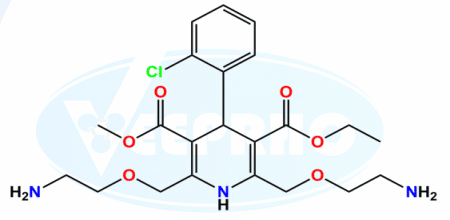
Additional information on CAS 2733700-89-3
| Parent drug | Amlodipine |
|---|---|
| Product type | Impurity standards |
| IUPAC name | 3-ethyl 5-methyl 2-((2-aminoethoxy)methyl)-4-(2-chlorophenyl)-6-methylpyridine-3,5-dicarboxylate benzenesulfonate |
| EP name | Amlodipine EP Impurity D |
| USP name | Amlodipine related Compound A |
| SMILES | O=C(C1=C(C2=CC=CC=C2Cl)C(C(OC)=O)=C(C)N=C1COCCN)OCC.O=S(C3=CC=CC=C3)(O)=O |
| InChI | InChI=1S/C20H23ClN2O5.C6H6O3S/c1-4-28-20(25)18-15(11-27-10-9-22)23-12(2)16(19(24)26-3)17(18)13-7-5-6-8-14(13)21;7-10(8,9)6-4-2-1-3-5-6/h5-8H,4,9-11,22H2,1-3H3;1-5H,(H,7,8,9) |
| InChIKey | RHYAPECMMUBIFD-UHFFFAOYSA-N |
| CHNS Ratio (%) (calculated) | C 55.27 · H 5.17 · N 4.96 · S 5.67 |
| References | Jiang | Yuxuan | et al. The Effect of Ion Pairing on the Skin Permeation of Amlodipine: Ingenta Connect.†Ingentaconnect.com | 2018 | https://doi.org/info:doi/10.1691/ph.2008.7302. |
| Description | Amlodipine EP Impurity D, also designated Amlodipine Related Compound A as the besylate salt, is a defined organic process- and degradation-related impurity associated with the dihydropyridine calcium channel blocker amlodipine. With CAS 2733700-89-3, molecular formula C26H29ClN2O8S, and molecular weight 565.04 g/mol, it exists as a salt form containing the benzenesulfonate counterion. Its occurrence may arise during API synthesis, salt formation, or oxidative transformation of the dihydropyridine nucleus. Quantification typically requires orthogonal chromatographic resolution by HPLC or UPLC with LC-MS/MS confirmation, and in some cases HRMS for structural elucidation. It is relevant to impurity profiling under pharmacopeial and ICH impurity control expectations. |
Request a Quote
"*" indicates required fields
Other products related to Amlodipine impurities
| Impurity structure | Name of Impurity | Catalogue No. |
|---|---|---|
| Amlodipine EP Impurity A | VL19004 | |
| Amlodipine EP Impurity B | VL19002 | |
| Amlodipine EP Impurity C | VL19030 | |
| Amlodipine EP Impurity D (Free Base) | VL19023 | |
| Amlodipine EP Impurity D (Fumarate salt) | VL19024 | |
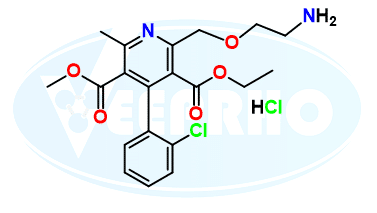 | Amlodipine EP Impurity D (HCl Salt) | VE0012177 |
| Amlodipine EP Impurity D (Mesylate salt) | VE006056 | |
| Amlodipine EP Impurity D (Oxalate Salt) | VL19015 | |
| Amlodipine EP Impurity E | VL19005 | |
 | Amlodipine EP Impurity E (Oxalate Salt) | VE006552 |
| Amlodipine EP Impurity F | VL19026 | |
| Amlodipine EP Impurity F (Maleate Salt) | VE0012174 |
Show all related products N-Nitroso Amlodipine impurities (13)