
- 100% accuracy of data
- 24/7 scientific support
- 0% tolerance in quality of product
Stock Locations
- New Jersey, USA
- Czech Republic, EU
* Stock subject to availability.
Documentation
Includes: HPLC, MASS/LC-MS, 1H NMR, FT-IR, Potency, Structure Elucidation Report (SER), and additional analytical data depending on the product.
2089065-77-8
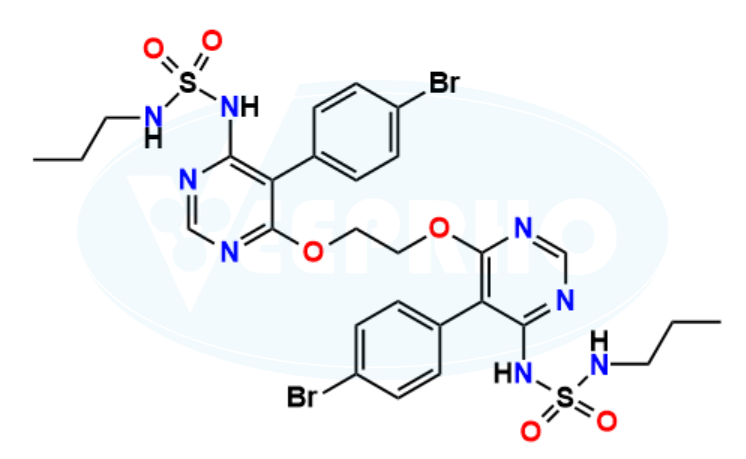
Macitentan Impurity D
● In Stock
| Catalogue No.: | VE0010292 |
|---|---|
| CAS No.: | 2089065-77-8 |
| Mol. Formula: | C28H32Br2N8O6S2 |
| Mol. Weight: | 800.54 g/mol |
For laboratory use only: analytical, development and regulatory purposes. Supplied in mg quantities. Not for human or veterinary use.
Request a quote for a set
- Request quote for this set
All USP impurities of Macitentan
2 productsSee the 2 products
- Macitentan Impurity A VE0010276
CAS 1433875-21-8 - Macitentan Impurity D VE0010292
CAS 2089065-77-8
- Macitentan Impurity A VE0010276
Additional information on CAS 2089065-77-8
| Parent drug | Macitentan |
|---|---|
| Product type | Impurity standards |
| IUPAC name | O-Desbromo-pyrimidinyl O-[6-N-(N’-propyl)sulfamido-5-(4-bromophenyl)pyrimidin-4-yl] Macitentan |
| USP name | Macitentan Sulfamide Dimer |
| Pharmacopeial synonyms | Macitentan Sulfamide Dimer |
| Other Synonyms | (N,N′′-[1,2-Ethanediylbis[oxy[5-(4-bromophenyl)-6,4-pyrimidinediyl]]]bis[N′-propylsulfamide]) |
| SMILES | BrC1=CC=C(C2=C(OCCOC3=C(C4=CC=C(Br)C=C4)C(NS(=O)(NCCC)=O)=NC=N3)N=CN=C2NS(=O)(NCCC)=O)C=C1 |
| InChI | InChI=1S/C28H32Br2N8O6S2/c1-3-13-35-45(39,40)37-25-23(19-5-9-21(29)10-6-19)27(33-17-31-25)43-15-16-44-28-24(20-7-11-22(30)12-8-20)26(32-18-34-28)38-46(41,42)36-14-4-2/h5-12,17-18,35-36H,3-4,13-16H2,1-2H3,(H,31,33,37)(H,32,34,38) |
| InChIKey | AHHRKAUBXBVVDS-UHFFFAOYSA-N |
| CHNS Ratio (%) (calculated) | C 42.01 · H 4.03 · N 14.00 · S 8.01 |
| References | - |
| Description | Macitentan Impurity D, also designated Macitentan Dimer or Macitentan Sulfamide Dimer, CAS 2089065-77-8, is a structurally defined dimeric process-related impurity associated with macitentan sulfamide chemistry. The entity, C28H32Br2N8O6S2, molecular weight 800.54 g/mol, contains two bromophenyl pyrimidine motifs linked through an ethylenedioxy bridge and paired N-propylsulfamide functions. Its origin is consistent with overcondensation or coupling during synthetic assembly rather than oxidative degradation. Because of its size and polarity, trace-level characterization commonly requires LC-MS/MS, high-resolution LC-MS, and orthogonal LC-UV methods, with impurity profiling considered under ICH Q3A/Q3B principles and, where relevant, genotoxic impurity assessment. |
Request a Quote
"*" indicates required fields
Other products related to Macitentan impurities
| Impurity structure | Name of Impurity | Catalogue No. |
|---|---|---|
| 5-(4-Bromophenyl)-4,6-dichloropyrimidine | VE0013249 | |
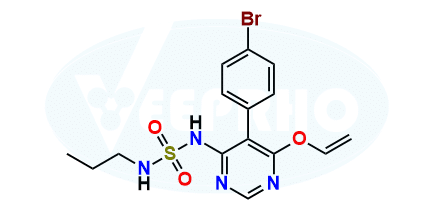
| 5-(4-bromophenyl)-6-(vinyloxy)pyrimidin-4-amine | VE0016575 | |
| 5-(4-Bromophenyl)pyrimidine-4,6-diol | VE0013247 | |
| 5-Bromo-2-chloropyrimidine | VE0011370 | |
| Hydroxy Macitentan | VE0011423 | |
| Macitentan Impurity 7 | VE0016571 | |
| Macitentan Impurity 8 | VE0016572 | |
| Macitentan Impurity 13 | VE0016573 | |
| Macitentan Impurity 14 | VE0016574 | |
| Macitentan Impurity 15 | VE0015365 | |
| Macitentan Impurity 16 | VE0016576 | |
 | Macitentan Impurity 17 | VE0016577 |
Show all related products N-Nitroso Macitentan impurities (3)