
- 100% accuracy of data
- 24/7 scientific support
- 0% tolerance in quality of product
Mutagenicity assessment (ICH M7)
Potentially mutagenic impurity (ICH M7 Class 1–3).
N-nitroso compound: ICH M7 cohort of concern.EMA100 ng/dayAppendix 1 Rev. 14
Stock Locations
- New Jersey, USA
- Czech Republic, EUIn stock
* Stock subject to availability.
Documentation
Includes: HPLC, MASS/LC-MS, 1H NMR, FT-IR, Potency, Structure Elucidation Report (SER), and additional analytical data depending on the product.
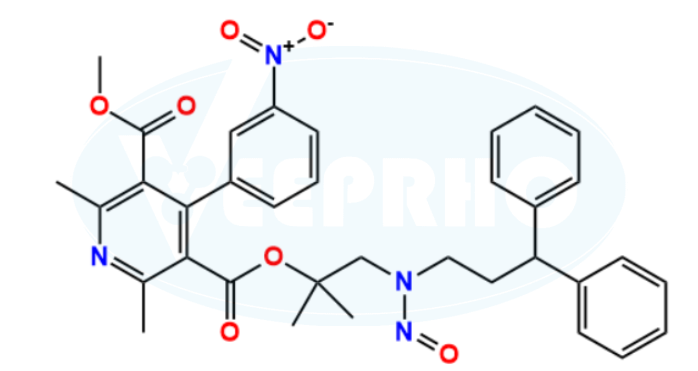
N-Desmethyl N-Nitroso Lercanidipine EP Impurity C
● In Stock
| Catalogue No.: | VE0023144 |
|---|---|
| CAS No.: | N/A |
| Mol. Formula: | C35H36N4O7 |
| Mol. Weight: | 624.68 g/mol |
For laboratory use only: analytical, development and regulatory purposes. Supplied in mg quantities. Not for human or veterinary use.
Request a quote for a set
- Request quote for this set
All nitrosamine impurities of Lercanidipine
7 productsSee the 7 products
- Lercanidipine Nitroso Impurity 1 VE0021541
- Lercanidipine Nitroso Impurity 1 VE0024102
- N-Desmethyl N-Nitroso Lercanidipine EP Impurity C VE0023144
- N-Nitroso Lercanidipine VE0011168
- N-Nitroso Lercanidipine: Synthesis Attempts and Failure Report (NAP Test) VE0023189
- N-Nitroso Lercanidipine EP Impurity A VE0021348
- N-(3,3-diphenylpropyl)-N-(2-hydroxy-2-methylpropyl)nitrous amide VE0021542
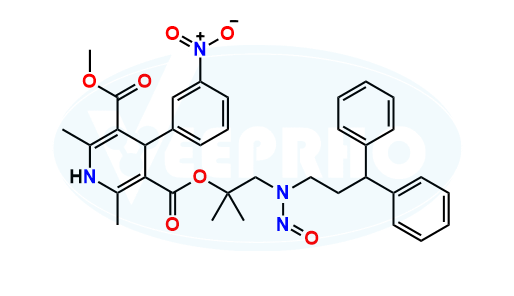
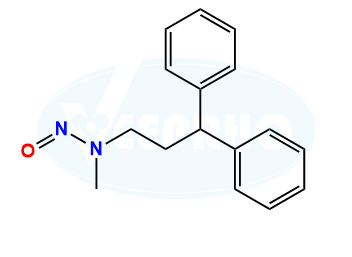
Additional information on N-Desmethyl N-Nitroso Lercanidipine EP Impurity C
| Parent drug | Lercanidipine |
|---|---|
| Product type | Impurity standards, Nitroso impurities |
| IUPAC name | 3-(1-((3,3-diphenylpropyl)(nitroso)amino)-2-methylpropan-2-yl) 5-methyl 2,6-dimethyl-4-(3-nitrophenyl)pyridine-3,5-dicarboxylate |
| SMILES | COC(=O)c1c(C)nc(C)c(C(=O)OC(C)(C)CN(CCC(c2ccccc2)c2ccccc2)N=O)c1-c1cccc([N+](=O)[O-])c1 |
| InChIKey | NWHJUBUWSYLXNU-UHFFFAOYSA-N |
| CHNS Ratio (%) (calculated) | C 67.29 · H 5.81 · N 8.97 · S 0.00 |
| Description | N-Desmethyl N-Nitroso Lercanidipine EP Impurity C is a nitrosamine-related degradant and process impurity of the dihydropyridine calcium channel blocker lercanidipine. With molecular formula C35H36N4O7 and molecular weight 624.68 g/mol, it represents the N-nitrosated derivative of the N-desmethyl analog, consistent with secondary amine nitrosation during synthesis, storage, or exposure to nitrosating conditions. As a structural alert compound within current nitrosamine risk assessment frameworks, it warrants consideration under ICH M7 principles because of potential genotoxic relevance. Trace characterization typically relies on LC-MS/MS, high-resolution LC-MS, and confirmatory chromatographic methods with UV or MS detection. |
Request a Quote
"*" indicates required fields
Other products related to Lercanidipine and Nitroso impurities




Show all related products N-Nitroso Lercanidipine impurities (4)