
- 100% accuracy of data
- 24/7 scientific support
- 0% tolerance in quality of product
Stock Locations
- New Jersey, USA
- Czech Republic, EU
* Stock subject to availability.
Documentation
Includes: HPLC, MASS/LC-MS, 1H NMR, FT-IR, Potency, Structure Elucidation Report (SER), and additional analytical data depending on the product.
3030749-28-8
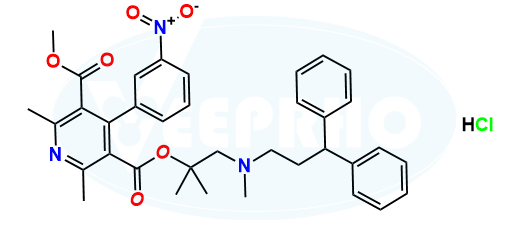
Lercanidipine EP Impurity C (HCl Salt)
● In Stock
| Catalogue No.: | VE0023093 |
|---|---|
| CAS No.: | 3030749-28-8 |
| Mol. Formula: | C36H40ClN3O6 |
| Mol. Weight: | 646.18 g/mol |
For laboratory use only: analytical, development and regulatory purposes. Supplied in mg quantities. Not for human or veterinary use.
Request a quote for a set
- Request quote for this set
All EP impurities of Lercanidipine
3 productsSee the 3 products
- Lercanidipine EP Impurity C (HCl Salt) VE0023093
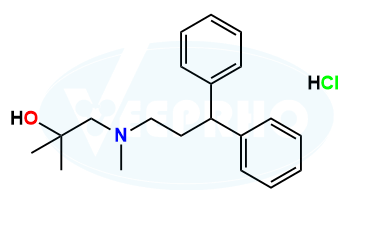
CAS 3030749-28-8 - Lercanidipine EP Impurity D (Free Base) VE0016055
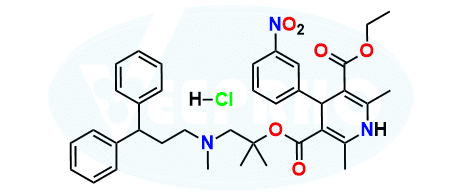
CAS 786625-22-7 - Lercanidipine EP Impurity E (Hydrochloride Salt) VE0021347
- Lercanidipine EP Impurity C (HCl Salt) VE0023093

Additional information on CAS 3030749-28-8
| Parent drug | Lercanidipine |
|---|---|
| Product type | Impurity standards |
| IUPAC name | 3-[1-[(3,3-Diphenylpropyl)(methyl)amino]-2-methylpropan-2-yl] 5-methyl 2,6-dimethyl-4-(3-nitrophenyl)pyridine-3,5-dicarboxylate hydrochloride |
| EP name | Lercanidipine EP Impurity C |
| SMILES | COC(=O)c1c(C)nc(C)c(C(=O)OC(C)(C)CN(C)CCC(c2ccccc2)c2ccccc2)c1-c1cccc([N+](=O)[O-])c1.Cl |
| InChIKey | SZFPEQPDCIKNQV-UHFFFAOYSA-N |
| CHNS Ratio (%) (calculated) | C 66.92 · H 6.24 · N 6.50 · S 0.00 |
| Description | Lercanidipine EP Impurity C (HCl salt), CAS 3030749-28-8, is a related-substance reference material corresponding to a chlorinated dihydropyridine derivative associated with lercanidipine synthetic impurity profiles. With molecular formula C36H40ClN3O6 and molecular weight 646.18 g/mol, the salt form reflects protonation of the basic nitrogen and can influence chromatographic retention and peak shape. Such impurities are commonly traced to incomplete coupling, side reactions during esterification, or minor degradation of the dihydropyridine scaffold. Structural assignment and quantification typically require HPLC with UV detection, LC-MS/MS, and, when needed, high-resolution MS or NMR for impurity confirmation under pharmacopeial and ICH impurity-control expectations. |
Request a Quote
"*" indicates required fields
Other products related to Lercanidipine impurities


Show all related products N-Nitroso Lercanidipine impurities (4)