
- 100% accuracy of data
- 24/7 scientific support
- 0% tolerance in quality of product
Mutagenicity assessment (ICH M7)
Treated as a potentially non-mutagenic impurity (ICH M7 Class 4–5).
Computational (in silico) assessmentStock Locations
- New Jersey, USA
- Czech Republic, EUIn stock
* Stock subject to availability.
Documentation
Includes: HPLC, MASS/LC-MS, 1H NMR, FT-IR, Potency, Structure Elucidation Report (SER), and additional analytical data depending on the product.
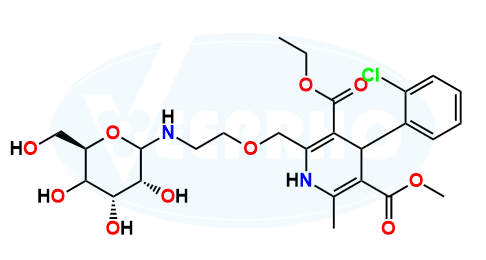
Amlodipine N-Glucose
● In Stock
| Catalogue No.: | VL19044 |
|---|---|
| CAS No.: | N/A |
| Mol. Formula: | C26H35ClN2O10 |
| Mol. Weight: | 571.03 g/mol |
For laboratory use only: analytical, development and regulatory purposes. Supplied in mg quantities. Not for human or veterinary use.
Additional information on Amlodipine N-Glucose
| Parent drug | Amlodipine |
|---|---|
| Product type | Impurity standards |
| IUPAC name | 2-[[2-[(D-Galactopyranosyl)amino]ethoxy]methyl]-4-(2-chlorophenyl)-1,4-dihydro-6-methyl-3,5-pyridinedicarboxylic Acid 3-Ethyl 5-Methyl Ester |
| Other Synonyms | Amlodipine Galactose Adduct |
| SMILES | O=C(C1=C(COCCNC2[C@@H]([C@H]([C@H]([C@@H](CO)O2)O)O)O)NC(C)=C(C(OC)=O)C1C3=CC=CC=C3Cl)OCC |
| InChI | InChI=1S/C26H35ClN2O10/c1-4-38-26(35)20-16(12-37-10-9-28-24-23(33)22(32)21(31)17(11-30)39-24)29-13(2)18(25(34)36-3)19(20)14-7-5-6-8-15(14)27/h5-8,17,19,21-24,28-33H,4,9-12H2,1-3H3/t17-,19?,21+,22+,23-,24?/m1/s1 |
| InChIKey | OTEHFFALUMYABS-LKABTVLFSA-N |
| CHNS Ratio (%) (calculated) | C 54.69 · H 6.18 · N 4.91 · S 0.00 |
| References | - |
| Description | Amlodipine N-Glucose, also referred to as Amlodipine Galactose Adduct, is a carbohydrate-derived amine adduct associated with amlodipine during process-related transformation or degradation in the presence of reducing sugars. With molecular formula C26H35ClN2O10 and molecular weight 571.03 g/mol, it reflects glycation at the amino side chain rather than a simple oxidative impurity. The species is structurally important in impurity profiling because it may co-elute with related adducts and often requires LC-MS/MS, high-resolution LC-MS, and orthogonal HPLC methods for unequivocal assignment and quantification. Although not a nitrosamine, its formation pathway is relevant to forced-degradation studies and stability-indicating assessments. |
Request a Quote
"*" indicates required fields
Other products related to Amlodipine impurities
| Impurity structure | Name of Impurity | Catalogue No. |
|---|---|---|
| Amlodipine EP Impurity A | VL19004 | |
| Amlodipine EP Impurity B | VL19002 | |
| Amlodipine EP Impurity C | VL19030 | |
| Amlodipine EP Impurity D (Besylate Salt) | VL19001 | |
| Amlodipine EP Impurity D (Free Base) | VL19023 | |
| Amlodipine EP Impurity D (Fumarate salt) | VL19024 | |
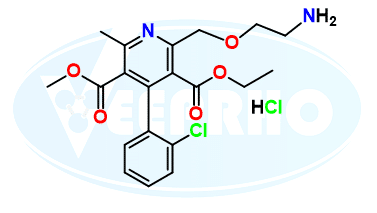 | Amlodipine EP Impurity D (HCl Salt) | VE0012177 |
| Amlodipine EP Impurity D (Mesylate salt) | VE006056 | |
| Amlodipine EP Impurity D (Oxalate Salt) | VL19015 | |
| Amlodipine EP Impurity E | VL19005 | |
 | Amlodipine EP Impurity E (Oxalate Salt) | VE006552 |
| Amlodipine EP Impurity F | VL19026 |
Show all related products N-Nitroso Amlodipine impurities (13)