

- 100% accuracy of data
- 24/7 scientific support
- 0% tolerance in quality of product
Stock Locations
- New Jersey, USA
- Czech Republic, EUIn stock
* Stock subject to availability.
Documentation
Includes: HPLC, MASS/LC-MS, 1H NMR, FT-IR, Potency, Structure Elucidation Report (SER), and additional analytical data depending on the product.
129722-25-4
Aripiprazole EP Impurity E
● In Stock
| Catalogue No.: | VL197007 |
|---|---|
| CAS No.: | 129722-25-4 |
| Mol. Formula: | C23H25Cl2N3O2 |
| Mol. Weight: | 446.37 g/mol |
For laboratory use only: analytical, development and regulatory purposes. Supplied in mg quantities. Not for human or veterinary use.
Request a quote for a set
- Request quote for this set
All EP impurities of Aripiprazole
9 productsSee the 9 products
- Aripiprazole EP Impurity A VL197010
CAS 22246-18-0 - Aripiprazole EP Impurity B VL197013
CAS 119532-26-2 - Aripiprazole EP Impurity B (Free Base) VE006771
CAS 41202-77-1 - Aripiprazole EP Impurity C VL197012
CAS 203395-81-7 - Aripiprazole EP Impurity D VL197009
CAS 203395-82-8 - Aripiprazole EP Impurity E VL197007
CAS 129722-25-4 - Aripiprazole EP Impurity E (HCl Salt) VE006772
CAS 1008531-60-9 - Aripiprazole EP Impurity F VL197008
CAS 573691-09-5 - Aripiprazole EP Impurity G (Free Base) VL197001
CAS 1797986-18-5
- Aripiprazole EP Impurity A VL197010
- Request quote for this set
All USP impurities of Aripiprazole
12 productsSee the 12 products
- Aripiprazole Chlorobutoxy Quinoline VL197018
- Aripiprazole Diquinoline Butanediol Impurity VL197011
CAS 882880-12-8 - Aripiprazole EP Impurity A VL197010
CAS 22246-18-0 - Aripiprazole EP Impurity B VL197013
CAS 119532-26-2 - Aripiprazole EP Impurity B (Free Base) VE006771
CAS 41202-77-1 - Aripiprazole EP Impurity E VL197007
CAS 129722-25-4 - Aripiprazole EP Impurity E (HCl Salt) VE006772
CAS 1008531-60-9 - Aripiprazole EP Impurity F VL197008
CAS 573691-09-5 - Aripiprazole EP Impurity G (Free Base) VL197001
CAS 1797986-18-5 - Aripiprazole Impurity 7 (HCl Salt) VE0012334
- Aripiprazole Related Compound B VL197014
CAS 889443-20-3 - Aripiprazole Related Compound H VL197015
CAS 1796928-63-6
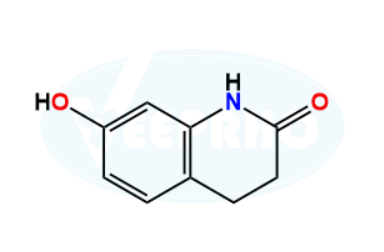


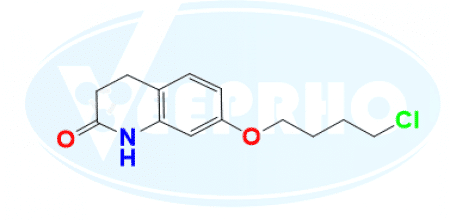

Additional information on CAS 129722-25-4
| Parent drug | Aripiprazole |
|---|---|
| Product type | Impurity standards |
| IUPAC name | 7-[4-[4-(2,3-Dichlorophenyl)piperazin-1-yl]butoxy]quinolin-2(1H)-one |
| EP name | Aripiprazole EP Impurity E |
| USP name | Aripiprazole Related Compound G |
| SMILES | O=c1ccc2ccc(OCCCCN3CCN(c4cccc(Cl)c4Cl)CC3)cc2[nH]1 |
| InChIKey | CDONPRYEWWPREK-UHFFFAOYSA-N |
| CHNS Ratio (%) (calculated) | C 61.89 · H 5.65 · N 9.41 · S 0.00 |
| References | Ar?kan | Mehmet Kemal | et al. Gamma Oscillations Predict Treatment Response to Aripiprazole in Bipolar Disorder.†Journal of Affective Disorders | vol. 294 | Nov. 2021 | pp. 159–62 | https://doi.org/10.1016/j.jad.2021.07.044. Mace | Shubhra | and David Taylor. Aripiprazole.†CNS Drugs | vol. 23 | no. 9 | Sept. 2009 | pp. 773–80 | https://doi.org/10.2165/11310820-000000000-00000. |
| Description | Aripiprazole EP Impurity E, also designated Aripiprazole Related Compound G and Dehydro Aripiprazole, is a process- or degradation-associated aripiprazole analog rather than a reactive mutagenic impurity. CAS 129722-25-4 corresponds to the neutral heteroaromatic scaffold with formula C23H25Cl2N3O2 and molecular weight 446.37 g/mol. Structurally, it reflects oxidation or dehydrogenation at the arylpiperazine framework, preserving the dichlorophenyl and dioxopiperazine motifs of the parent drug. Characterization typically requires orthogonal liquid chromatographic separation with high-resolution MS, LC-MS/MS, and, when needed, NMR confirmation. Its monitoring is relevant to impurity profiling under pharmacopeial specifications and ICH Q3A/Q3B. |
Request a Quote
"*" indicates required fields