
- 100% accuracy of data
- 24/7 scientific support
- 0% tolerance in quality of product
Stock Locations
- New Jersey, USA
- Czech Republic, EU
* Stock subject to availability.
Documentation
The batch COA includes HPLC, MASS/LC-MS, 1H NMR, FT-IR, Potency, and Structure Elucidation Report (SER)..
307974-61-4
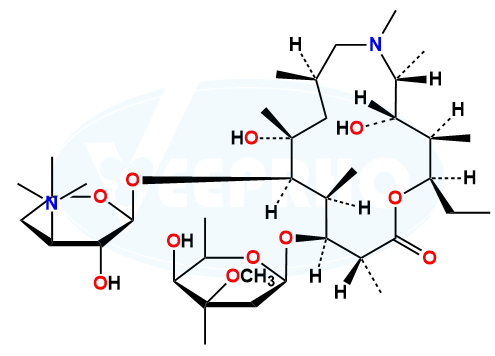
Azithromycin EP Impurity B
● In Stock
| Catalogue No.: | VL186008 |
|---|---|
| CAS No.: | 307974-61-4 |
| Mol. Formula: | C38H72N2O11 |
| Mol. Weight: | 732.98 g/mol |
For laboratory use only: analytical, development and regulatory purposes. Supplied in mg quantities. Not for human or veterinary use.
Request a quote for a set
- Request quote for this set
All EP impurities of Azithromycin
16 productsSee the 16 products
- Azithromycin EP Impurity A VL1860013
CAS 76801-85-9 - Azithromycin EP Impurity B VL186008
CAS 307974-61-4 - Azithromycin EP Impurity C VL186009
CAS 620169-47-3 - Azithromycin EP Impurity D VL1860018
CAS 612069-26-8 - Azithromycin EP Impurity E VL186007
CAS 612069-27-9 - Azithromycin EP Impurity F VL186004
CAS 612069-28-0 - Azithromycin EP Impurity G VL1860011
CAS 612069-31-5 - Azithromycin EP Impurity H VL1860012
CAS 612069-30-4 - Azithromycin EP Impurity I VL186003
CAS 172617-84-4 - Azithromycin EP Impurity J VL186002
CAS 117693-41-1 - Azithromycin EP Impurity K VL1860017
CAS 612534-95-9 - Azithromycin EP Impurity L VL186001
CAS 90503-06-3 - Azithromycin EP Impurity M VL186005
CAS 765927-71-7 - Azithromycin EP Impurity N VL186006
CAS 612069-25-7 - Azithromycin EP Impurity O VL1860010
CAS 763924-54-5 - Azithromycin EP Impurity Q VL1860019
CAS 2095879-65-3
- Azithromycin EP Impurity A VL1860013
- Request quote for this set
All USP impurities of Azithromycin
11 productsSee the 11 products
- Azithromycin EP Impurity A VL1860013
CAS 76801-85-9 - Azithromycin EP Impurity B VL186008
CAS 307974-61-4 - Azithromycin EP Impurity C VL186009
CAS 620169-47-3 - Azithromycin EP Impurity F VL186004
CAS 612069-28-0 - Azithromycin EP Impurity H VL1860012
CAS 612069-30-4 - Azithromycin EP Impurity I VL186003
CAS 172617-84-4 - Azithromycin EP Impurity J VL186002
CAS 117693-41-1 - Azithromycin EP Impurity L VL186001
CAS 90503-06-3 - Azithromycin EP Impurity M VL186005
CAS 765927-71-7 - Azithromycin EP Impurity N VL186006
CAS 612069-25-7 - Azithromycin EP Impurity O VL1860010
CAS 763924-54-5
- Azithromycin EP Impurity A VL1860013


Additional information on CAS 307974-61-4
| Parent drug | Azithromycin |
|---|---|
| Product type | Impurity standards |
| IUPAC name | 3-deoxy azithromycin |
| EP name | Azithromycin EP Impurity B |
| USP name | 3-Deoxyazithromycin/ 3-Deshydroxy Azithromycin /Azithromycin B |
| SMILES | CC[C@H]1OC(=O)[C@H](C)[C@@H](O[C@H]2C[C@@](C)(OC)[C@@H](O)[C@H](C)O2)[C@H](C)[C@@H](O[C@@H]2O[C@H](C)C[C@H](N(C)C)[C@H]2O)[C@](C)(O)C[C@@H](C)CN(C)[C@H](C)[C@@H](O)[C@H]1C |
| InChIKey | JBYIGHZCRVMHAK-VINPOOLWSA-N |
| CHNS Ratio (%) (calculated) | C 62.27 · H 9.90 · N 3.82 · S 0.00 |
| References | Langtry | Heather D. | and Julia A. Balfour. Azithromycin.” Drugs | vol. 56 | no. 2 | 1998 | pp. 273–97 | https://doi.org/10.2165/00003495-199856020-00014. |
| Additional characterisation data | QNMR, D2O Exchange, 13C NMR, 13C APT, COSY NMR, NOESY NMR, 15N NMR, HSQC NMR, HMQC NMR, and HMBC NMR. These are available upon request and may be free or subject to additional charges. |
| Description | Azithromycin EP Impurity B, also designated 3-Deoxyazithromycin or 3-Deshydroxy Azithromycin, is a macrolide-related process and degradative impurity associated with the azalide scaffold. It corresponds to CAS 307974-61-4, molecular formula C38H72N2O11, and molecular weight 732.98 g/mol. The structure lacks the C3 hydroxy substituent present in azithromycin, reflecting a deoxygenation or incomplete oxidation pathway during semisynthetic manufacture or subsequent degradation. Characterization generally requires high-resolution LC-MS/MS, HPLC with photodiode array detection, and, where structural confirmation is needed, NMR spectroscopy. As a closely related structural analog rather than a genotoxic alert impurity, it is assessed within pharmacopeial and impurity profiling frameworks. |
Request a Quote
"*" indicates required fields