

- 100% accuracy of data
- 24/7 scientific support
- 0% tolerance in quality of product
Stock Locations
- New Jersey, USA
- Czech Republic, EU
* Stock subject to availability.
Documentation
Includes: HPLC, MASS/LC-MS, 1H NMR, FT-IR, Potency, Structure Elucidation Report (SER), and additional analytical data depending on the product.
257877-44-4
Buspirone EP Impurity N
● In Stock
| Catalogue No.: | VL249006 |
|---|---|
| CAS No.: | 257877-44-4 |
| Mol. Formula: | C22H32N2O4 |
| Mol. Weight: | 388.50 g/mol |
For laboratory use only: analytical, development and regulatory purposes. Supplied in mg quantities. Not for human or veterinary use.
Request a quote for a set
- Request quote for this set
All EP impurities of Buspirone
20 productsSee the 20 products
- Buspirone Chlorobuspirone VL249014
CAS 2725354-99-2 - Buspirone EP Impurity A VL249004
CAS 20980-22-7 - Buspirone EP Impurity A (Dihydrochloride Salt) VE0020605
CAS 94021-22-4 - Buspirone EP Impurity B VE0013149
CAS 81461-72-5 - Buspirone EP Impurity B (Free Base) VE0020603
CAS 179071-85-3 - Buspirone EP Impurity C VL249009
CAS 257877-45-5 - Buspirone EP Impurity D VL249010
- Buspirone EP Impurity D (4HCl Salt) VE0013150
- Buspirone EP Impurity D (Free Base) VE0020602
CAS 2724726-67-2 - Buspirone EP Impurity E VL249001
CAS 257877-43-3 - Buspirone EP Impurity F VL249012
CAS 2512210-24-9 - Buspirone EP Impurity G VL249005
CAS 84746-24-7 - Buspirone EP Impurity H VL249013
CAS 2708578-34-9 - Buspirone EP Impurity J VL249003
CAS 2726492-72-2 - Buspirone EP Impurity J (Oxalate Salt) VE0020604
CAS 2726492-73-3 - Buspirone EP Impurity K VL249002
CAS 1075-89-4 - Buspirone EP Impurity L VL249007
CAS 21098-11-3 - Buspirone EP Impurity M VL249016
CAS 80827-62-9 - Buspirone EP Impurity N VL249006
CAS 257877-44-4 - Buspirone Spiroammonium Salt VL249008
CAS 81461-73-6
- Buspirone Chlorobuspirone VL249014
- Request quote for this set
All USP impurities of Buspirone
14 productsSee the 14 products
- Buspirone EP Impurity A VL249004
CAS 20980-22-7 - Buspirone EP Impurity A (Dihydrochloride Salt) VE0020605
CAS 94021-22-4 - Buspirone EP Impurity C VL249009
CAS 257877-45-5 - Buspirone EP Impurity D VL249010
- Buspirone EP Impurity D (Free Base) VE0020602
CAS 2724726-67-2 - Buspirone EP Impurity E VL249001
CAS 257877-43-3 - Buspirone EP Impurity F VL249012
CAS 2512210-24-9 - Buspirone EP Impurity G VL249005
CAS 84746-24-7 - Buspirone EP Impurity H VL249013
CAS 2708578-34-9 - Buspirone EP Impurity J VL249003
CAS 2726492-72-2 - Buspirone EP Impurity K VL249002
CAS 1075-89-4 - Buspirone EP Impurity L VL249007
CAS 21098-11-3 - Buspirone EP Impurity M VL249016
CAS 80827-62-9 - Buspirone EP Impurity N VL249006
CAS 257877-44-4
- Buspirone EP Impurity A VL249004


Additional information on CAS 257877-44-4
| Parent drug | Buspirone |
|---|---|
| Product type | Impurity standards |
| IUPAC name | 8, 8′-(butane-1, 4-diyl) bis (8-azaspiro [4, 5] decane-7, 9-dione). |
| EP name | Buspirone EP Impurity N |
| USP name | Buspirone Related Compound N |
| Pharmacopeial synonyms | Buspirone Related Compound N |
| Other Synonyms | 8,8′-(1,4-Butanediyl)bis-8-azaspiro[4.5]decane-7,9-dione; 8-[4-(7,9-dioxo-8-azaspiro[4.5]decan-8-yl)butyl]-8-azaspiro[4.5]decane-7,9-dione |
| SMILES | O=C(N(CCCCN(C(C1)=O)C(CC21CCCC2)=O)C(C3)=O)CC43CCCC4 |
| InChI | InChI=1S/C22H32N2O4/c25-17-13-21(7-1-2-8-21)14-18(26)23(17)11-5-6-12-24-19(27)15-22(16-20(24)28)9-3-4-10-22/h1-16H2 |
| InChIKey | VBBOKKNQJOSKIX-UHFFFAOYSA-N |
| CHNS Ratio (%) (calculated) | C 68.01 · H 8.30 · N 7.21 · S 0.00 |
| Description | Buspirone EP Impurity N, also described as Buspirone Related Compound N, corresponds to CAS 257877-44-4 and has molecular formula C22H32N2O4 with molecular weight 388.50 g/mol. Structurally, it is a bis-spiro diketone dimer derived from two buspirone-like azaspiro[4.5]decane units linked through a butanediyl bridge, and is generally regarded as a process-related impurity rather than a hydrolytic degradant. Its occurrence may reflect coupling or over-alkylation events during synthesis of the azaspiro scaffold. Due to its structural similarity to the parent API, identification typically relies on LC-MS/MS and orthogonal LC-UV methods, with NMR confirmation when necessary. |
Request a Quote
"*" indicates required fields
Other products related to Buspirone impurities
| Impurity structure | Name of Impurity | Catalogue No. |
|---|---|---|
| Buspirone EP Impurity A | VL249004 | |
| Buspirone EP Impurity A (Dihydrochloride Salt) | VE0020605 | |
 | Buspirone EP Impurity B | VE0013149 |
 | Buspirone EP Impurity B (Free Base) | VE0020603 |
| Buspirone EP Impurity C | VL249009 | |
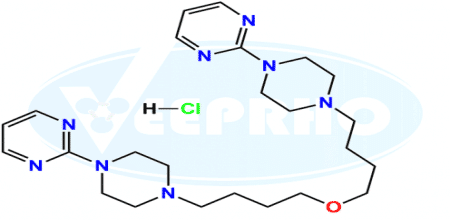 | Buspirone EP Impurity D | VL249010 |
 | Buspirone EP Impurity D (4HCl Salt) | VE0013150 |
| Buspirone EP Impurity D (Free Base) | VE0020602 | |
| Buspirone EP Impurity E | VL249001 | |
| Buspirone EP Impurity E (HCl salt) | VE0022308 | |
| Buspirone EP Impurity F | VL249012 | |
| Buspirone EP Impurity G | VL249005 |