
- 100% accuracy of data
- 24/7 scientific support
- 0% tolerance in quality of product
Stock Locations
- New Jersey, USA
- Czech Republic, EU
* Stock subject to availability.
Documentation
Includes: HPLC, MASS/LC-MS, 1H NMR, FT-IR, Potency, Structure Elucidation Report (SER), and additional analytical data depending on the product.
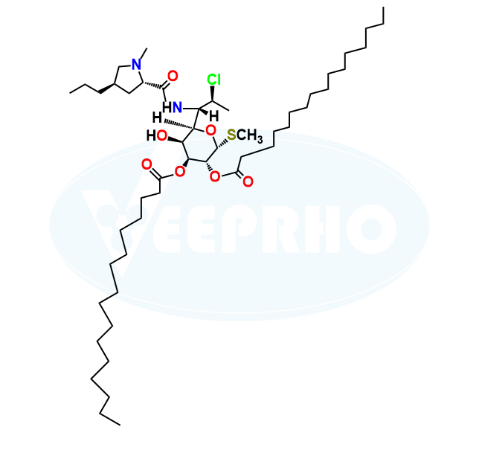
Clindamycin 2,3-Dipalmitate
● In Stock
| Catalogue No.: | VE0028162 |
|---|---|
| CAS No.: | N/A |
| Mol. Formula: | C50H93ClN2O7S |
| Mol. Weight: | 901.80 g/mol |
For laboratory use only: analytical, development and regulatory purposes. Supplied in mg quantities. Not for human or veterinary use.
Additional information on Clindamycin 2,3-Dipalmitate
| Parent drug | Clindamycin |
|---|---|
| Product type | Impurity standards |
| IUPAC name | Methyl 7-chloro-6,7,8-trideoxy-6-(1-methyl-trans-4-propyl-L-2-pyrrolidinecarboxamido)-1-thio-L-threo-alpha-D-galacto-octopyranoside 2,3-dipalmitate |
| SMILES | O=C(CCCCCCCCCCCCCCC)O[C@@H]1[C@@H](OC(CCCCCCCCCCCCCCC)=O)[C@@H](O)[C@]([C@]([H])(NC([C@H]2N(C)C[C@H](CCC)C2)=O)[C@@H](Cl)C)([H])O[C@@H]1SC |
| InChI | InChI=1S/C50H93ClN2O7S/c1-7-10-12-14-16-18-20-22-24-26-28-30-32-35-42(54)58-47-45(56)46(44(39(4)51)52-49(57)41-37-40(34-9-3)38-53(41)5)60-50(61-6)48(47)59-43(55)36-33-31-29-27-25-23-21-19-17-15-13-11-8-2/h39-41,44-48,50,56H,7-38H2,1-6H3,(H,52,57)/t39-,40+,41-,44+,45-,46+,47-,48+,50?/m0/s1 |
| InChIKey | HPMBDJNVAAGAKM-UWYFMMCGSA-N |
| CHNS Ratio (%) (calculated) | C 66.59 · H 10.40 · N 3.11 · S 3.56 |
| Description | Clindamycin 2,3-Dipalmitate impurity presents as a lipophilic ester derivative arising from esterification of clindamycin during synthesis or storage. Its increased hydrophobicity relative to the parent drug alters chromatographic retention and detection sensitivity, complicating routine HPLC assays and necessitating optimized reversed-phase methods and LC-MS/MS confirmation for accurate quantification. Stability studies should monitor ester hydrolysis and formation pathways under thermal and accelerated conditions. Regulatory impurity profiling requires validated limits, orthogonal analytical techniques for structure elucidation, and appropriate control strategies in both API manufacture and finished dosage forms to mitigate potential impacts on potency and safety. Analytical specificity and resolution are critical for reliable release testing. |
Request a Quote
"*" indicates required fields
Other products related to Clindamycin impurities
| Impurity structure | Name of Impurity | Catalogue No. |
|---|---|---|
| Clindamycin BP Impurity C | VE006945 | |
| Clindamycin EP Impurity C | VE0011459 | |
| Clindamycin HCl EP Impurity B | VE006944 | |
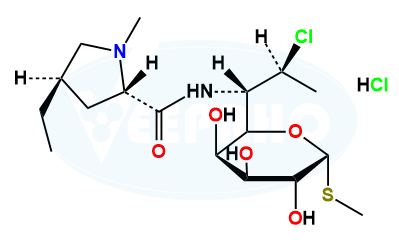 | Clindamycin Hydrochloride EP Impurity B (Hydrochloride Salt) | VE0021230 |
| Clindamycin Hydrochloride EP Impurity F (HCl Salt) | VE0014592 | |
| Clindamycin Phosphate EP Impurity A | VL1030001 | |
| Clindamycin Phosphate EP Impurity C | VL1030003 | |
 | Clindamycin Phosphate EP Impurity D | VE005869 |
| Clindamycin Phosphate EP Impurity E (Free Base) | VL1030009 | |
| Clindamycin Phosphate EP Impurity E (HCl salt) | VL1030007 | |
| Clindamycin Phosphate EP Impurity F | VL1030010 | |
| Clindamycin Phosphate EP Impurity G | VE006094 |