

- 100% accuracy of data
- 24/7 scientific support
- 0% tolerance in quality of product
Stock Locations
- New Jersey, USA
- Czech Republic, EU
* Stock subject to availability.
Documentation
Includes: HPLC, MASS/LC-MS, 1H NMR, FT-IR, Potency, Structure Elucidation Report (SER), and additional analytical data depending on the product.
54887-30-8
Clindamycin Phosphate EP Impurity D
● In Stock
| Catalogue No.: | VE005869 |
|---|---|
| CAS No.: | 54887-30-8 |
| Mol. Formula: | C18H34ClN2O8PS |
| Mol. Weight: | 504.97 g/mol |
For laboratory use only: analytical, development and regulatory purposes. Supplied in mg quantities. Not for human or veterinary use.
Request a quote for a set
- Request quote for this set
All EP impurities of Clindamycin
18 productsSee the 18 products
- Clindamycin EP Impurity C VE0011459
CAS 16684-06-3 - Clindamycin HCl EP Impurity B VE006944
CAS 18323-43-8 - Clindamycin Hydrochloride EP Impurity B (Hydrochloride Salt) VE0021230
CAS 68225-58-1 - Clindamycin Hydrochloride EP Impurity F (Free Base) VE008211
- Clindamycin Phosphate EP Impurity A VL1030001
CAS 154-21-2 - Clindamycin Phosphate EP Impurity C VL1030003
CAS 28708-34-1 - Clindamycin Phosphate EP Impurity D VE005869
CAS 54887-30-8 - Clindamycin Phosphate EP Impurity E (Free Base) VL1030009
CAS 18323-44-9 - Clindamycin Phosphate EP Impurity E (HCl salt) VL1030007
CAS 21462-39-5 - Clindamycin Phosphate EP Impurity F VL1030010
CAS 27480-30-4 - Clindamycin Phosphate EP Impurity G VE006094
- Clindamycin Phosphate EP Impurity H VE005867
- Clindamycin Phosphate EP Impurity I VE005868
CAS 1309048-48-3 - Clindamycin Phosphate EP Impurity J VE005870
CAS 1309349-64-1 - Clindamycin Phosphate EP Impurity K VL1030005
- Clindamycin Phosphate EP Impurity L VE005873
CAS 620181-05-7 - Clindamycin Phosphate EP Impurity Q VE0010565
- 2'-Cis-Clindamycin VE009162
CAS 1440605-46-8
- Clindamycin EP Impurity C VE0011459
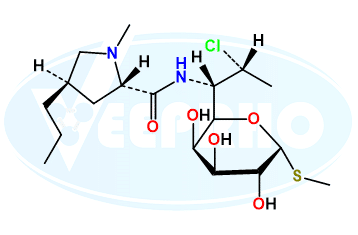

Additional information on CAS 54887-30-8
| Parent drug | Clindamycin |
|---|---|
| Product type | Impurity standards |
| IUPAC name | methyl 7-chloro-6,7,8-trideoxy-6-[[[(2S,4R)-1-methyl-4-propylpyrrolidin-2-yl]carbonyl]amino]-4-O-phosphono-1-thio-L-threo-α-D-galacto-octopyranoside |
| EP name | Clindamycin phosphate EP Impurity D |
| CHNS Ratio (%) (calculated) | C 42.81 · H 6.79 · N 5.55 · S 6.35 |
| References | Davoudi, Mojtaba, et al. “ELECTROCHEMICAL DEGRADATION of CLINDAMYCIN by ANODIC OXIDATION on SnO2-Sb COATED TITANIUM ANODES.†Environmental Engineering and Management Journal, vol. 17, no. 2, 2018, pp. 343–55, https://doi.org/10.30638/eemj.2018.036. ‌Ajantha, GS, et al. “Phenotypic Detection of Inducible Clindamycin Resistance among Staphylococcus Aureus Isolates by Using the Lower Limit of Recommended Inter-Disk Distance.†Indian Journal of Pathology and Microbiology, vol. 51, no. 3, 2008, p. 376, https://doi.org/10.4103/0377-4929.42515. ‌ |
| Description | Clindamycin phosphate EP Impurity D, CAS 54887-30-8, is a phosphorus-containing degradant of the lincosamide ester series, formally represented by C18H34ClN2O8PS with a molecular weight of 504.97 g/mol. The impurity is associated with hydrolytic and process-related transformation of clindamycin phosphate, reflecting cleavage and rearrangement within the phosphorylated side chain rather than simple stereochemical variation. Its polar ionic character and low volatility preclude routine GC approaches, so characterization typically relies on LC-MS/MS, high-resolution LC-MS, and orthogonal ion-pair or hydrophilic interaction chromatography with UV or charged aerosol detection. In pharmacopeial contexts, it is monitored as a specified related substance with defined impurity control limits. |
Request a Quote
"*" indicates required fields
Other products related to Clindamycin impurities
| Impurity structure | Name of Impurity | Catalogue No. |
|---|---|---|
| Clindamycin BP Impurity C | VE006945 | |
| Clindamycin EP Impurity C | VE0011459 | |
| Clindamycin HCl EP Impurity B | VE006944 | |
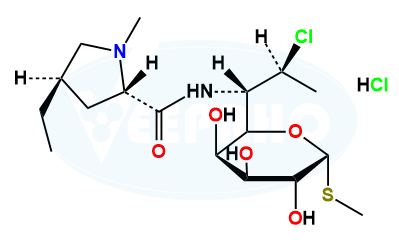 | Clindamycin Hydrochloride EP Impurity B (Hydrochloride Salt) | VE0021230 |
| Clindamycin Hydrochloride EP Impurity F (HCl Salt) | VE0014592 | |
| Clindamycin Phosphate EP Impurity A | VL1030001 | |
| Clindamycin Phosphate EP Impurity C | VL1030003 | |
| Clindamycin Phosphate EP Impurity E (Free Base) | VL1030009 | |
| Clindamycin Phosphate EP Impurity E (HCl salt) | VL1030007 | |
| Clindamycin Phosphate EP Impurity F | VL1030010 | |
| Clindamycin Phosphate EP Impurity G | VE006094 | |
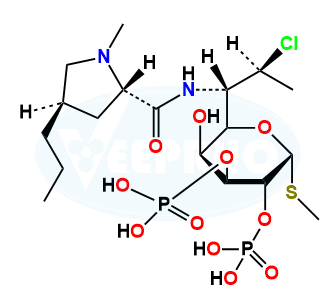 | Clindamycin Phosphate EP Impurity H | VE005867 |