

- 100% accuracy of data
- 24/7 scientific support
- 0% tolerance in quality of product
Stock Locations
- New Jersey, USA
- Czech Republic, EU
* Stock subject to availability.
Documentation
Includes: HPLC, MASS/LC-MS, 1H NMR, FT-IR, Potency, Structure Elucidation Report (SER), and additional analytical data depending on the product.
1242137-18-3
Enzalutamide Oxo Impurity
● In Stock
| Catalogue No.: | VE006364 |
|---|---|
| CAS No.: | 1242137-18-3 |
| Mol. Formula: | C21H16F4N4O3 |
| Mol. Weight: | 448.37 |
For laboratory use only: analytical, development and regulatory purposes. Supplied in mg quantities. Not for human or veterinary use.
Additional information on CAS 1242137-18-3
| Parent drug | Enzalutamide |
|---|---|
| Product type | Impurity standards |
| IUPAC name | 4-[3-[4-Cyano-3-(trifluoromethyl)phenyl]-5,5-dimethyl-2,4-dioxo-1-imidazolidinyl]-2-fluoro-N-methylbenzamide |
| SMILES | CNC(=O)c1ccc(N2C(=O)N(c3ccc(C#N)c(C(F)(F)F)c3)C(=O)C2(C)C)cc1F |
| InChIKey | BPEQXCBJXGZMSB-UHFFFAOYSA-N |
| CHNS Ratio (%) (calculated) | C 56.25 · H 3.60 · N 12.50 · S 0.00 |
| References | "Schrader | Andres Jan | et al. “Enzalutamide in Castration-Resistant Prostate Cancer Patients Progressing after Docetaxel and Abiraterone.†European Urology | vol. 65 | no. 1 | Jan. 2014 | pp. 30–36 | https://doi.org/10.1016/j.eururo.2013.06.042. ?Graff | Julie N. | et al. “Early Evidence of Anti-PD-1 Activity in Enzalutamide-Resistant Prostate Cancer.†Oncotarget | vol. 7 | no. 33 | July 2016 | pp. 52810–17 | https://doi.org/10.18632/oncotarget.10547. ?" |
| Description | Enzalutamide Oxo Impurity, also designated Enzalutamide Inhouse Impurity A, CAS 1242137-18-3, is an oxygenated process-related impurity associated with the aryl amide and oxo-functionalized scaffold of enzalutamide. With molecular formula C21H16F4N4O3 and molecular weight 448.37, it is structurally distinct from the parent API by incorporation of an additional carbonyl oxygen, consistent with oxidative transformation or synthetic over-oxidation during intermediate handling. Such impurities are assessed under impurity qualification principles and, when present at trace levels, typically require LC-MS/MS and LC-HRMS for structural confirmation, with LC-UV or HPLC for quantification. Its profile is relevant to stability, route specificity, and impurity fate studies. |
Request a Quote
"*" indicates required fields
Other products related to Enzalutamide impurities


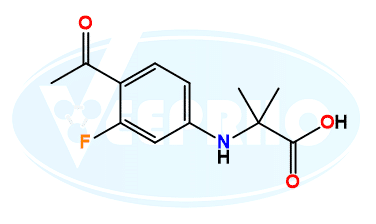
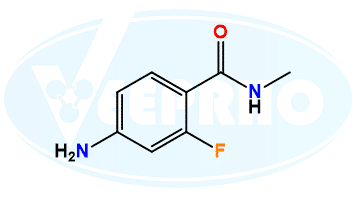
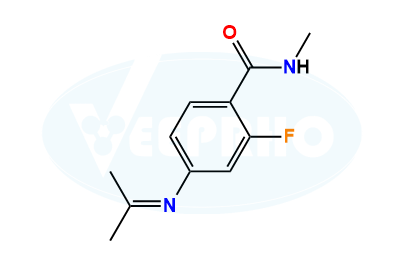
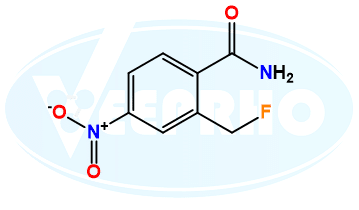
Show all related products N-Nitroso Enzalutamide impurities (5)