
- 100% accuracy of data
- 24/7 scientific support
- 0% tolerance in quality of product
Mutagenicity assessment (ICH M7)
Potentially mutagenic impurity (ICH M7 Class 1–3).
N-nitroso compound: ICH M7 cohort of concern.Stock Locations
- New Jersey, USA
- Czech Republic, EU
* Stock subject to availability.
Documentation
Includes: HPLC, MASS/LC-MS, 1H NMR, FT-IR, Potency, Structure Elucidation Report (SER), and additional analytical data depending on the product.
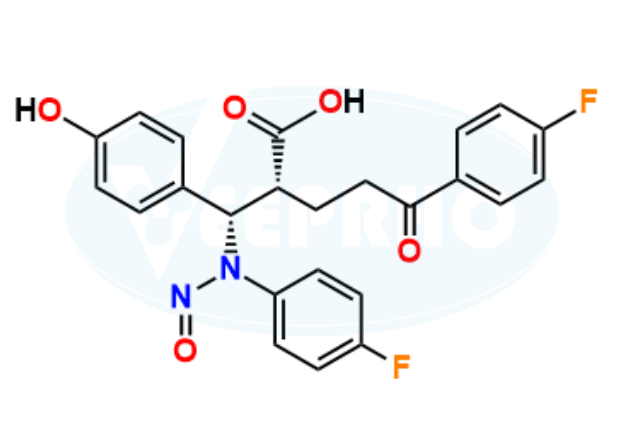
Ezetimibe Nitroso Impurities 10
● In Stock
| Catalogue No.: | VE0028966 |
|---|---|
| CAS No.: | N/A |
| Mol. Formula: | C24H20F2N2O5 |
| Mol. Weight: | 454.42 g/mol |
For laboratory use only: analytical, development and regulatory purposes. Supplied in mg quantities. Not for human or veterinary use.
Request a quote for a set
- Request quote for this set
All nitrosamine impurities of Ezetimibe
15 productsSee the 15 products
- Ezetimibe Nitroso Impurities 10 VE0028966
- Ezetimibe Nitroso Impurity VE0010294
- Ezetimibe Nitroso Impurity 1 VE0010001
- Ezetimibe Nitroso Impurity 4 VE0028968
- Ezetimibe Nitroso Impurity 4; Synthesis Attempts and Failure Report (NAP Test) VE0028970
- Ezetimibe Nitroso Impurity 11 VE0028964
- Ezetimibe Nitroso Impurity 11; Synthesis Attempts and Failure Report (NAP Test) VE0028965
- Ezetimibe Open-Ring Acid Nitroso Impurity VE0028947
- N-Nitroso Ezetimibe Azetidinone Ring Opened Impurity VE0021410
- N-Nitroso Ezetimibe Azetidinone Ring Opened Impurity; Synthesis Attempts and Failure Report (NAP Test) VE0025926
- N-Nitroso Ezetimibe Impurity 2 VE0010003
- N-Nitroso rac-Ezetimibe Benzyl Diol Impurity VE0024622
- N-((1S,2R,5S)-1-(4-(benzyloxy)phenyl)-5-(4-fluorophenyl)-5-hydroxy-2-((S)-2-oxo-4-phenyloxazolidine-3-carbonyl)pentyl)-N-(4-fluorophenyl)nitrous amide VE0026228
- N-((4-(benzyloxy)phenyl)(6-(4-fluorophenyl)-2-oxotetrahydro-2H-pyran-3-yl)methyl)-N-(4-fluorophenyl)nitrous amide VE0026227
- N-(4-fluorophenyl)-N-((1S,2R,5S)-5-(4-fluorophenyl)-5-hydroxy-2-(hydroxymethyl)-1-(4-hydroxyphenyl)pentyl)nitrous amide VE0028946


Additional information on Ezetimibe Nitroso Impurities 10
| Parent drug | Ezetimibe |
|---|---|
| Product type | Impurity standards, Nitroso impurities |
| IUPAC name | (R)-5-(4-fluorophenyl)-2-((S)-((4-fluorophenyl)(nitroso)amino)(4-hydroxyphenyl)methyl)-5-oxopentanoic acid |
| SMILES | FC1=CC=C(C(CC[C@@H](C(O)=O)[C@H](N(C2=CC=C(F)C=C2)N=O)C3=CC=C(O)C=C3)=O)C=C1 |
| InChI | InChI=1S/C24H20F2N2O5/c25-17-5-1-15(2-6-17)22(30)14-13-21(24(31)32)23(16-3-11-20(29)12-4-16)28(27-33)19-9-7-18(26)8-10-19/h1-12,21,23,29H,13-14H2,(H,31,32)/t21-,23-/m1/s1 |
| InChIKey | JMWGLGGVYOCECN-FYYLOGMGSA-N |
| CHNS Ratio (%) (calculated) | C 63.43 · H 4.44 · N 6.16 · S 0.00 |
| Description | Ezetimibe Nitroso Impurities 10 is a nitroso-related process impurity associated with the ezetimibe chemical space, bearing molecular formula C24H20F2N2O5 and molecular weight 454.42 g/mol. Its structural motif indicates formation through nitrosation of a nitrogen-containing precursor during synthesis or through oxidative nitrosative degradation under stressed storage conditions. As a potential nitrosamine-like impurity, it warrants toxicological consideration under ICH M7 principles because trace levels may be relevant to genotoxic risk assessment. Characterization and quantification typically require LC-MS/MS, high-resolution LC-MS, and, when volatility permits, GC-MS, often coupled with NMR confirmation. |
Request a Quote
"*" indicates required fields
Other products related to Ezetimibe and Nitroso impurities
| Impurity structure | Name of Impurity | Catalogue No. |
|---|---|---|
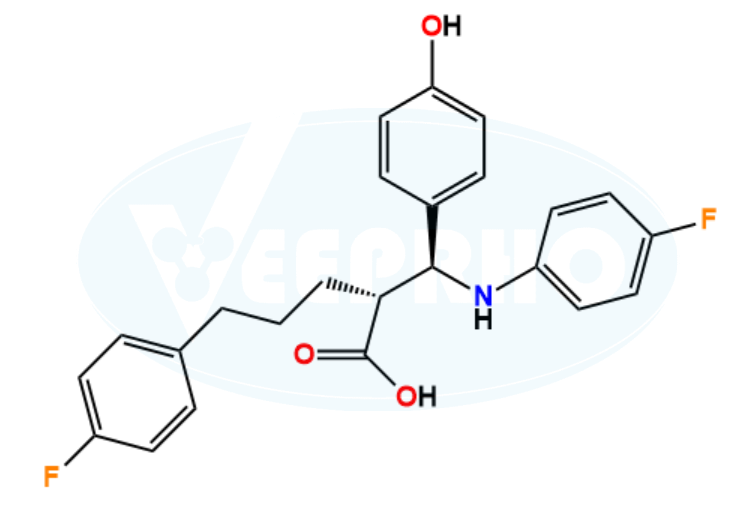 | (R)-5-(4-fluorophenyl)-2-((S)-((4-fluorophenyl)amino)(4-hydroxyphenyl)methyl)pentanoic acid | VE0011660 |
 | (S)-1-(3-Fluorophenyl)-5-(2-oxo-4-phenyloxazolidin-3-yl)pentane-1,5-dione | VE008807 |
| 3-O-Acetyl Ezetimibe | VE0015616 | |
 | 3’-Anhydro-Z-Ezetimibe | VE008805 |
| 4-((2R,3S,6S)-6-(4-Fluorophenyl)-3-(hydroxymethyl)tetrahydro-2H-pyran-2-yl)phenol | VE009235 | |
| 4-(4-Fluorobenzoyl)butyric Acid | VE0011659 | |
| 4-Fluoroaniline | VE0020130 | |
| 5-(2-Fluorophenyl)-5-oxovaleric Acid | VE008756 | |
| Desilylated EZM-II | VE0010975 | |
| Ent-Ezetimibe Ketone | VE009622 | |
| Ezetimibe (RSR) Isomer | VL203012 | |
| Ezetimibe (RSS)-Isomer | VE007989 |
Show all related products N-Nitroso Ezetimibe impurities (11)