
- 100% accuracy of data
- 24/7 scientific support
- 0% tolerance in quality of product
Mutagenicity assessment (ICH M7)
Potentially mutagenic impurity (ICH M7 Class 1–3).
N-nitroso compound: ICH M7 cohort of concern.Stock Locations
- New Jersey, USA
- Czech Republic, EU
* Stock subject to availability.
Documentation
Includes: HPLC, MASS/LC-MS, 1H NMR, FT-IR, Potency, Structure Elucidation Report (SER), and additional analytical data depending on the product.
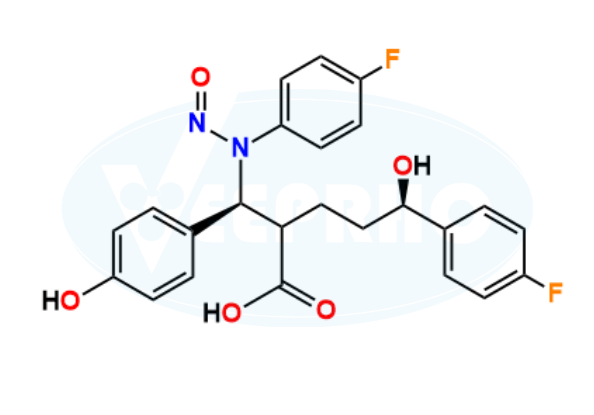
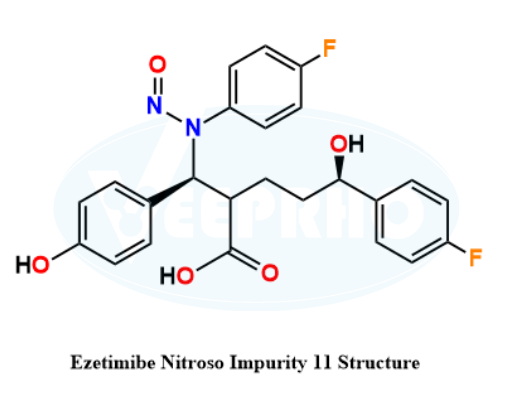
Ezetimibe Nitroso Impurity 11
● In Stock
| Catalogue No.: | VE0028964 |
|---|---|
| CAS No.: | N/A |
| Mol. Formula: | C24H22F2N2O5 |
| Mol. Weight: | 456.44 g/mol |
For laboratory use only: analytical, development and regulatory purposes. Supplied in mg quantities. Not for human or veterinary use.
Request a quote for a set
- Request quote for this set
All nitrosamine impurities of Ezetimibe
15 productsSee the 15 products
- Ezetimibe Nitroso Impurities 10 VE0028966
- Ezetimibe Nitroso Impurity VE0010294
- Ezetimibe Nitroso Impurity 1 VE0010001
- Ezetimibe Nitroso Impurity 4 VE0028968
- Ezetimibe Nitroso Impurity 4; Synthesis Attempts and Failure Report (NAP Test) VE0028970
- Ezetimibe Nitroso Impurity 11 VE0028964
- Ezetimibe Nitroso Impurity 11; Synthesis Attempts and Failure Report (NAP Test) VE0028965
- Ezetimibe Open-Ring Acid Nitroso Impurity VE0028947
- N-Nitroso Ezetimibe Azetidinone Ring Opened Impurity VE0021410
- N-Nitroso Ezetimibe Azetidinone Ring Opened Impurity; Synthesis Attempts and Failure Report (NAP Test) VE0025926
- N-Nitroso Ezetimibe Impurity 2 VE0010003
- N-Nitroso rac-Ezetimibe Benzyl Diol Impurity VE0024622
- N-((1S,2R,5S)-1-(4-(benzyloxy)phenyl)-5-(4-fluorophenyl)-5-hydroxy-2-((S)-2-oxo-4-phenyloxazolidine-3-carbonyl)pentyl)-N-(4-fluorophenyl)nitrous amide VE0026228
- N-((4-(benzyloxy)phenyl)(6-(4-fluorophenyl)-2-oxotetrahydro-2H-pyran-3-yl)methyl)-N-(4-fluorophenyl)nitrous amide VE0026227
- N-(4-fluorophenyl)-N-((1S,2R,5S)-5-(4-fluorophenyl)-5-hydroxy-2-(hydroxymethyl)-1-(4-hydroxyphenyl)pentyl)nitrous amide VE0028946
- Request quote for this set
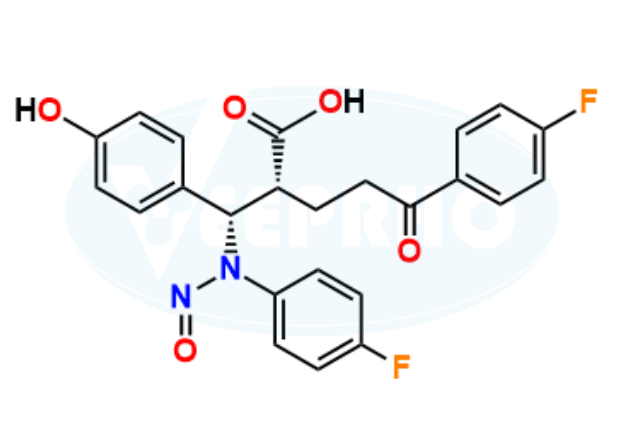
This impurity and its failure report
2 productsSee the 2 products


Additional information on Ezetimibe Nitroso Impurity 11
| Parent drug | Ezetimibe |
|---|---|
| Product type | Impurity standards, Nitroso impurities |
| IUPAC name | (5R)-5-(4-fluorophenyl)-2-((S)-((4-fluorophenyl)(nitroso)amino)(4-hydroxyphenyl)methyl)-5-hydroxypentanoic acid |
| SMILES | FC1=CC=C(N([C@H](C2=CC=C(O)C=C2)C(CC[C@@H](O)C3=CC=C(F)C=C3)C(O)=O)N=O)C=C1 |
| InChI | InChI=1S/C24H22F2N2O5/c25-17-5-1-15(2-6-17)22(30)14-13-21(24(31)32)23(16-3-11-20(29)12-4-16)28(27-33)19-9-7-18(26)8-10-19/h1-12,21-23,29-30H,13-14H2,(H,31,32)/t21?,22-,23-/m1/s1 |
| InChIKey | KBBKVOZKIRVHMA-XMCWYHTOSA-N |
| CHNS Ratio (%) (calculated) | C 63.15 · H 4.86 · N 6.14 · S 0.00 |
| Description | Ezetimibe Nitroso Impurity 11 is a nitroso-related process impurity associated with ezetimibe, with molecular formula C24H22F2N2O5 and molecular weight 456.44 g/mol. The nitroso functionality indicates concern for nitrosamine-like reactivity and potential genotoxicity, warranting assessment under ICH M7 principles when present at trace level. Such species may arise from nitrosating conditions during synthesis or from oxidative transformation of amine-containing intermediates. Because of its low expected abundance and structural similarity to the parent drug, identification typically requires LC-MS/MS, high-resolution MS, and, where volatility permits, GC-MS. Its characterization supports impurity profiling and mechanistic understanding of process-related degradation. |
Request a Quote
"*" indicates required fields
Other products related to Ezetimibe and Nitroso impurities
| Impurity structure | Name of Impurity | Catalogue No. |
|---|---|---|
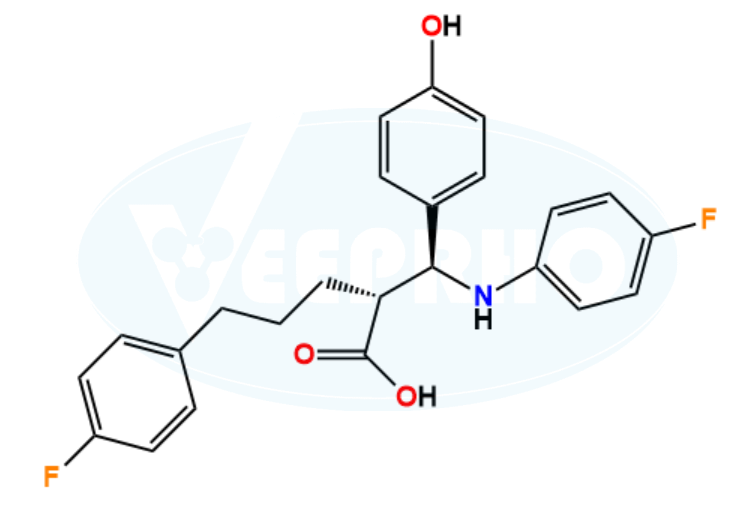 | (R)-5-(4-fluorophenyl)-2-((S)-((4-fluorophenyl)amino)(4-hydroxyphenyl)methyl)pentanoic acid | VE0011660 |
 | (S)-1-(3-Fluorophenyl)-5-(2-oxo-4-phenyloxazolidin-3-yl)pentane-1,5-dione | VE008807 |
| 3-O-Acetyl Ezetimibe | VE0015616 | |
 | 3’-Anhydro-Z-Ezetimibe | VE008805 |
| 4-((2R,3S,6S)-6-(4-Fluorophenyl)-3-(hydroxymethyl)tetrahydro-2H-pyran-2-yl)phenol | VE009235 | |
| 4-(4-Fluorobenzoyl)butyric Acid | VE0011659 | |
| 4-Fluoroaniline | VE0020130 | |
| 5-(2-Fluorophenyl)-5-oxovaleric Acid | VE008756 | |
| Desilylated EZM-II | VE0010975 | |
| Ent-Ezetimibe Ketone | VE009622 | |
| Ezetimibe (RSR) Isomer | VL203012 | |
| Ezetimibe (RSS)-Isomer | VE007989 |
Show all related products N-Nitroso Ezetimibe impurities (11)