
- 100% accuracy of data
- 24/7 scientific support
- 0% tolerance in quality of product
Stock Locations
- New Jersey, USA
- Czech Republic, EU
* Stock subject to availability.
Documentation
The batch COA includes HPLC, MASS/LC-MS, 1H NMR, FT-IR, Potency, and Structure Elucidation Report (SER)..
119018-29-0
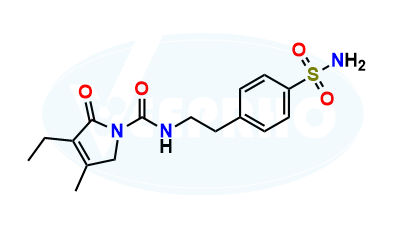
Glimepiride EP Impurity B
● In Stock
| Catalogue No.: | VL71002 |
|---|---|
| CAS No.: | 119018-29-0 |
| Mol. Formula: | C16H21N3O4S |
| Mol. Weight: | 351.42 g/mol |
For laboratory use only: analytical, development and regulatory purposes. Supplied in mg quantities. Not for human or veterinary use.
Request a quote for a set
- Request quote for this set
All EP impurities of Glimepiride
10 productsSee the 10 products
- Glimepiride EP Impurity A VL71001
CAS 684286-46-2 - Glimepiride EP Impurity B VL71002
CAS 119018-29-0 - Glimepiride EP Impurity C VL71003
CAS 119018-30-3 - Glimepiride EP Impurity D VL71004
CAS 791104-62-6 - Glimepiride EP Impurity E VL71005
CAS 2366968-77-4 - Glimepiride EP Impurity F VL71006
CAS 2731586-74-4 - Glimepiride EP Impurity G VL71007
- Glimepiride EP Impurity H VL71008
CAS 2724503-28-8 - Glimepiride EP Impurity I VL71010
CAS 878480-70-7 - Glimepiride EP Impurity J VL71009
CAS 41176-98-1
- Glimepiride EP Impurity A VL71001
- Request quote for this set
All USP impurities of Glimepiride
5 productsSee the 5 products
- Glimepiride EP Impurity A VL71001
CAS 684286-46-2 - Glimepiride EP Impurity B VL71002
CAS 119018-29-0 - Glimepiride EP Impurity C VL71003
CAS 119018-30-3 - Glimepiride EP Impurity D VL71004
CAS 791104-62-6 - Glimepiride EP Impurity F VL71006
CAS 2731586-74-4
- Glimepiride EP Impurity A VL71001

Additional information on CAS 119018-29-0
| Parent drug | Glimepiride |
|---|---|
| Product type | Impurity standards |
| IUPAC name | 3-Ethyl-4-methyl-2-oxo-N-(4-sulfamoylphenethyl)-2,5-dihydro-1H-pyrrole-1-carboxamide |
| EP name | Glimepiride EP Impurity B |
| USP name | Glimepiride Related Compound B |
| SMILES | CCC1=C(C)CN(C(=O)NCCc2ccc(S(N)(=O)=O)cc2)C1=O |
| InChIKey | AJEMFZRCUKJSES-UHFFFAOYSA-N |
| CHNS Ratio (%) (calculated) | C 54.69 · H 6.02 · N 11.96 · S 9.12 |
| Shipping condition | Ambient Temperature |
| References | Pathare | Dnyandeo B. | et al. “RP-LC Determination of the Cis-Isomer of Glimepiride in a Bulk Drug Substance.” Chromatographia | vol. 66 | no. 7-8 | Sept. 2007 | pp. 639–41 | https://doi.org/10.1365/s10337-007-0356-x. |
| Additional characterisation data | QNMR, D2O Exchange, 13C NMR, 13C APT, COSY NMR, NOESY NMR, 15N NMR, HSQC NMR, HMQC NMR, and HMBC NMR. These are available upon request and may be free or subject to additional charges. |
| Description | Glimepiride Related Compound B, also designated Glimepiride EP Impurity B or Glimepiride BP Impurity B, is Glimepiride sulfonamide, CAS 119018-29-0, with molecular formula C16H21N3O4S and molecular weight 351.42 g/mol. This impurity is consistent with a synthetic or degradative desulfurization-associated transformation of the parent sulfonylurea scaffold, yielding the corresponding sulfonamide analog. It is structurally significant in impurity profiling because subtle polarity and ionization changes can alter chromatographic behavior. Quantification typically requires stability-indicating reversed-phase HPLC with LC-MS/MS or high-resolution LC-MS confirmation, and, where needed, forced-degradation comparison to distinguish process-related formation from storage degradation. |
Request a Quote
"*" indicates required fields