
- 100% accuracy of data
- 24/7 scientific support
- 0% tolerance in quality of product
Stock Locations
- New Jersey, USA
- Czech Republic, EU
* Stock subject to availability.
Documentation
Includes: HPLC, MASS/LC-MS, 1H NMR, FT-IR, Potency, Structure Elucidation Report (SER), and additional analytical data depending on the product.
661463-79-2
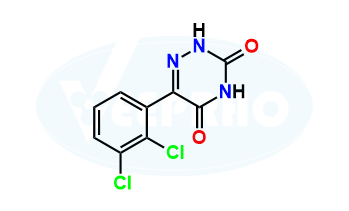
Lamotrigine EP Impurity D
● In Stock
| Catalogue No.: | VL980008 |
|---|---|
| CAS No.: | 661463-79-2 |
| Mol. Formula: | C9H5Cl2N3O2 |
| Mol. Weight: | 258.06 g/mol |
For laboratory use only: analytical, development and regulatory purposes. Supplied in mg quantities. Not for human or veterinary use.
Request a quote for a set
- Request quote for this set
All EP impurities of Lamotrigine
7 productsSee the 7 products
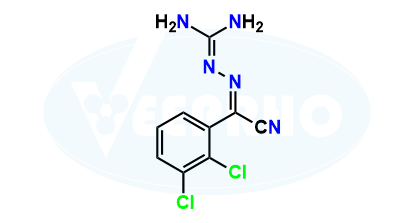
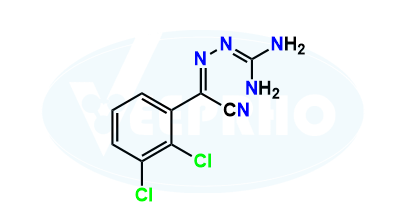
- Lamotrigine EP Impurity A VL980002
CAS 252186-78-0 - Lamotrigine EP Impurity B VL980007
CAS 94213-24-8 - Lamotrigine EP Impurity C VL980006
CAS 94213-23-7 - Lamotrigine EP Impurity D VL980008
CAS 661463-79-2 - Lamotrigine EP Impurity E VL980010
CAS 50-45-3 - Lamotrigine EP Impurity F VL980023
CAS 252186-79-1 - Lamotrigine EP Impurity G VL980009
CAS 38943-76-9
- Lamotrigine EP Impurity A VL980002

Additional information on CAS 661463-79-2
| Parent drug | Lamotrigine |
|---|---|
| Product type | Impurity standards |
| IUPAC name | 6-(2,3-Dichlorophenyl)-1,2,4-triazine-3,5(2H,4H)-dione |
| EP name | Lamotrigine EP Impurity D |
| SMILES | O=c1[nH]nc(-c2cccc(Cl)c2Cl)c(=O)[nH]1 |
| InChIKey | JWSXBRQDWPGEPC-UHFFFAOYSA-N |
| CHNS Ratio (%) (calculated) | C 41.89 · H 1.95 · N 16.28 · S 0.00 |
| Description | Lamotrigine EP Impurity D, also designated 3,5-Didesamino-3,5-dioxo Lamotrigine, is a process-related degradant of the triazine anticonvulsant scaffold. CAS 661463-79-2; molecular formula C9H5Cl2N3O2; molecular weight 258.06 g/mol. Structurally, it reflects oxidative deamination and carbonyl substitution at the 3,5-positions of the diaminotriazine core, yielding a more oxidized heteroaromatic impurity profile than the parent API. Its occurrence is typically associated with synthetic side reactions or oxidative degradation during manufacture and storage. Determination generally requires highly selective LC-MS/MS, often complemented by HPLC-UV and, where needed, HRMS confirmation for trace-level qualification under impurity control and ICH M7 assessment. |
Request a Quote
"*" indicates required fields
Other products related to Lamotrigine impurities
| Impurity structure | Name of Impurity | Catalogue No. |
|---|---|---|
| Lamotrigine EP Impurity A | VL980002 | |
| Lamotrigine EP Impurity B | VL980007 | |
| Lamotrigine EP Impurity C | VL980006 | |
| Lamotrigine EP Impurity E | VL980010 | |
| Lamotrigine EP Impurity F | VL980023 | |
| Lamotrigine EP Impurity G | VL980009 | |
| 1,2-dinitrosohydrazine | VE0011365 | |
| 2 3 Dichlorobenzoyl Cyanide Lamotrigine | VL980011 | |
| 2,5 Dichloro Lamotrigine | VL980019 | |
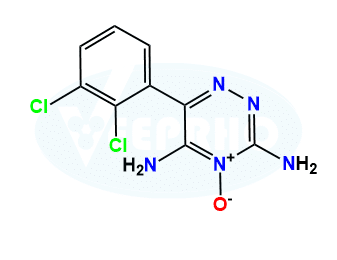 | 3,5-diamino-6-(2,3-dichlorophenyl)-1,2,4-triazine 4-oxide | VE0017722 |
| In-house Impurity B(Lamotrigine impurity) | VL980021 | |
| Lamotrigine 3-3 Dimer | VE0010940 |
Show all related products N-Nitroso Lamotrigine impurities (2)