
- 100% accuracy of data
- 24/7 scientific support
- 0% tolerance in quality of product
Stock Locations
- New Jersey, USA
- Czech Republic, EUIn stock
* Stock subject to availability.
Documentation
Includes: HPLC, MASS/LC-MS, 1H NMR, FT-IR, Potency, Structure Elucidation Report (SER), and additional analytical data depending on the product.
391901-45-4
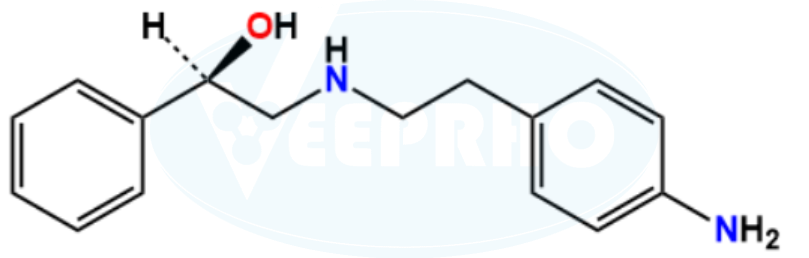
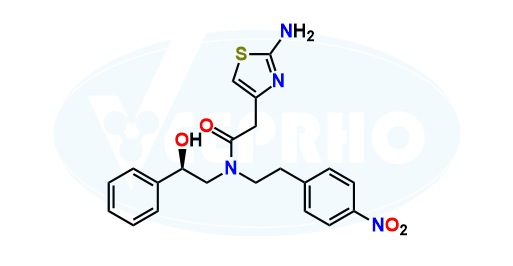
Mirabegron EP Impurity B
● In Stock
| Catalogue No.: | VE006797 |
|---|---|
| CAS No.: | 391901-45-4 |
| Mol. Formula: | C16H20N2O |
| Mol. Weight: | 256.34 g/mol |
For laboratory use only: analytical, development and regulatory purposes. Supplied in mg quantities. Not for human or veterinary use.
Request a quote for a set
- Request quote for this set
All EP impurities of Mirabegron
5 productsSee the 5 products
- Mirabegron EP Impurity B VE006797
CAS 391901-45-4 - Mirabegron EP Impurity E (Free Base) VE0011095
CAS 24954-67-4 - Mirabegron EP Impurity E (HCl Salt) VE0011577
CAS 29968-78-3 - Mirabegron EP Impurity I (HCl Salt ) VE0011799
CAS 25952-53-8 - Mirabegron S-Isomer (Free Base) VL3070006
CAS 1796931-48-0
- Mirabegron EP Impurity B VE006797
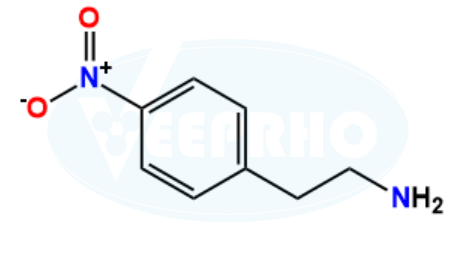
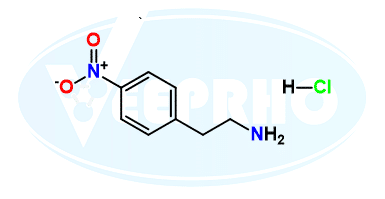
Additional information on CAS 391901-45-4
| Parent drug | Mirabegron |
|---|---|
| Product type | Impurity standards |
| IUPAC name | (1R)-2-[[2-(4-Aminophenyl)ethyl]amino]-1-phenylethan-1-ol |
| EP name | Mirabegron EP Impurity B |
| Other Synonyms | Mirabegron Des-ATAA Impurity |
| SMILES | [H][C@@](CNCCC1=CC=C(N)C=C1)(O)C2=CC=CC=C2 |
| InChI | InChI=1S/C16H20N2O/c17-15-8-6-13(7-9-15)10-11-18-12-16(19)14-4-2-1-3-5-14/h1-9,16,18-19H,10-12,17H2/t16-/m0/s1 |
| InChIKey | TUAHDMSPHZSMQN-INIZCTEOSA-N |
| CHNS Ratio (%) (calculated) | C 74.97 · H 7.86 · N 10.93 · S 0.00 |
| Shipping condition | Ambient Temperature |
| References | Takusagawa, Shin, et al. “Absorption, Metabolism, and Excretion of [14C]Mirabegron (YM178), a Potent and Selective β3-Adrenoceptor Agonist, after Oral Administration to Healthy Male Volunteers.” Drug Metabolism and Disposition, vol. 40, no. 4, Jan. 2012, pp. 815–24, https://doi.org/10.1124/dmd.111.043588. |
| Description | Mirabegron EP Impurity B, also designated Mirabegron MIA-03 Impurity and Mirabegron Des-ATAA Impurity, is a defined process-related impurity of mirabegron with CAS 391901-45-4. It has molecular formula C16H20N2O and molecular weight 256.34 g/mol. Structurally, it represents a de-acylated analogue arising from synthetic pathway divergence or incomplete transformation of the aryloxyalkyl amine scaffold. Owing to its close structural similarity to the parent drug, separation commonly requires LC-MS or LC-MS/MS with orthogonal chromatographic selectivity, and confirmation may involve high-resolution mass spectrometry and NMR. Its presence is relevant in impurity profiling and regulatory specification setting under ICH Q3A/Q3B principles. |
Request a Quote
"*" indicates required fields
Other products related to Mirabegron impurities
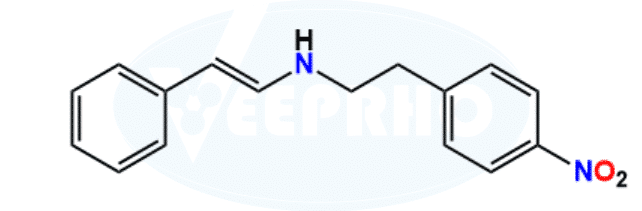
Show all related products N-Nitroso Mirabegron impurities (9)