

- 100% accuracy of data
- 24/7 scientific support
- 0% tolerance in quality of product
Mutagenicity assessment (ICH M7)
Potentially mutagenic impurity (ICH M7 Class 1–3).
N-nitroso compound: ICH M7 cohort of concern.Stock Locations
- New Jersey, USA
- Czech Republic, EU
* Stock subject to availability.
Documentation
Includes: HPLC, MASS/LC-MS, 1H NMR, FT-IR, Potency, Structure Elucidation Report (SER), and additional analytical data depending on the product.
N-Desmethyl Nitroso Nefopam
● In Stock
| Catalogue No.: | VE0024888 |
|---|---|
| CAS No.: | N/A |
| Mol. Formula: | C16H16N2O2 |
| Mol. Weight: | 268.31 g/mol |
For laboratory use only: analytical, development and regulatory purposes. Supplied in mg quantities. Not for human or veterinary use.
Packs and prices
| Pack | Price | Qty |
|---|---|---|
| 50 mg | USD 1,252.50 |
Prices shown are valid for issuing a purchase order.
Prices are subject to change depending on compound availability and the cost of synthesis based on current raw material costs. Veeprho reserves the right to change prices without notice.
Need another pack size or quantity? Request a custom quoteHow can we help?
Request a quote for a set
- Request quote for this set
All nitrosamine impurities of Nefopam
3 productsSee the 3 products
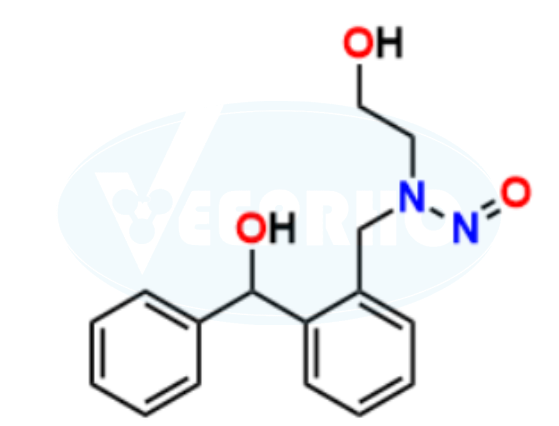
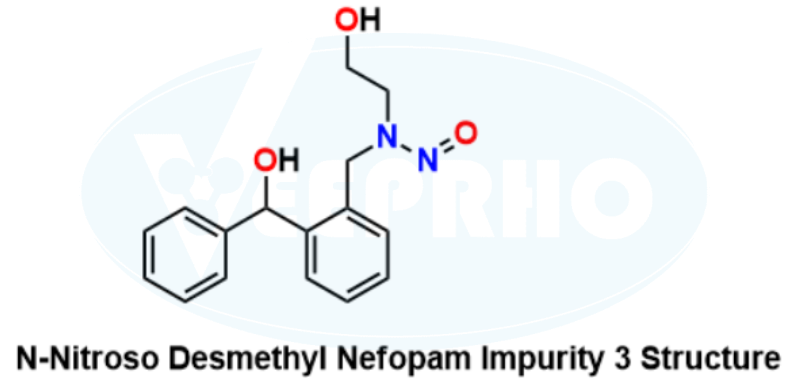
Additional information on N-Desmethyl Nitroso Nefopam
| Parent drug | Nefopam |
|---|---|
| Product type | Impurity standards, Nitroso impurities |
| IUPAC name | 5-nitroso-1-phenyl-3,4,5,6-tetrahydro-1H-benzo[f][1,4]oxazocine |
| SMILES | O=NN1CCOC(c2ccccc2)c2ccccc2C1 |
| InChIKey | IMEYALBQZNGYEA-UHFFFAOYSA-N |
| CHNS Ratio (%) (calculated) | C 71.62 · H 6.01 · N 10.44 · S 0.00 |
| Description | N-Desmethyl Nitroso Nefopam is a nitrosamine-related impurity derived from nefopam, with the molecular formula C16H16N2O2 and molecular weight 268.31 g/mol. Structurally, it represents the N-nitrosated analogue of a demethylated tertiary amine, and may arise through nitrosation of desmethyl precursors under acidic or oxidizing conditions during synthesis or storage. As a member of the nitrosamine class, it is of regulatory concern because such species are often assessed under ICH M7 principles for potential genotoxicity. Trace-level determination typically requires LC-MS/MS, high-resolution mass spectrometry, or GC-MS with selective ion monitoring. |
Request a Quote
"*" indicates required fields
Other products related to Nefopam and Nitroso impurities
| Impurity structure | Name of Impurity | Catalogue No. |
|---|---|---|
| N-Desmethyl Nefopam | VE0021617 | |
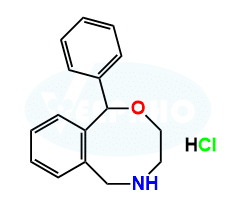 | N-Desmethyl Nefopam (HCl) | VE0017315 |
| N-Nitroso Desmethyl Nefopam Impurity 3 | VE0028879 | |
| Nefopam Deoxy Impurity | VE0021618 | |
| Nefopam Keto Amine Impurity | VE0021621 | |
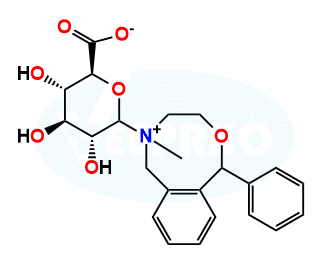 | Nefopam N-Glucuronide (Mixture of Diastereomers) | VE0017312 |
| Nefopam N-Oxide | VE0017314 | |
| (1-(2′-(1-Nitroso-1H-tetrazol-5-yl)-[1,1′-biphenyl]-4-yl)-2-oxohexyl)-L-valine | VE009745 | |
| (1-Nitrosoazepan-4yl)benzozide | VE0023775 | |
| (1R,2R,3R,4S)-3-((R)-1-acetamido-2-ethylbutyl)-2-hydroxy-4-(1-nitrosoguanidino)cyclopentanecarboxylic acid | VE0022642 | |
| (1R,2S,3S,4R)-3-((S)-1-acetamido-2-ethylbutyl)-2-hydroxy-4-(1-nitrosoguanidino)cyclopentanecarboxylic acid | VE0022643 | |
| (1R,2S)-2-amino-6-(4-nitrophenyl)-1-phenylhex-5-yn-1-ol hydrochloride | VE0025678 |