
- 100% accuracy of data
- 24/7 scientific support
- 0% tolerance in quality of product
Mutagenicity assessment (ICH M7)
Potentially mutagenic impurity (ICH M7 Class 1–3).
N-nitroso compound: ICH M7 cohort of concern.EMA18 ng/dayAppendix 1 Rev. 14
Stock Locations
- New Jersey, USA
- Czech Republic, EU
* Stock subject to availability.
Documentation
Includes: HPLC, MASS/LC-MS, 1H NMR, FT-IR, Potency, Structure Elucidation Report (SER), and additional analytical data depending on the product.
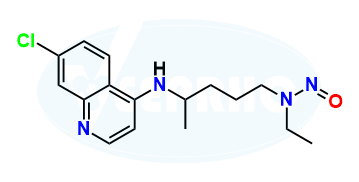
N-Nitroso Hydroxychloroquine EP Impurity D
● In Stock
| Catalogue No.: | VE0024783 |
|---|---|
| CAS No.: | N/A |
| Mol. Formula: | C16H21ClN4O |
| Mol. Weight: | 320.82 g/mol |
For laboratory use only: analytical, development and regulatory purposes. Supplied in mg quantities. Not for human or veterinary use.
Request a quote for a set
- Request quote for this set
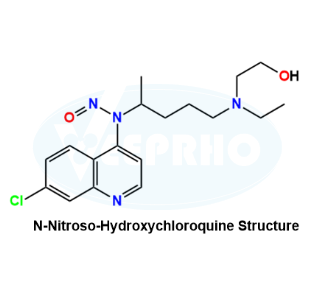
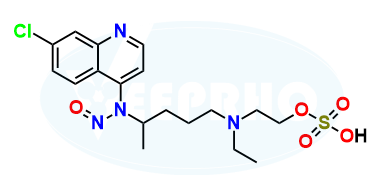
All nitrosamine impurities of Hydroxychloroquine
6 productsSee the 6 products
- N-Nitroso Hydroxychloroquine VE007645
- N-Nitroso-Hydroxychloroquine; Synthesis Attempts and Failure Report (NAP Test) VE0027669
- N-Nitroso Hydroxychloroquine EP Impurity B VE0024797
- N-Nitroso Hydroxychloroquine EP Impurity C VE0024798
- N-Nitroso Hydroxychloroquine EP Impurity D VE0024783
- N-Nitroso Hydroxychloroquine-O-Acetate VE0024784

Additional information on N-Nitroso Hydroxychloroquine EP Impurity D
| Parent drug | Hydroxychloroquine |
|---|---|
| Product type | Impurity standards, Nitroso impurities |
| IUPAC name | N-(7-chloroquinolin-4-yl)-N-(5-(ethylamino)pentan-2-yl)nitrous amide |
| SMILES | CCN(CCCC(C)Nc1ccnc2cc(Cl)ccc12)N=O |
| InChIKey | BEPUZVKLGLGLQB-UHFFFAOYSA-N |
| CHNS Ratio (%) (calculated) | C 59.90 · H 6.60 · N 17.46 · S 0.00 |
| Description | N-Nitroso Hydroxychloroquine EP Impurity D is a nitrosamine-related process or degradation impurity of hydroxychloroquine, structurally defined by N-nitrosation of the side-chain amino functionality. Its molecular formula is C16H21ClN4O with a molecular weight of 320.82 g/mol. Compounds of this class are treated as potentially genotoxic under current regulatory expectations, including ICH M7 principles, because nitrosation can arise from residual nitrite, acidic conditions, or other manufacturing interactions. Structural assignment and trace-level quantification generally require LC-MS/MS or high-resolution MS, with orthogonal confirmation by LC-UV or, where applicable, GC-MS after suitable derivatization. |
Request a Quote
"*" indicates required fields
Other products related to Hydroxychloroquine and Nitroso impurities
| Impurity structure | Name of Impurity | Catalogue No. |
|---|---|---|
| Hydroxychloroquine EP Impurity A | VE005938 | |
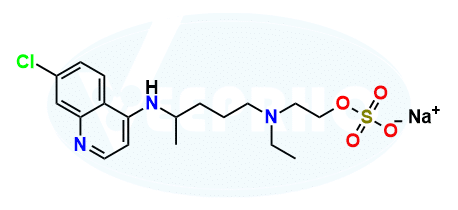 | Hydroxychloroquine EP Impurity B | VE0014930 |
| Hydroxychloroquine EP Impurity B (Free Base) | VE005945 | |
 | Hydroxychloroquine EP Impurity B (Na Salt) | VL3670002 |
| Hydroxychloroquine EP Impurity C | VE005939 | |
| Hydroxychloroquine EP Impurity D | VE005940 | |
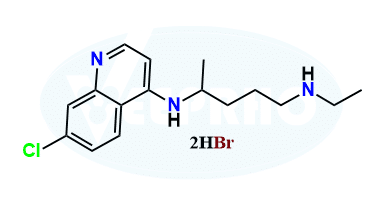 | Hydroxychloroquine EP Impurity D | VE0014931 |
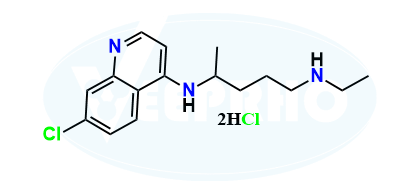 | Hydroxychloroquine EP Impurity D | VE0014934 |
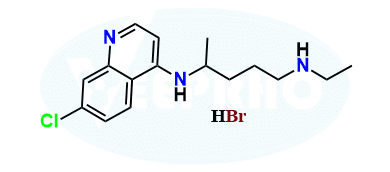 | Hydroxychloroquine EP Impurity D | VE0014935 |
| Hydroxychloroquine EP Impurity E | VE005942 | |
| Hydroxychloroquine EP Impurity F | VE005943 | |
| Hydroxychloroquine EP Impurity G | VE005944 |
Show all related products N-Nitroso Hydroxychloroquine impurities (5)