
- 100% accuracy of data
- 24/7 scientific support
- 0% tolerance in quality of product
Mutagenicity assessment (ICH M7)
Potentially mutagenic impurity (ICH M7 Class 1–3).
N-nitroso compound: ICH M7 cohort of concern.Stock Locations
- New Jersey, USA
- Czech Republic, EU
* Stock subject to availability.
Documentation
Includes: HPLC, MASS/LC-MS, 1H NMR, FT-IR, Potency, Structure Elucidation Report (SER), and additional analytical data depending on the product.
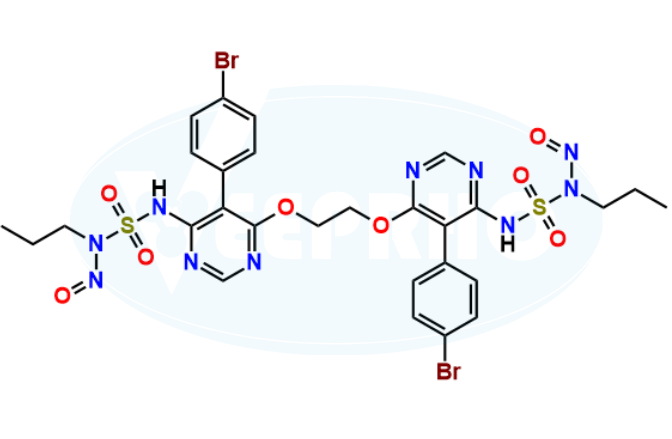
N-Nitroso Macitentan Dimer Impurity
● In Stock
| Catalogue No.: | VE0026391 |
|---|---|
| CAS No.: | N/A |
| Mol. Formula: | C28H30Br2N10O8S2 |
| Mol. Weight: | 858.54 g/mol |
For laboratory use only: analytical, development and regulatory purposes. Supplied in mg quantities. Not for human or veterinary use.
Request a quote for a set
- Request quote for this set
All nitrosamine impurities of Macitentan
4 productsSee the 4 products
- Macitentan Pyrimidine N-Nitroso N-Propyl Impurity VE0024104
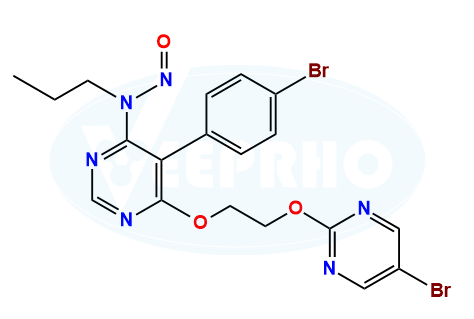
- N-Nitroso Macitentan VE0014976
- N-Nitroso Macitentan Dimer Impurity VE0026391
- Nitroso Pyrimidine N-Propyl Impurity / Hydroxy N-Nitroso N-Propyl Impurity VE0026766
CAS 3104323-52-3

Additional information on N-Nitroso Macitentan Dimer Impurity
| Parent drug | Macitentan |
|---|---|
| Product type | Impurity standards, Nitroso impurities |
| IUPAC name | N-Nitroso Macitentan Dimer Impurity |
| SMILES | BrC1=CC=C(C2=C(N=CN=C2OCCOC3=C(C(NS(=O)(N(N=O)CCC)=O)=NC=N3)C4=CC=C(C=C4)Br)NS(=O)(N(CCC)N=O)=O)C=C1 |
| InChI | InChI=1S/C28H30Br2N10O8S2/c1-3-13-39(37-41)49(43,44)35-25-23(19-5-9-21(29)10-6-19)27(33-17-31-25)47-15-16-48-28-24(20-7-11-22(30)12-8-20)26(32-18-34-28)36-50(45,46)40(38-42)14-4-2/h5-12,17-18H,3-4,13-16H2,1-2H3,(H,31,33,35)(H,32,34,36) |
| InChIKey | GHQOUCLLRNZSPT-UHFFFAOYSA-N |
| CHNS Ratio (%) (calculated) | C 39.17 · H 3.52 · N 16.31 · S 7.47 |
| Description | N-Nitroso Macitentan Dimer Impurity is a nitrosamine-related byproduct observed during macitentan synthesis and storage. Characterized by its dimeric nitrosamine motif, this impurity poses potential genotoxicity concerns and requires sensitive analytical control. Typical identification employs high resolution LC-MS and GC-MS complemented by targeted HPLC quantitation using validated methods with low detection limits. Control measures include precursor level management, optimized reaction quenching and robust purification to minimize formation. Stability testing and batch release screening under ICH M7-aligned thresholds are recommended to ensure regulatory compliance. Accurate quantitation and trend analysis facilitate root cause investigation and continuous improvement of synthetic processes. |
Request a Quote
"*" indicates required fields
Other products related to Macitentan and Nitroso impurities
| Impurity structure | Name of Impurity | Catalogue No. |
|---|---|---|
| 5-(4-Bromophenyl)-4,6-dichloropyrimidine | VE0013249 | |
| 5-(4-bromophenyl)-6-(vinyloxy)pyrimidin-4-amine | VE0016575 | |
| 5-(4-Bromophenyl)pyrimidine-4,6-diol | VE0013247 | |
| 5-Bromo-2-chloropyrimidine | VE0011370 | |
| Hydroxy Macitentan | VE0011423 | |
| Macitentan Impurity 7 | VE0016571 | |
| Macitentan Impurity 8 | VE0016572 | |
| Macitentan Impurity 13 | VE0016573 | |
| Macitentan Impurity 14 | VE0016574 | |
| Macitentan Impurity 15 | VE0015365 | |
| Macitentan Impurity 16 | VE0016576 | |
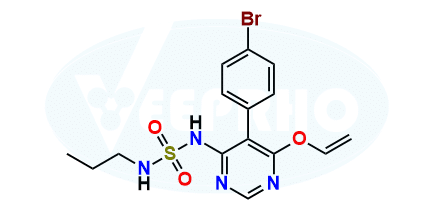 | Macitentan Impurity 17 | VE0016577 |
Show all related products N-Nitroso Macitentan impurities (3)