
- 100% accuracy of data
- 24/7 scientific support
- 0% tolerance in quality of product
Mutagenicity assessment (ICH M7)
Potentially mutagenic impurity (ICH M7 Class 1–3).
N-nitroso compound: ICH M7 cohort of concern.Stock Locations
- New Jersey, USA
- Czech Republic, EU
* Stock subject to availability.
Documentation
Includes: HPLC, MASS/LC-MS, 1H NMR, FT-IR, Potency, Structure Elucidation Report (SER), and additional analytical data depending on the product.
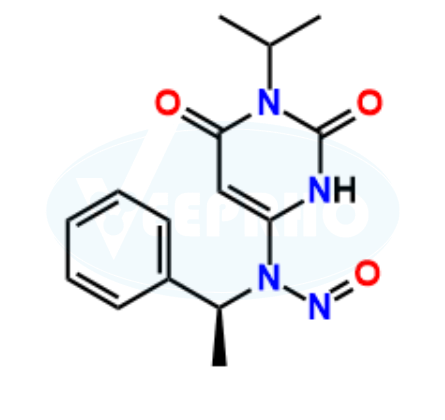
N-Nitroso Mavacamten
● In Stock
| Catalogue No.: | VE0028299 |
|---|---|
| CAS No.: | N/A |
| Mol. Formula: | C15H18N4O3 |
| Mol. Weight: | 302.3 g/mol |
For laboratory use only: analytical, development and regulatory purposes. Supplied in mg quantities. Not for human or veterinary use.
Request a quote for a set
- Request quote for this set
All nitrosamine impurities of Mavacamten
3 productsSee the 3 products
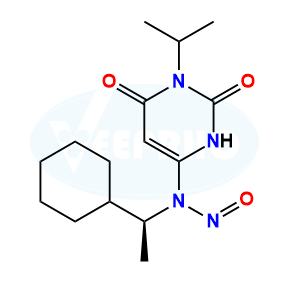
- Mavacamten N-Nitroso-Cyclohexyl Analog Impurity VE0024947
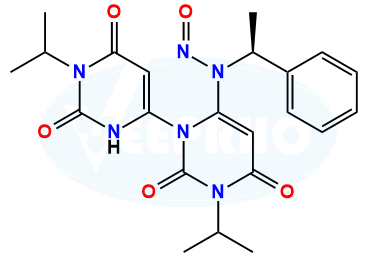
- Mavacamten Nitroso Impurity 1 VE0024945
- N-Nitroso Mavacamten VE0028299
Additional information on N-Nitroso Mavacamten
| Parent drug | Mavacamten |
|---|---|
| Product type | Impurity standards, Nitroso impurities |
| IUPAC name | (S)-N-(1-Isopropyl-2,6-dioxo-1,2,3,6-tetrahydropyrimidin-4-yl)-N-(1-phenylethyl)nitrous amide |
| SMILES | O=NN(C(NC1=O)=CC(N1C(C)C)=O)[C@H](C2=CC=CC=C2)C |
| InChI | InChI=1S/C15H18N4O3/c1-10(2)18-14(20)9-13(16-15(18)21)19(17-22)11(3)12-7-5-4-6-8-12/h4-11H,1-3H3,(H,16,21)/t11-/m0/s1 |
| InChIKey | OPJRXGBPBPIGDP-NSHDSACASA-N |
| CHNS Ratio (%) (calculated) | C 59.59 · H 6.00 · N 18.53 · S 0.00 |
| Description | N-Nitroso Mavacamten impurity presents as a low-level nitrosated degradation product of mavacamten, requiring targeted analytical and control measures. Its nitroso functionality confers potential mutagenic risk, prompting classification as a nitrosamine-type impurity under ICH M7 principles and necessitating trace-level monitoring by validated LC-MS/MS, GC-MS or high-resolution MS methods. Formation pathways include nitrosation during synthesis, acid-catalyzed conditions or storage in presence of nitrosating agents. Stability, solubility and extractability influence control strategies including process optimization, raw material limits, and purge studies to establish acceptable limits. Robust method validation, routine batch testing and risk-based specification setting are essential to ensure product safety and regulatory compliance. |
Request a Quote
"*" indicates required fields