
- 100% accuracy of data
- 24/7 scientific support
- 0% tolerance in quality of product
Mutagenicity assessment (ICH M7)
Potentially mutagenic impurity (ICH M7 Class 1–3).
N-nitroso compound: ICH M7 cohort of concern.Stock Locations
- New Jersey, USA
- Czech Republic, EU
* Stock subject to availability.
Documentation
Includes: HPLC, MASS/LC-MS, 1H NMR, FT-IR, Potency, Structure Elucidation Report (SER), and additional analytical data depending on the product.
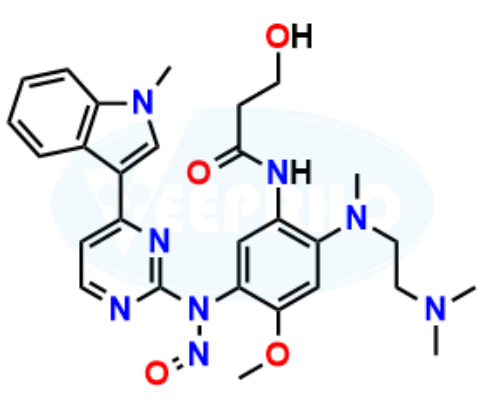
N-Nitroso Osimertinib 3-Hydroxy Impurity
● In Stock
| Catalogue No.: | VE0025909 |
|---|---|
| CAS No.: | N/A |
| Mol. Formula: | C28H34N8O4 |
| Mol. Weight: | 546.62 g/mol |
For laboratory use only: analytical, development and regulatory purposes. Supplied in mg quantities. Not for human or veterinary use.
Request a quote for a set
- Request quote for this set
All nitrosamine impurities of Osimertinib
9 productsSee the 9 products
- N-Nitroso N-desmethyl Osimertinib VE009898
- N-(4-ethyl-2-(methyl(2-(methyl(nitroso)amino)ethyl)amino)-5-((4-(1-methyl-1H-indol-3-yl)pyrimidin-2-yl)amino)phenyl)acrylamide VE009899
- N-Nitroso N-Desmethyl Osimertinib 1 VE0023526
- N-Nitroso Osimertinib VE0025912
- N-Nitroso Osimertinib; Synthesis Attempts and Failure Report (NAP Test) VE0028444
- N-Nitroso Osimertinib 3-Hydroxy Impurity VE0025909
- N-Nitroso Osimertinib Chloro Impurity VE0025919
- N-Nitroso Osimertinib N-Oxide VE0025911
- Osimertinib Nitroso Impurity 2 VE009896


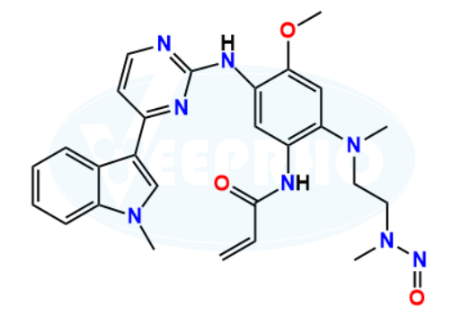
Additional information on N-Nitroso Osimertinib 3-Hydroxy Impurity
| Parent drug | Osimertinib |
|---|---|
| Product type | Impurity standards, Nitroso impurities |
| IUPAC name | N-(2-((2-(dimethylamino)ethyl)(methyl)amino)-4-methoxy-5-((4-(1-methyl-1H-indol-3-yl)pyrimidin-2-yl)(nitroso)amino)phenyl)-3-hydroxypropanamide |
| SMILES | O=C(CCO)NC1=C(N(CCN(C)C)C)C=C(OC)C(N(N=O)C2=NC(C3=CN(C)C4=C3C=CC=C4)=CC=N2)=C1 |
| InChI | InChI=1S/C28H34N8O4/c1-33(2)13-14-34(3)24-17-26(40-5)25(16-22(24)30-27(38)11-15-37)36(32-39)28-29-12-10-21(31-28)20-18-35(4)23-9-7-6-8-19(20)23/h6-10,12,16-18,37H,11,13-15H2,1-5H3,(H,30,38) |
| InChIKey | NYRZSBZXIAVVQZ-UHFFFAOYSA-N |
| CHNS Ratio (%) (calculated) | C 61.52 · H 6.27 · N 20.50 · S 0.00 |
| Description | N-Nitroso Osimertinib 3-Hydroxy Impurity is a nitrosamine-derived degradation product characterized by nitrosation of the Osimertinib scaffold with a 3-hydroxy substitution, posing analytical and control challenges in drug substance development. This polar impurity is typically monitored by LC-HRMS and LC-MS/MS for accurate mass and fragmentation patterns, with orthogonal confirmation by 1H and 13C NMR and HPLC-UV retention profiling. Formation pathways include nitrosation under acidic or oxidative conditions and hydroxylation during synthesis or storage. Effective control strategies include optimization of synthetic routes, elimination of nitrosating reagents, validated purification and desalting steps, and stability testing with established limits. |
Request a Quote
"*" indicates required fields
Other products related to Osimertinib and Nitroso impurities

Show all related products N-Nitroso Osimertinib impurities (7)