
- 100% accuracy of data
- 24/7 scientific support
- 0% tolerance in quality of product
Mutagenicity assessment (ICH M7)
Potentially mutagenic impurity (ICH M7 Class 1–3).
N-nitroso compound: ICH M7 cohort of concern.Stock Locations
- New Jersey, USA
- Czech Republic, EU
* Stock subject to availability.
Documentation
Includes: HPLC, MASS/LC-MS, 1H NMR, FT-IR, Potency, Structure Elucidation Report (SER), and additional analytical data depending on the product.
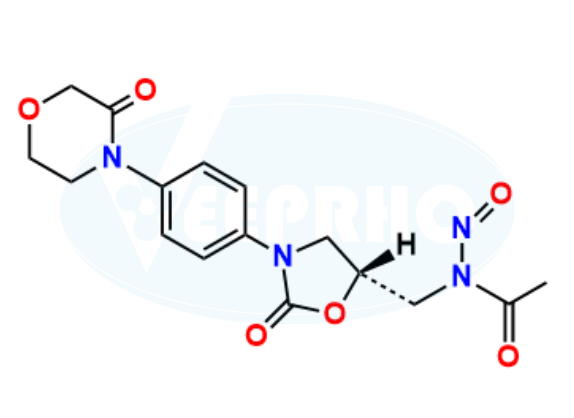
N-Nitroso Rivaroxaban EP Impurity B
● Under Development
| Catalogue No.: | VE0027972 |
|---|---|
| CAS No.: | N/A |
| Mol. Formula: | C16H18N4O6 |
| Mol. Weight: | 362.34 g/mol |
For laboratory use only: analytical, development and regulatory purposes. Supplied in mg quantities. Not for human or veterinary use.
Request a quote for a set
- Request quote for this set
All nitrosamine impurities of Rivaroxaban
6 productsSee the 6 products
- N-Nitroso Rivaroxaban EP Impurity B VE0027972
- N-Nitroso Rivaroxaban Open-Ring Acid Impurity VE0010627
CAS 3069765-41-6 - Rivaroxaban Amino Acid Phthalimide Nitroso Impurity VE0024466
- Rivaroxaban Nitroso Impurity 1 VE009423
CAS 25413-76-7 - Rivaroxaban Nitroso impurity 5 VZA000016
- 2-(2-((4-aminophenyl)(nitroso)amino)ethoxy)acetic acid VE0023938


Additional information on N-Nitroso Rivaroxaban EP Impurity B
| Parent drug | Rivaroxaban |
|---|---|
| Product type | Impurity standards, Nitroso impurities |
| IUPAC name | (R)-N-nitroso-N-((2-oxo-3-(4-(3-oxomorpholino)phenyl)oxazolidin-5-yl)methyl)acetamide |
| SMILES | O=C1N(C2=CC=C(N3C(O[C@@]([H])(CN(N=O)C(C)=O)C3)=O)C=C2)CCOC1 |
| InChI | InChI=1S/C16H18N4O6/c1-11(21)20(17-24)9-14-8-19(16(23)26-14)13-4-2-12(3-5-13)18-6-7-25-10-15(18)22/h2-5,14H,6-10H2,1H3/t14-/m1/s1 |
| CHNS Ratio (%) (calculated) | C 53.04 · H 5.01 · N 15.46 · S 0.00 |
| Description | N-Nitroso Rivaroxaban EP Impurity B is an N-nitroso-class degradation product identified during synthesis and stability studies of rivaroxaban active substance. This polar, low-level impurity exhibits typical nitrosamine reactivity and requires trace-level detection due to potential genotoxicity concerns. Analytical characterization employs sensitive LC-MS/MS, GC-MS after derivatization, and high resolution MS for confirmatory identification and quantification. Control strategies include nitrosation risk assessment, optimized quench steps, reagent selection, and validated cleaning procedures to minimize formation. Stability profiling under forced degradation and storage conditions informs specification setting and routine batch release testing to ensure consistent impurity control. |
Request a Quote
"*" indicates required fields