
- 100% accuracy of data
- 24/7 scientific support
- 0% tolerance in quality of product
Mutagenicity assessment (ICH M7)
Potentially mutagenic impurity (ICH M7 Class 1–3).
N-nitroso compound: ICH M7 cohort of concern.Stock Locations
- New Jersey, USA
- Czech Republic, EU
* Stock subject to availability.
Documentation
Includes: HPLC, MASS/LC-MS, 1H NMR, FT-IR, Potency, Structure Elucidation Report (SER), and additional analytical data depending on the product.
67856-68-2
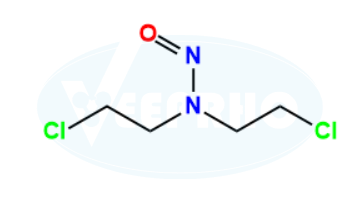
N-Nitroso bis(2-chloroethyl)amine
● In Stock
| Catalogue No.: | VE006103 |
|---|---|
| CAS No.: | 67856-68-2 |
| Mol. Formula: | C4H8Cl2N2O |
| Mol. Weight: | 171.02 g/mol |
For laboratory use only: analytical, development and regulatory purposes. Supplied in mg quantities. Not for human or veterinary use.
Request a quote for a set
- Request quote for this set
All nitrosamine impurities of Cyclophosphamide
4 productsSee the 4 products
- N-Nitroso bis(2-chloroethyl)amine VE006103
CAS 67856-68-2 - N-Nitroso Cyclophosphamide VE0015663
- N-Nitroso Cyclophosphamide Related compound B VE0024419
- N-Nitroso Cyclophosphamide Related compound D VE0024420
- N-Nitroso bis(2-chloroethyl)amine VE006103


Additional information on CAS 67856-68-2
| Parent drug | Cyclophosphamide |
|---|---|
| Product type | Impurity standards, Nitroso impurities |
| IUPAC name | Nitroso bis 2 chloro ethyl amine |
| Other Synonyms | 2-Chloro-N-(2-chloroethyl)-N-nitrosoethanamine; BIS(2-CHLOROETHYL)(NITROSO)AMINE; DIETHYLAMINE, 2,2′-DICHLORO-N-NITROSO-; Ethanamine, 2-chloro-N-(2-chloroethyl)-N-nitroso- |
| SMILES | ClCCN(N=O)CCCl |
| InChI | InChI=1S/C4H8Cl2N2O/c5-1-3-8(7-9)4-2-6/h1-4H2 |
| InChIKey | VWQXNTZBSSUTAB-UHFFFAOYSA-N |
| CHNS Ratio (%) (calculated) | C 28.09 · H 4.72 · N 16.38 · S 0.00 |
| References | - |
| Description | N-Nitroso bis(2-chloroethyl)amine (CAS 67856-68-2), molecular formula C4H8Cl2N2O, molecular weight 171.02 g/mol, is a dichlorinated alkylnitrosamine associated with potent electrophilic reactivity and alkylating behavior. This impurity may arise from nitrosation of bis(2-chloroethyl)amine related intermediates or from process-related contamination during synthesis of chloroethylating agents. As a recognized genotoxic impurity, it falls within the risk-based control concepts of ICH M7. Determination typically requires highly selective methods such as LC-MS/MS or GC-MS, often with isotope-dilution approaches, because of low regulatory limits and trace-level occurrence. |
Request a Quote
"*" indicates required fields
Other products related to Cyclophosphamide and Nitroso impurities
| Impurity structure | Name of Impurity | Catalogue No. |
|---|---|---|
| Cyclophosphamide EP Impurity A | VE0010580 | |
| Cyclophosphamide EP Impurity G | VE0014596 | |
 | Cyclophosphamide Related Compound A (HCl Salt) | VL165001 |
| Cyclophosphamide Related Compound B | VL165006 | |
 | Cyclophosphamide Related Compound B (Ethyl Ester TFA Salt) | VE008842 |
| Cyclophosphamide Related Compound C | VL165003 | |
 | Cyclophosphamide Related Compound C (Ethyl Ester HCl Salt) | VE008843 |
| Cyclophosphamide Related Compound D | VL165002 | |
 | Cyclophosphamide Related Compound D (Ethyl Ester HCl Salt) | VE008844 |
| N-Nitroso Cyclophosphamide Related compound B | VE0024419 | |
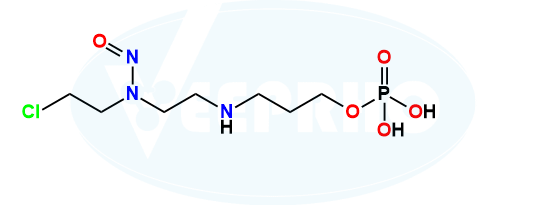 | N-Nitroso Cyclophosphamide Related compound D | VE0024420 |
| Alcocyclophosphamide | VE0013969 |
Show all related products N-Nitroso Cyclophosphamide impurities (2)