
- 100% accuracy of data
- 24/7 scientific support
- 0% tolerance in quality of product
Stock Locations
- New Jersey, USA
- Czech Republic, EU
* Stock subject to availability.
Documentation
Includes: HPLC, MASS/LC-MS, 1H NMR, FT-IR, Potency, Structure Elucidation Report (SER), and additional analytical data depending on the product.
1393717-45-7
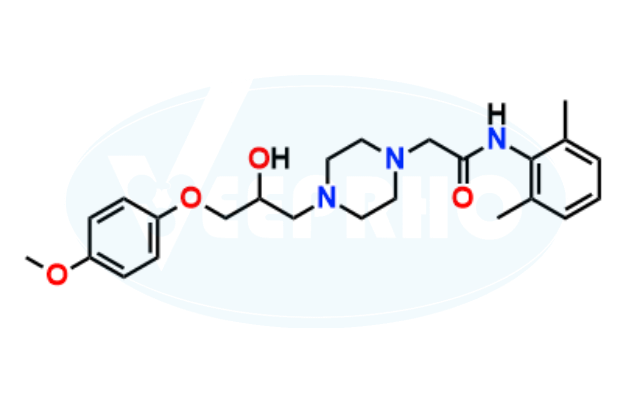
p-Ranolazine
● In Stock
| Catalogue No.: | VL770016 |
|---|---|
| CAS No.: | 1393717-45-7 |
| Mol. Formula: | C24H33N3O4 |
| Mol. Weight: | 427.54 g/mol |
For laboratory use only: analytical, development and regulatory purposes. Supplied in mg quantities. Not for human or veterinary use.
Request a quote for a set
- Request quote for this set
All USP impurities of Ranolazine
7 productsSee the 7 products
- Lidocaine Dimer N-Oxide VE0016054
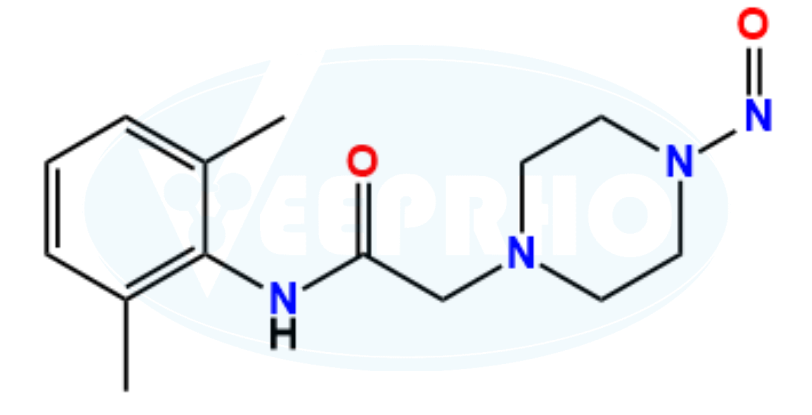
CAS 2725395-82-2 - Nitroso Piperazine Acetamide VE007754
CAS 3038740-93-8 - p-Ranolazine VL770016
CAS 1393717-45-7 - Ranolazine Related Compound A VL770008
CAS 2210-74-4 - Ranolazine Related Compound B VL770009
CAS 755711-09-2 - Ranolazine Related Compound C VL770004
CAS 5294-61-1 - Ranolazine Related Compound D VL770003
CAS 380204-72-8
- Lidocaine Dimer N-Oxide VE0016054

Additional information on CAS 1393717-45-7
| Parent drug | Ranolazine |
|---|---|
| Product type | Impurity standards |
| IUPAC name | N-(2,6-Dimethylphenyl)-4-[2-hydroxy-3-(4-methoxyphenoxy)propyl]-1-piperazineacetamide |
| USP name | p-Ranolazine |
| SMILES | O=C(NC1=C(C)C=CC=C1C)CN2CCN(CC(O)COC3=CC=C(OC)C=C3)CC2 |
| InChI | InChI=1S/C24H33N3O4/c1-18-5-4-6-19(2)24(18)25-23(29)16-27-13-11-26(12-14-27)15-20(28)17-31-22-9-7-21(30-3)8-10-22/h4-10,20,28H,11-17H2,1-3H3,(H,25,29) |
| InChIKey | YCRVPHYZFCHTNN-UHFFFAOYSA-N |
| CHNS Ratio (%) (calculated) | C 67.42 · H 7.78 · N 9.83 · S 0.00 |
| References | Ghosh, GopalChandra, et al. “Ranolazine: Multifaceted Role beyond Coronary Artery Disease, a Recent Perspective.” Heart Views, vol. 19, no. 3, 2018, p. 88, https://doi.org/10.4103/heartviews.heartviews_18_18. |
| Description | p-Ranolazine impurity (CAS 1393717-45-7) typically refers to structurally related synthetic byproducts and degradation species that co-elute or appear as discrete peaks during HPLC analysis. These impurities arise from incomplete reactions, regioisomer formation, N-oxidation or alkylation side-reactions, and oxidative or hydrolytic degradation during manufacture or storage. Characterization uses LC-MS, high-resolution MS and NMR to determine exact mass and structural assignments, while quantitative control relies on validated HPLC methods and defined impurity limits in accordance with ICH guidelines. Robust purification, stress testing and stability-indicating assays are essential to minimize impurity levels and ensure pharmaceutical quality. |
Request a Quote
"*" indicates required fields