

- 100% accuracy of data
- 24/7 scientific support
- 0% tolerance in quality of product
Stock Locations
- New Jersey, USA
- Czech Republic, EU
* Stock subject to availability.
Documentation
Includes: HPLC, MASS/LC-MS, 1H NMR, FT-IR, Potency, Structure Elucidation Report (SER), and additional analytical data depending on the product.
1322626-23-2/ 1394842-91-1
Paroxetine HCl EP Impurity A (HCl Salt)
● In Stock
| Catalogue No.: | VL1400005 |
|---|---|
| CAS No.: | 1322626-23-2/ 1394842-91-1 |
| Mol. Formula: | C19H22ClNO3 |
| Mol. Weight: | 347.84 g/mol |
For laboratory use only: analytical, development and regulatory purposes. Supplied in mg quantities. Not for human or veterinary use.
Request a quote for a set
- Request quote for this set
All EP impurities of Paroxetine
14 productsSee the 14 products
- Paroxetine EP Impurity A VE0021962
CAS 324024-00-2 - Paroxetine EP Impurity B VL1400004
CAS 533-31-3 - Paroxetine EP Impurity D (HCl salt) VL1400002
CAS 130855-30-0 - Paroxetine EP Impurity E VL1400001
CAS 105813-05-6 - Paroxetine EP Impurity G VL1400007
CAS 69675-10-1 - Paroxetine EP Impurity J (HCl Salt) VE008352
- Paroxetine HCl Anhydrous EP Impurity H VE006158
CAS 201855-60-9 - Paroxetine HCl Anhydrous EP Impurity I VE006159
CAS 125224-43-3 - Paroxetine HCl EP Impurity A (HCl Salt) VL1400005
CAS 1322626-23-2/ 1394842-91-1 - Paroxetine HCl EP Impurity C (Free Base) VE006837
CAS 105813-14-7 - Paroxetine HCl EP Impurity F (Free Base) VE006838
CAS 105813-40-9 - Paroxetine HCl Hemihydrate EP Impurity C (HCl salt) VL1400009
CAS 1346597-97-4 - Paroxetine Hemihydrate EP Impurity C VL1400003
CAS 1395408-54-4 - Paroxetine Hydrochloride Anhydrous EP Impurity J VE0021960
- Paroxetine EP Impurity A VE0021962
- Request quote for this set
All USP impurities of Paroxetine
10 productsSee the 10 products
- Paroxetine EP Impurity A VE0021962
CAS 324024-00-2 - Paroxetine EP Impurity D (HCl salt) VL1400002
CAS 130855-30-0 - Paroxetine EP Impurity E VL1400001
CAS 105813-05-6 - Paroxetine EP Impurity G VL1400007
CAS 69675-10-1 - Paroxetine HCl EP Impurity A (HCl Salt) VL1400005
CAS 1322626-23-2/ 1394842-91-1 - Paroxetine Impurity 18 VE0018691
CAS 105812-81-5 - Paroxetine Related Compound F VL1400006
CAS 110429-36-2 - Paroxetine Related Compound G VE007335
CAS 1217655-87-2 - (3R,4R)-Paroxol VE0018678
CAS 100332-12-5 - (3S,4S)-Paroxol VE0018676
CAS 100332-20-5
- Paroxetine EP Impurity A VE0021962
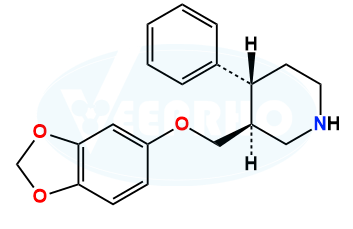


Additional information on CAS 1322626-23-2/ 1394842-91-1
| Parent drug | Paroxetine |
|---|---|
| Product type | Impurity standards |
| IUPAC name | (3S,4R)-3-[(1,3-Benzodioxol-5-yloxy)methyl]-4-phenylpiperidine HCl |
| EP name | Paroxetine HCl EP Impurity A/ Paroxetine HCl Hemihydrate EP Impurity A |
| USP name | Paroxetine Related Compound B |
| SMILES | Cl.c1ccc([C@@H]2CCNC[C@H]2COc2ccc3c(c2)OCO3)cc1 |
| InChIKey | XLYKTAGGMBYJOB-NBLXOJGSSA-N |
| CHNS Ratio (%) (calculated) | C 65.61 · H 6.38 · N 4.03 · S 0.00 |
| References | Paroxetine-The Antidepressant from Hell? Probably Not | But Caution Required By Robert M Nevels | Samuel T Gontkovsky | Bryman E Williams Container: Psychopharmacology bulletin Publisher: MedWorks Media Global Year: 2016 Volume: 46 Issue: 1 URL: https://www.ncbi.nlm.nih.gov/pmc/articles/PMC5044489/ |
| Description | Paroxetine HCl EP Impurity A, also referenced as Paroxetine Related Compound B and desfluoro paroxetine hydrochloride, is a structural analogue of paroxetine in which the para-fluoro substituent is absent from the aryl moiety. This non-volatile organic impurity, CAS 1322626-23-2 and 1394842-91-1, has molecular formula C19H22ClNO3 and molecular weight 347.84 g/mol. It is typically associated with incomplete fluorination, side-product formation, or synthetic route impurities rather than oxidative degradation. Determination generally requires orthogonal LC-MS/MS and LC-UV methods, with chiral LC considerations when stereochemical purity is relevant. Its presence is assessed within pharmacopeial impurity control frameworks. |
Request a Quote
"*" indicates required fields
Other products related to Paroxetine impurities
| Impurity structure | Name of Impurity | Catalogue No. |
|---|---|---|
| N-Nitroso Paroxetine EP Impurity A | VE0028020 | |
| N-Nitroso Paroxetine EP Impurity D | VE0028022 | |
| Paroxetine EP Impurity A | VE0021962 | |
| Paroxetine EP Impurity B | VL1400004 | |
| Paroxetine EP Impurity D (HCl salt) | VL1400002 | |
| Paroxetine EP Impurity E | VL1400001 | |
| Paroxetine EP Impurity G | VL1400007 | |
 | Paroxetine EP Impurity J (HCl Salt) | VE008352 |
| Paroxetine HCl Anhydrous EP Impurity F | VE0015164 | |
| Paroxetine HCl Anhydrous EP Impurity H | VE006158 | |
| Paroxetine HCl Anhydrous EP Impurity I | VE006159 | |
| Paroxetine HCl EP Impurity C (Free Base) | VE006837 |
Show all related products N-Nitroso Paroxetine impurities (3)