
- 100% accuracy of data
- 24/7 scientific support
- 0% tolerance in quality of product
Stock Locations
- New Jersey, USA
- Czech Republic, EUIn stock
* Stock subject to availability.
Documentation
Includes: HPLC, MASS/LC-MS, 1H NMR, FT-IR, Potency, Structure Elucidation Report (SER), and additional analytical data depending on the product.
885516-61-0
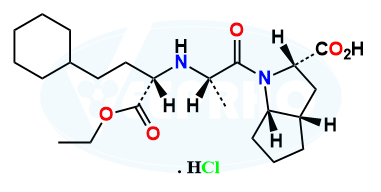
Ramipril EP Impurity C (HCl salt)
● In Stock
| Catalogue No.: | VL129005 |
|---|---|
| CAS No.: | 885516-61-0 |
| Mol. Formula: | C23H39ClN2O5 |
| Mol. Weight: | 459.02 g/mol |
For laboratory use only: analytical, development and regulatory purposes. Supplied in mg quantities. Not for human or veterinary use.
Request a quote for a set
- Request quote for this set
All EP impurities of Ramipril
14 productsSee the 14 products
- Enalapril EP Impurity B VL1360002
CAS 82717-96-2 - Ramipril EP Impurity A VL129001
CAS 108313-11-7 - Ramipril EP Impurity B VL129015
CAS 295328-72-2 - Ramipril EP Impurity C (HCl salt) VL129005
CAS 885516-61-0 - Ramipril EP Impurity D VL129014
CAS 108731-95-9 - Ramipril EP Impurity E VL129009
CAS 87269-97-4 - Ramipril EP Impurity H VL129006
CAS 104195-90-6 - Ramipril EP Impurity I VL129007
CAS 129939-65-7 - Ramipril EP Impurity J VL129011
CAS 1246253-05-3 - Ramipril EP Impurity K VL129004
CAS 108736-10-3 - Ramipril EP Impurity L VL129008
CAS 1309040-96-7 - Ramipril EP Impurity M VL129012
CAS 2743-38-6 - Ramipril EP Impurity N VL129013
CAS 129939-63-5 - Ramipril EP Impurity O VL129003
CAS 151387-05-2
- Enalapril EP Impurity B VL1360002
- Request quote for this set
All USP impurities of Ramipril
5 productsSee the 5 products
- Enalapril EP Impurity B VL1360002
CAS 82717-96-2 - Ramipril EP Impurity A VL129001
CAS 108313-11-7 - Ramipril EP Impurity B VL129015
CAS 295328-72-2 - Ramipril EP Impurity C (HCl salt) VL129005
CAS 885516-61-0 - Ramipril EP Impurity D VL129014
CAS 108731-95-9
- Enalapril EP Impurity B VL1360002


Additional information on CAS 885516-61-0
| Parent drug | Ramipril |
|---|---|
| Product type | Impurity standards |
| IUPAC name | (2S,3aS,6aS)-1-[(2S)-2-[[(2S)-4-cyclohexyl-1-ethoxy-1-oxobutan-2-yl]amino]propanoyl]octahydrocyclopenta[b]-pyrrole-2-carboxylic acid Hydrochloride |
| EP name | Ramipril EP Impurity C; Hexahydro Ramipril |
| USP name | Ramipril Related Compound C |
| Pharmacopeial synonyms | Hexahydro Ramipril (HCl salt); Ramipril Related Compound C (HCl salt) |
| SMILES | O=C([C@@H]1C[C@@](CCC2)([H])[C@@]2([H])N1C([C@@H](N[C@@H](CCC3CCCCC3)C(OCC)=O)C)=O)O.[H]Cl |
| InChI | InChI=1S/C23H38N2O5.ClH/c1-3-30-23(29)18(13-12-16-8-5-4-6-9-16)24-15(2)21(26)25-19-11-7-10-17(19)14-20(25)22(27)28;/h15-20,24H,3-14H2,1-2H3,(H,27,28);1H/t15-,17-,18-,19-,20-;/m0./s1 |
| InChIKey | KYSZJGRJQYQTJD-IKZVEOHFSA-N |
| CHNS Ratio (%) (calculated) | C 60.18 · H 8.56 · N 6.10 · S 0.00 |
| References | Chauhan | Munish | et al. “Ramipril.†Nih.gov | StatPearls Publishing | 6 Feb. 2022 | www.ncbi.nlm.nih.gov/books/NBK537119/. |
| Description | Ramipril EP Impurity C, also designated Cyclohexyl Ramipril Analog HCl, Hexahydro Ramipril Hydrochloride, or Ramipril Related Compound C, is a process- and degradation-related structural analog of the ACE inhibitor ramipril. CAS 99742-35-5 corresponds to a hydrochloride salt with molecular formula C23H39ClN2O5 and molecular weight 459.02 g/mol. The impurity retains the dipeptide-like prodrug scaffold but incorporates a saturated cyclohexyl moiety, consistent with hydrogenation or synthetic diversion during manufacturing. Because of its close structural relationship to the active substance, trace-level control commonly requires LC-MS/MS, LC-UV, and orthogonal confirmation by high-resolution mass spectrometry, with impurity profiling aligned to pharmacopeial specifications and stability-indicating methods. |
Request a Quote
"*" indicates required fields