
- 100% accuracy of data
- 24/7 scientific support
- 0% tolerance in quality of product
Stock Locations
- New Jersey, USA
- Czech Republic, EU
* Stock subject to availability.
Documentation
Includes: HPLC, MASS/LC-MS, 1H NMR, FT-IR, Potency, Structure Elucidation Report (SER), and additional analytical data depending on the product.
1263358-12-8
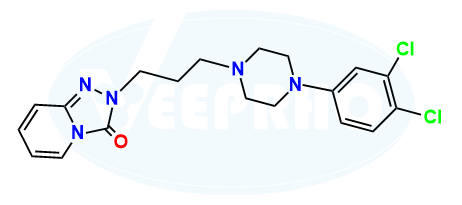
Trazodone EP Impurity J (Free Base)
● In Stock
| Catalogue No.: | VE0025509 |
|---|---|
| CAS No.: | 1263358-12-8 |
| Mol. Formula: | C19H21Cl2N5O |
| Mol. Weight: | 406.31 g/mol |
For laboratory use only: analytical, development and regulatory purposes. Supplied in mg quantities. Not for human or veterinary use.
Request a quote for a set
- Request quote for this set
All EP impurities of Trazodone
8 productsSee the 8 products
- Hydroxypropyl Chlorophenylpiperazine VL620010
CAS 32229-98-4 - Trazodone EP Impurity A (HCl Salt) VE0022659
CAS 55290-66-9 - Trazodone EP Impurity D (Free Base) VE0022429
CAS 1263358-13-9 - Trazodone EP Impurity E (HCl) VE0022754
CAS 2413903-91-8 - Trazodone EP Impurity G ( Free Base) VE0025511
CAS 2470436-00-9 - Trazodone EP Impurity G (HCl Salt) VE0025510
CAS 2470441-00-8 - Trazodone EP Impurity H (2HCl salt) VE0022846
CAS 2408971-27-5 - Trazodone EP Impurity J (Free Base) VE0025509
CAS 1263358-12-8
- Hydroxypropyl Chlorophenylpiperazine VL620010

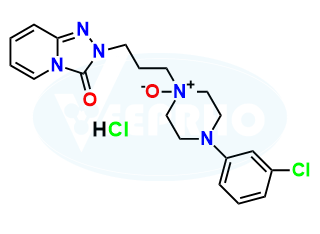
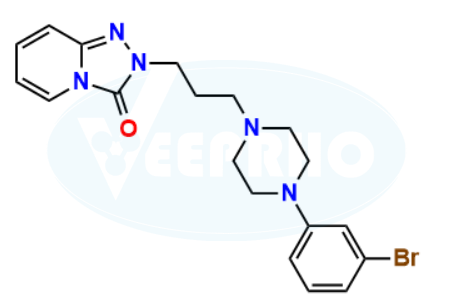
Additional information on CAS 1263358-12-8
| Parent drug | Trazodone |
|---|---|
| Product type | Impurity standards |
| IUPAC name | 2-[3-[4-(3,4-Dichlorophenyl)piperazin-1-yl]propyl][1,2,4]triazolo[4,3-a]pyridin-3(2H)-one |
| EP name | Trazodone EP Impurity J |
| SMILES | O=c1n(CCCN2CCN(c3ccc(Cl)c(Cl)c3)CC2)nc2ccccn12 |
| InChIKey | BYMWUBUCHMEWPM-UHFFFAOYSA-N |
| CHNS Ratio (%) (calculated) | C 56.17 · H 5.21 · N 17.24 · S 0.00 |
| Description | Trazodone EP Impurity J (Free Base), CAS: 1263358-12-8, is a process-related and degradation impurity observed during trazodone synthesis and stability studies. This basic impurity requires targeted quantitation using validated HPLC-UV and LC-MS methods for impurity profiling and batch release. Structural confirmation by NMR supports identification and root cause analysis. Control strategy should include raw material qualification, optimized reaction conditions, and in-process monitoring to limit formation, with established specification and reporting thresholds aligned to regulatory guidance. Stability testing under forced degradation clarifies propensity for formation, aiding specification setting and impurity qualification in regulatory submissions. |
Request a Quote
"*" indicates required fields
Other products related to Trazodone impurities
| Impurity structure | Name of Impurity | Catalogue No. |
|---|---|---|
| Trazodone BP Impurity A | VL620001 | |
| Trazodone BP Impurity C (free base) | VL620024 | |
| Trazodone BP Impurity C (HCl salt) | VL620002 | |
| Trazodone BP Impurity C (HCL salt) | VL620003 | |
| Trazodone BP Impurity D | VL620004 | |
| Trazodone BP Impurity E | VL620005 | |
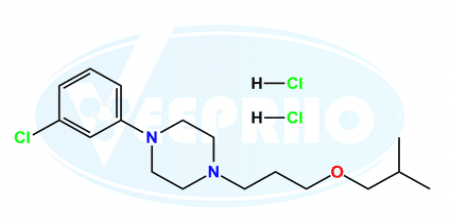 | Trazodone BP Impurity G | VL620007 |
| Trazodone BP Impurity H | VL620008 | |
| Trazodone EP Impurity A (HCl Salt) | VE0022659 | |
| Trazodone EP Impurity D (Free Base) | VE0022429 | |
| Trazodone EP Impurity E (HCl) | VE0022754 | |
| Trazodone EP Impurity F(HCl salt) | VL620006 |
Show all related products N-Nitroso Trazodone impurities (4)