
Read this article in:EnglishDeutschPortuguêsEspañol한국어日本語
Qualification of Non-Mutagenic Impurities

As per ICH Q3 A and B, Qualification is the process of acquiring and evaluating data that establishes the biological safety of an individual impurity/degradation product or a given impurity profile/degradation profile at the level(s) specified.
The level of any impurity present in a new drug substance or any degradation product present in a new drug product would be considered qualified once it has been adequately tested in safety and/or clinical studies. Impurities and degradation products that are also significant metabolites present in animal and/or human studies are generally considered qualified.
The qualification process
At the onset, all impurities under the purview of ICH Q3A and B should be subjected for mutagenic assessment followed by their classification as per ICH M7. Class 1, 2 and 3 impurities being mutagenic should be controlled at trace level. If a non-mutagenic (Class 4 and 5) impurity in drug substance, or degradation product in drug product, cannot be reduced below the qualification threshold then it is mandatory to conduct general toxicity studies as per the decision tree – see below.
If general toxicity studies are desirable, one or more studies should be designed to allow comparison of unqualified to qualified material. The study duration should be based on available relevant information. It must be performed in the species most likely to maximise the potential to detect the toxicity of an impurity.
On a case-by-case basis, single-dose studies can be appropriate, especially for single dose drugs. In general, a minimum duration of 14 days and a maximum duration of 90 days would be considered appropriate.

The animal testing is performed to evaluate the toxicity as per the following:
Administration Routes
- Administration route (e.g., oral, dermal, inhalation, or injection).
- Ensuring the route is relevant to human exposure.
Study Design
- Acute toxicity: single dose, observe for 14 days.
- Sub-acute toxicity: repeated doses, 28-90 days.
- Chronic toxicity: long-term exposure, 6-12 months or more.
Animals Required
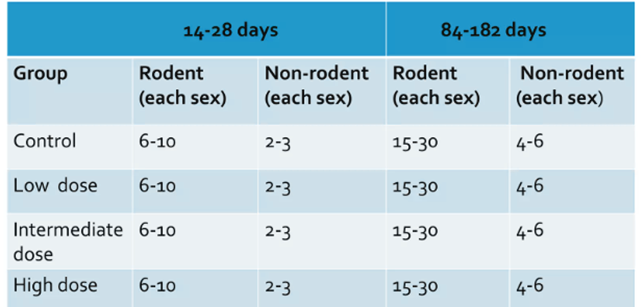
Taking in to account the significant number of animals that would be needed for such studies, the European Medicines Agency (EMA) provided a draft reflection paper encouraging the incorporation of 3Rs (Replacement, Reduction, and Refinement) for qualification of pharmaceutical impurities. Below mentioned approaches can be considered mainly as alternative to animal testing.
- Integrated risk assessment
- Structure activity relationships
- Use of pharmacological and toxicological databases
How to conclude acceptable levels of safety?
To assess whether a non-mutagenic impurity (NGI) has acceptable safety at the proposed specified level, a case-by-case approach should be used. The integrated risk assessment may encompass several or all of the approaches mentioned below but may also be limited to a single or only few steps. The reflection paper does not give specific recommendations which in silico tools or in vitro methods to use. However, regulatory acceptance of any tool or assay should be supported with data showing the method is suitable for its intended purpose.
For NGI qualification there is no strict requirement to determine a NOAEL for the NGI in order to draw a conclusion on the safety of the NGI at the specified level. The only requirement is to determine that at the specified level no adverse effects are expected. To reach a conclusion a weight-of-evidence (WoE) approach may be applied. This approach should describe both the evidence pointing to a risk and the evidence showing the absence of risk.
To build weight of evidence case it is required to gather all information from all possible sources including:
- Published literature
- Read-across from chemical analogues
- (Q)SAR predictions
- Data from existing studies
- in vitro studies
- Epidemiological data/human experience.
A typical approach for qualification, factors, and evidences to support safety can be as follows:
- Mutagenicity assessment: To confirm the impurity is non mutagenic
- In silico toxicological assessment: To check other toxicity alerts present in the impurity
- In vivo or clinical studies: Metabolic activation.
- Cramer classification: Structural features
- Read across: Assessment based on structural analogue
- Literature search: Available literature for toxicity
References
[1] ICH Q3A(R2) Impurities in New Drug Substances
[2] ICH Q3B(R2) Impurities in New Drug Products
[3] ICH M7 (R1) Assessment and control of DNA reactive (mutagenic) impurities in pharmaceuticals to 262 limit potential carcinogenic risk.