


Aceclofenac degradation: diclofenac, lactam and related impurities

Aceclofenac is an ester of diclofenac and glycolic acid. In a 2008 forced-degradation study, diclofenac was its principal identified degradation product. A separate 2014 tablet study resolved additional named related substances in stressed samples. The two experiments answer different questions and should not be collapsed into a single proposed reaction pathway. [1] [2]
What happened under stress?
Bhinge and colleagues tested aceclofenac after neutral, acid and alkaline hydrolysis, oxidation, heat and light exposure. It decomposed under all three hydrolytic conditions and under light when dissolved. Their solid sample remained stable under the tested light exposure, while the compound was stable under the reported oxidative and thermal conditions. They identified diclofenac by comparison with a reference standard. [1]
A 2014 RP-LC study examined an aceclofenac and thiocolchicoside tablet. The method separated the parent drugs from nine aceclofenac impurities. In that study, basic hydrolysis produced prominent diclofenac and impurity I peaks. Impurities D and B were also reported among the aceclofenac degradants, without a specific stress condition assigned in the results text. Acid stress also degraded aceclofenac, while oxidation gave only slight degradation. This is an observation in that formulation and method, not a claim that all four compounds will appear in every commercial lot. [2]
The ester bond is the first place to look
Aceclofenac contains diclofenac’s arylacetic-acid framework joined through an ester to a glycolic-acid unit. Hydrolysis cleaves that ester and yields the diclofenac free-acid structure. This is the net structural change consistent with the identified major degradation product in the 2008 study. It is not a depiction of all the steps or all the peaks in the stressed sample. [1] [3]
 AceclofenacCAS 89796-99-6
 Diclofenac free acidCAS 15307-86-5
Net hydrolysis relationship from the parent structure and identified product. The arrow does not imply that the full degradation profile is a single step.
Diclofenac: the principal identified hydrolysis product
The 2008 investigators used a diclofenac standard to confirm the main degradation peak. Their C18 assay separated aceclofenac from major and minor degradation products using methanol and 0.02% orthophosphoric acid (70:30), with detection at 275 nm. Those conditions describe the published experiment, not a universal method for every formulation. [1]
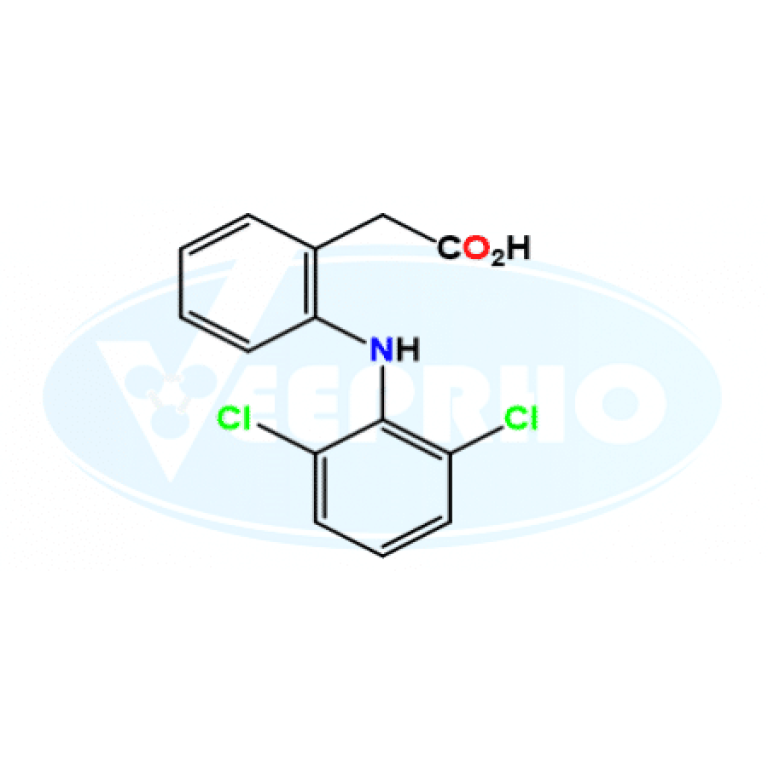
The sodium salt is a separate material with a different CAS and catalogue number. It belongs in the same analytical conversation but should not be described as the free acid.

Impurity I: the diclofenac lactam
In the 2014 combination-tablet study, impurity I was one of the major aceclofenac-related peaks after basic hydrolysis. Its structure is a cyclic lactam, 1-(2,6-dichlorophenyl)-1,3-dihydro-2H-indol-2-one, rather than another salt of diclofenac. [2]

Impurities B and D in the tablet experiment
The 2014 RP-LC study also reported aceclofenac impurities B and D among the degradants, without assigning a specific stress condition to either in the results text. B is diclofenac methyl ester, while D is aceclofenac methyl ester. These are observed peaks in the stressed tablet, not a measured sequence of reactions between the esters. [2]


Choosing a reference material for the analytical question
If a hydrolysis experiment shows a major peak, diclofenac free acid is the structurally relevant first comparison in the cited 2008 work. If a combination-tablet stress chromatogram contains additional resolved peaks, the 2014 study provides a published starting set that includes the lactam and two methyl esters. The analyst still has to confirm the identity in the actual matrix and use the current product specification for the intended assay. [1] [2]
Frequently asked technical questions
What is the main degradation product of aceclofenac?
Diclofenac was the major identified product in Bhinge and colleagues’ 2008 forced-degradation assay. The authors confirmed it by comparison with a diclofenac standard. [1]
Does aceclofenac degrade under light?
In the 2008 study, aceclofenac degraded under light in solution but remained stable under the tested photolytic stress in solid form. The matrix and exposure conditions therefore matter. [1]
Which aceclofenac impurities appeared after basic hydrolysis of a tablet?
In the cited aceclofenac and thiocolchicoside tablet study, diclofenac and impurity I were the major aceclofenac degradants reported after basic hydrolysis. [2]
Is aceclofenac impurity I the same as diclofenac?
No. Impurity I is the cyclic diclofenac lactam with CAS 15362-40-0. Diclofenac free acid has CAS 15307-86-5 and retains the carboxylic-acid group. [2]
Are aceclofenac EP impurity A free acid and its sodium salt interchangeable?
They are different chemical forms with separate catalogue numbers and CAS identifiers. Select the specified form for the analytical method and confirm its current documentation on the linked product page.
References
- Bhinge JR, Kumar RV, Sinha VR. A simple and sensitive stability-indicating RP-HPLC assay method for the determination of aceclofenac. Journal of Chromatographic Science. 2008;46(5):440-444. doi:10.1093/chromsci/46.5.440.
- Karbhari PA, Joshi SJ, Bhoir SI. RP-LC gradient elution method for simultaneous determination of thiocolchicoside, aceclofenac and related impurities in tablet formulation. Journal of Pharmacy and Bioallied Sciences. 2014;6(4):246-252. doi:10.4103/0975-7406.142955.
- National Center for Biotechnology Information. PubChem: Aceclofenac (CID 71771). Chemical identity and structure record.

