

- 100 % Datengenauigkeit
- Wissenschaftlicher Support rund um die Uhr
- 0 % Toleranz bei der Produktqualität
Lagerstandorte
- New Jersey, USA
- Tschechien, EU
* Bestand vorbehaltlich Verfügbarkeit.
Dokumentation
Enthält: HPLC, MASS/LC-MS, 1H-NMR, FT-IR, Gehalt, Structure Elucidation Report (SER) sowie zusätzliche analytische Daten je nach Produkt.
58-08-2
Theophylline EP Impurity A
● In Stock
| Katalog-Nr.: | VL3710002 |
|---|---|
| CAS-Nr.: | 58-08-2 |
| Summenformel: | C8H10N4O2 |
| Molare Masse: | 194.19 g/mol |
For laboratory use only: analytical, development and regulatory purposes. Supplied in mg quantities. Not for human or veterinary use.
Angebot für ein Set anfordern
- Angebot für dieses Set anfragen
Alle EP-Verunreinigungen von Theophylline
6 ProdukteDie 6 Produkte ansehen
- Theophylline EP Impurity A VL3710002
CAS 58-08-2 - Theophylline EP Impurity B VE006962
CAS 1076-22-8 - Theophylline EP Impurity C VE008571
CAS 7597-60-6 - Theophylline EP Impurity D (HCl Salt) VE0023640
CAS 116131-08-9 - Theophylline EP Impurity E VE006974
CAS 944-73-0 - Theophylline EP Impurity F VE009294
CAS 519-37-9
- Theophylline EP Impurity A VL3710002


Zusätzliche Informationen zu CAS 58-08-2
| Wirkstoff | Theophylline |
|---|---|
| Produkttyp | Verunreinigungsstandards |
| IUPAC-Name | 1,3,7-trimethyl-3,7-dihydro-1H-purine-2,6-dione |
| Name im EP | Theophylline EP Impurity A / Dimenhydrinate EP Impurity C / Pentoxifylline EP Impurity F |
| SMILES | Cn1c(=O)c2c(ncn2C)n(C)c1=O |
| InChIKey | RYYVLZVUVIJVGH-UHFFFAOYSA-N |
| CHNS-Verhältnis (%) (berechnet) | C 49.48 · H 5.19 · N 28.85 · S 0.00 |
| Beschreibung | CAS 58-08-2 bezeichnet Coffein, 1,3,7-Trimethylxanthin, ein Methylxanthin mit der Formel C8H10N4O2 und einer Molmasse von 194,19 g/mol. Im Kontext der Verunreinigungscharakterisierung ist es als strukturverwandtes Xanthinderivat relevant, das als verwandte Substanz, prozessbedingter Eintrag oder Kompositionsmarker in Matrizes im Umfeld von Theophyllin-, Pentoxifyllin- und Dimenhydrinat-Referenzmaterialien auftreten kann. Der planare heteroaromatische Kern liefert UV-Aktivität, jedoch nur begrenzte chromatographische Selektivität, weshalb die Bestätigung typischerweise HPLC mit Diodenarray-Detektion und LC-MS/MS erfordert, während GC-MS bei geeigneter Derivatisierung eingesetzt wird. Regulatorisch stehen Identität, Relativansprechen und Trennung nah verwandter Methylxanthine im Vordergrund. |
Angebot anfordern
"*" kennzeichnet Pflichtfelder
Weitere Produkte zu Theophylline Verunreinigungen
| Struktur der Verunreinigung | Name der Verunreinigung | Katalog-Nr. |
|---|---|---|
| Theophylline EP Impurity B | VE006962 | |
| Theophylline EP Impurity C | VE008571 | |
| Theophylline EP Impurity D (HCl Salt) | VE0023640 | |
| Theophylline EP Impurity E | VE006974 | |
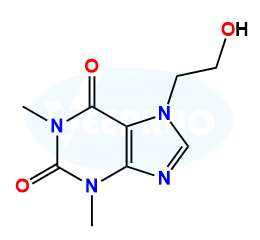 | Theophylline EP Impurity F | VE009294 |
| 1-Methyl Xanthine | VE0021609 | |
| 7-Ethyl Theophylline | VE0027128 | |
| 7-Methylxanthin | VE0017869 | |
| N-Nitroso Theophylline | VE0011721 | |
| N-Nitroso-8-Chlorotheophylline | VE0022877 | |
| N7-Nitroso Theophylline | VE0024194 | |
| 2-Bromoethyl Acetate | VE0020229 |
Alle verwandten Produkte zeigen N-Nitroso-Theophylline-Verunreinigungen (3)