
- 100 % Datengenauigkeit
- Wissenschaftlicher Support rund um die Uhr
- 0 % Toleranz bei der Produktqualität
Lagerstandorte
- New Jersey, USA
- Tschechien, EUAuf Lager
* Bestand vorbehaltlich Verfügbarkeit.
Dokumentation
Chargen-COA vorhanden. Das Chargen-COA enthält HPLC, MASS/LC-MS, 1H NMR, FT-IR, Potency, and Structure Elucidation Report (SER)..
519-37-9
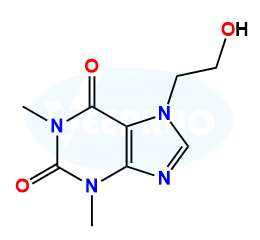
Theophylline EP Impurity F
● Auf Lager
| Katalog-Nr.: | VE009294 |
|---|---|
| CAS-Nr.: | 519-37-9 |
| Summenformel: | C9H12N4O3 |
| Molare Masse: | 224.22 g/mol |
For laboratory use only: analytical, development and regulatory purposes. Supplied in mg quantities. Not for human or veterinary use.
Angebot für ein Set anfordern
- Angebot für dieses Set anfragen
Alle EP-Verunreinigungen von Diprophylline
4 ProdukteDie 4 Produkte ansehen
- Caffeine EP Impurity A VL3710003
CAS 58-55-9 - Diprophylline EP Impurity A VE005962
CAS 6736-40-9 - Diprophylline EP Impurity D VE0023252
CAS 603-00-9 - Theophylline EP Impurity F VE009294
CAS 519-37-9
- Caffeine EP Impurity A VL3710003
- Angebot für dieses Set anfragen
Alle USP-Verunreinigungen von Diprophylline
2 ProdukteDie 2 Produkte ansehen
- Caffeine EP Impurity A VL3710003
CAS 58-55-9 - Theophylline EP Impurity F VE009294
CAS 519-37-9
- Caffeine EP Impurity A VL3710003
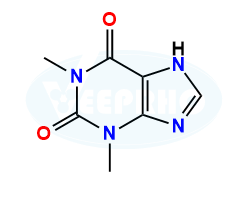
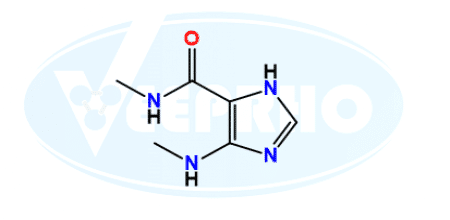
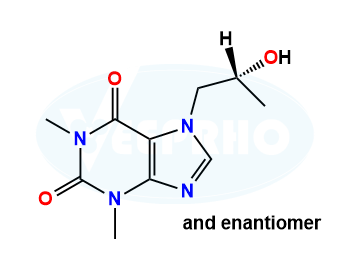
Zusätzliche Informationen zu CAS 519-37-9
| Wirkstoff | Diprophylline / Theophylline |
|---|---|
| Produkttyp | Verunreinigungsstandards |
| IUPAC-Name | 7-(2-Hydroxyethyl)-1,3-dimethyl-3,7-dihydro-1H-purine-2,6-dione |
| Name im EP | Theophylline EP Impurity F/ Diprophylline EP Impurity C |
| Name in der USP | Theophylline Related Compound F |
| Arzneibuch-Synonyme | Diprophylline EP Impurity C; Theophylline Related Compound F |
| Weitere Synonyme | Etofylline; 7-(2-Hydroxyethyl)theophylline; Aethophyllinum; Frekaphyllin; Soluphylline; 1,3-Dimethyl-7-(2-hydroxyethyl)xanthine; 7-hydroxyethyltheophylline; 7-Theophyllineethanol; Hydroxyethyl theophylline; Theophylline, 7-(2-hydroxyethyl)-; BETA-HYDROXYETHYL THEOPHYLLINE; Doxophylline metabolite m4; 3,7-Dihydro-7-(2-hydroxyethyl)-1,3-dimethyl-1H-purine-2,6-dione |
| SMILES | O=C(N1C)N(C)C2=C(N(CCO)C=N |
| InChI | InChI=1S/C9H12N4O3/c1-11-7-6(8(15)12(2)9(11)16)13(3-4-14)5-10-7/h5,14H,3-4H2,1-2H3 |
| CHNS-Verhältnis (%) (berechnet) | C 48.21 · H 5.39 · N 24.99 · S 0.00 |
| Versandbedingung | Ambient Temperature |
| Zusätzliche Charakterisierungsdaten | QNMR, D2O Exchange, 13C NMR, 13C APT, COSY NMR, NOESY NMR, 15N NMR, HSQC NMR, HMQC NMR, and HMBC NMR. These are available upon request and may be free or subject to additional charges. |
| Beschreibung | Theophyllin EP-Impurity F, auch Theophylline Related Compound F, Diprophylline EP Impurity C und Etofylline genannt, ist 7-(2-Hydroxyethyl)theophyllin (CAS 519-37-9), ein Methylxanthin-Derivat mit der Summenformel C9H12N4O3 und einer Molekülmasse von 224,22 g/mol. Die Verbindung ist ein strukturverwandtes Verunreinigungsprofil und potenzielles Biotransformationsprodukt von Theophyllin-Analoga, einschließlich Doxophyllin-Metaboliten. Die polare Hydroxyethyl-Substitution beeinflusst Retention und Ionisierung, sodass häufig LC-MS/MS oder HPLC mit Diodenarray-Detektion zur Trennung und Quantifizierung erforderlich sind, ergänzt durch LC-HRMS für Spurenanalysen. Regulatorisch steht die Identitätszuordnung und das quantitative Verunreinigungsprofil im Vordergrund. |
Angebot anfordern
"*" kennzeichnet Pflichtfelder