
- 100% accuracy of data
- 24/7 scientific support
- 0% tolerance in quality of product
Stock Locations
- New Jersey, USA
- Czech Republic, EU
* Stock subject to availability.
Documentation
Includes: HPLC, MASS/LC-MS, 1H NMR, FT-IR, Potency, Structure Elucidation Report (SER), and additional analytical data depending on the product.
1422262-97-2
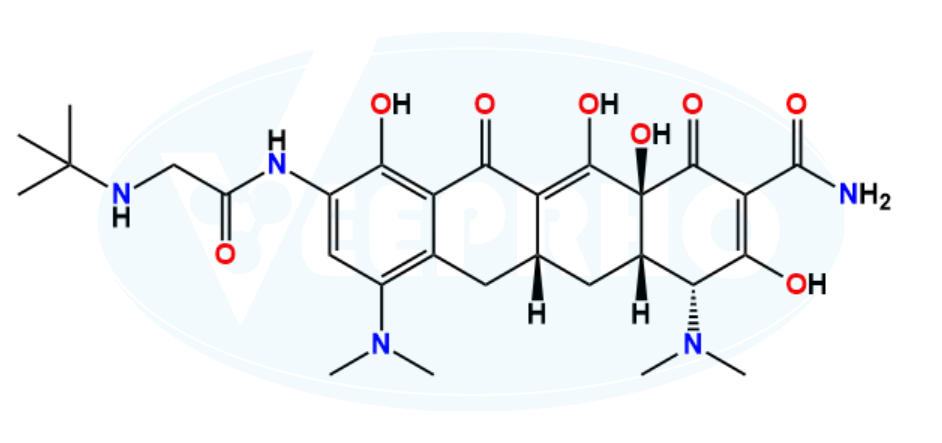
Tigecycline EP Impurity A
● In Stock
| Catalogue No.: | VE0012368 |
|---|---|
| CAS No.: | 1422262-97-2 |
| Mol. Formula: | C29H39N5O8 |
| Mol. Weight: | 585.7 g/mol |
For laboratory use only: analytical, development and regulatory purposes. Supplied in mg quantities. Not for human or veterinary use.
Request a quote for a set
- Request quote for this set
All EP impurities of Tigecycline
4 productsSee the 4 products
- Tigecycline EP Impurity A VE0012368
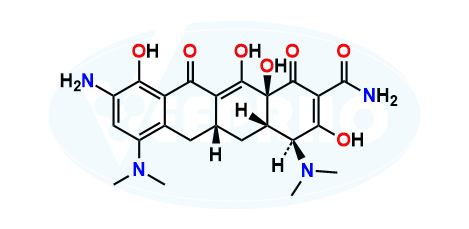
CAS 1422262-97-2 - Tigecycline EP Impurity B (Free Base) VE0022244
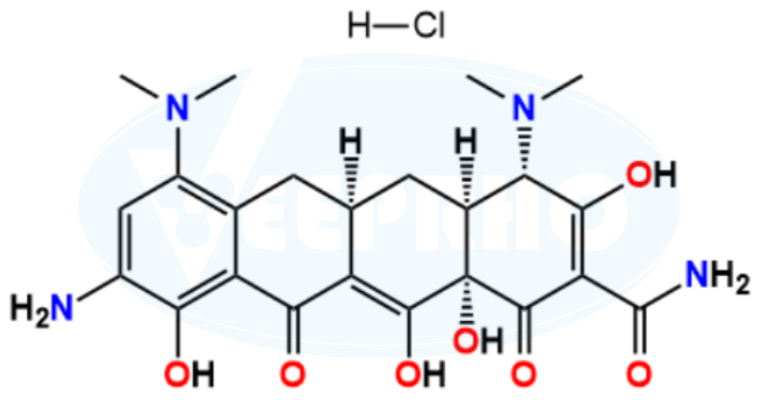
CAS 149934-19-0 - Tigecycline EP Impurity B (HCl Salt) VE0013881
CAS 149934-21-4 - Tigecycline EP Impurity C VE0018835
CAS 10118-90-8
- Tigecycline EP Impurity A VE0012368
Additional information on CAS 1422262-97-2
| Parent drug | Tigecycline |
|---|---|
| Product type | Impurity standards |
| IUPAC name | (4R,4aS,5aR,12aS)-9-[2-(tert-butylamino)acetamido]-4,7-bis(dimethylamino)-3,10,12,12a-tetrahydroxy-1,11-dioxo-1,4,4a,5,5a,6,11,12a-octahydrotetracene-2-carboxamide |
| EP name | Tigecycline EP Impurity A |
| SMILES | CN(C)c1cc(NC(=O)CNC(C)(C)C)c(O)c2c1C[C@H]1C[C@H]3[C@@H](N(C)C)C(=O)C(C(N)=O)=C(O)[C@@]3(O)C(=O)C1=C2O |
| InChIKey | SOVUOXKZCCAWOJ-RXEYFDPISA-N |
| CHNS Ratio (%) (calculated) | C 59.47 · H 6.71 · N 11.96 · S 0.00 |
| References | - |
| Description | Tigecycline EP Impurity A, also designated tigecycline epimer, CAS 1422262-97-2, is a stereochemical impurity arising from epimerization at a chiral center of the glycylcycline scaffold rather than from introduction of a new functional group. The compound retains the tetracyclic core and polyoxygenated side chain of tigecycline, with molecular formula C29H39N5O8 and molecular weight 585.7 g/mol. Its formation is typically associated with acidic, basic, or thermal stress during synthesis or storage. Structural assignment and quantification generally require orthogonal methods such as LC-MS/MS, high-resolution LC-MS, and chiral or reversed-phase HPLC, with NMR used for definitive configurational confirmation. |
Request a Quote
"*" indicates required fields
Other products related to Tigecycline impurities
| Impurity structure | Name of Impurity | Catalogue No. |
|---|---|---|
| Tigecycline EP Impurity B (Free Base) | VE0022244 | |
| Tigecycline EP Impurity B (HCl Salt) | VE0013881 | |
| Tigecycline EP Impurity C | VE0018835 | |
 | Tigecycline Related Compound B | VE009861 |
| 2-(tert-butylamino)acetic acid | VZA000059 | |
| N-Nitroso Desmethyl Tigecycline 1 | VE0017341 | |
| N-Nitroso Desmethyl Tigecycline 2 | VE0017343 | |
| N-Nitroso Tigecycline | VE008528 | |
| Tigecycline 12-oxo-11-hydroxy | VE0016867 | |
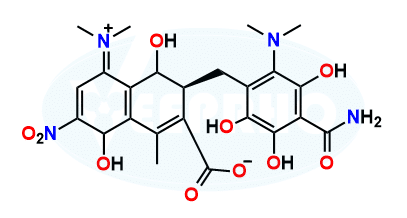 | Tigecycline Impurity 2 | VE0017052 |
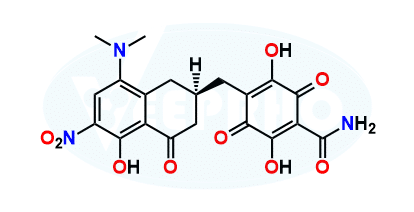 | Tigecycline Impurity 3 | VE0017049 |
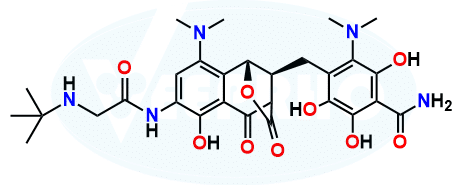 | Tigecycline Impurity 11 | VE0017053 |
Show all related products N-Nitroso Tigecycline impurities (3)