
- 100% accuracy of data
- 24/7 scientific support
- 0% tolerance in quality of product
Stock Locations
- New Jersey, USA
- Czech Republic, EU
* Stock subject to availability.
Documentation
Includes: HPLC, MASS/LC-MS, 1H NMR, FT-IR, Potency, Structure Elucidation Report (SER), and additional analytical data depending on the product.
149934-21-4
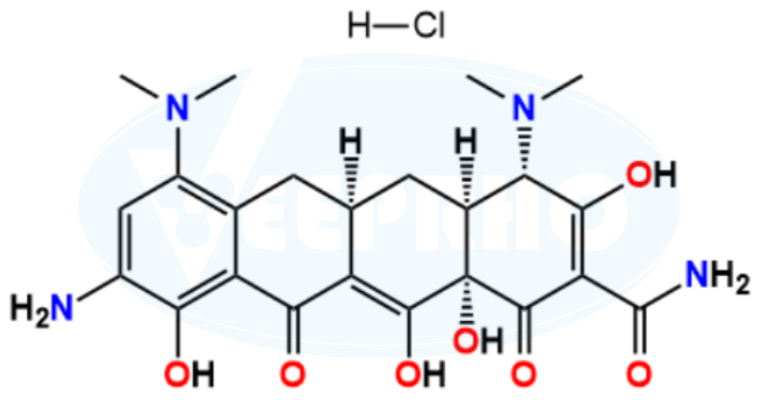
Tigecycline EP Impurity B (HCl Salt)
● In Stock
| Catalogue No.: | VE0013881 |
|---|---|
| CAS No.: | 149934-21-4 |
| Mol. Formula: | C23H29ClN4O7 |
| Mol. Weight: | 508.95 g/mol |
For laboratory use only: analytical, development and regulatory purposes. Supplied in mg quantities. Not for human or veterinary use.
Request a quote for a set
- Request quote for this set
All EP impurities of Tigecycline
4 productsSee the 4 products
- Tigecycline EP Impurity A VE0012368
CAS 1422262-97-2 - Tigecycline EP Impurity B (Free Base) VE0022244
CAS 149934-19-0 - Tigecycline EP Impurity B (HCl Salt) VE0013881
CAS 149934-21-4 - Tigecycline EP Impurity C VE0018835
CAS 10118-90-8
- Tigecycline EP Impurity A VE0012368
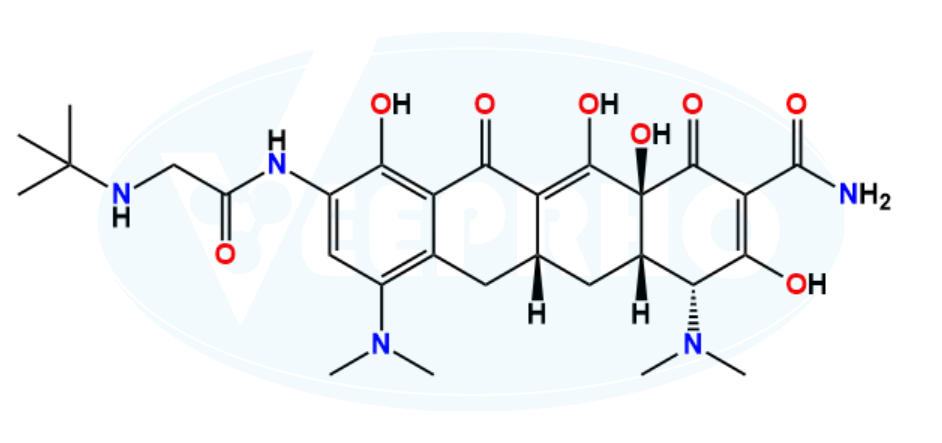
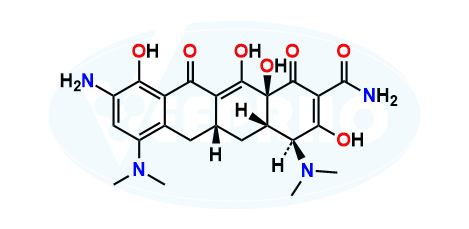
Additional information on CAS 149934-21-4
| Parent drug | Tigecycline |
|---|---|
| Product type | Impurity standards |
| IUPAC name | (4S,4aS,5aR,12aS)-9-Amino-4,7-bis(dimethylamino)-1,4,4a,5,5a,6,11,12a-octahydro-3,10,12,12a-tetrahydroxy-1,11-dioxo-2-naphthacenecarboxamide hydrochloride |
| EP name | Tigecycline EP Impurity B |
| Other Synonyms | 9-Aminominocycline;2-Naphthacenecarboxamide; |
| SMILES | O=C(C(C1=O)=C(O)[C@@H](N(C)C)[C@]2([H])C[C@]3([H])CC4=C(C(C3=C(O)[C@@]21O)=O)C(O)=C(N)C=C4N(C)C)N.[H]Cl |
| InChI | InChI=1S/C23H28N4O7.ClH/c1-26(2)12-7-11(24)17(28)14-9(12)5-8-6-10-16(27(3)4)19(30)15(22(25)33)21(32)23(10,34)20(31)13(8)18(14)29;/h7-8,10,16,28,30-31,34H,5-6,24H2,1-4H3,(H2,25,33);1H/t8-,10-,16-,23-;/m0./s1 |
| InChIKey | KYFXMIINWSZGCG-KBTHSJHISA-N |
| CHNS Ratio (%) (calculated) | C 54.28 · H 5.74 · N 11.01 · S 0.00 |
| References | - |
| Description | Tigecycline EP Impurity B (HCl salt), CAS 149934-21-4, is 9-aminominocycline, a tetracycline-derived process-related impurity and structural degrading species associated with aminolysis or deacylation at the C9 amide functionality of the tigecycline scaffold. Its molecular formula, C23H29ClN4O7, and molecular weight, 508.95 g/mol, reflect the protonated hydrochloride form used for isolation and characterization. Because of close structural similarity to the parent antibiotic, chromatographic resolution is often challenging and typically requires LC-MS/MS, high-resolution LC-MS, and orthogonal HPLC-UV methods; confirmatory impurity profiling may also employ NMR and, where needed, ion-pair LC methods. |
Request a Quote
"*" indicates required fields
Other products related to Tigecycline impurities
| Impurity structure | Name of Impurity | Catalogue No. |
|---|---|---|
| Tigecycline EP Impurity A | VE0012368 | |
| Tigecycline EP Impurity B (Free Base) | VE0022244 | |
| Tigecycline EP Impurity C | VE0018835 | |
 | Tigecycline Related Compound B | VE009861 |
| 2-(tert-butylamino)acetic acid | VZA000059 | |
| N-Nitroso Desmethyl Tigecycline 1 | VE0017341 | |
| N-Nitroso Desmethyl Tigecycline 2 | VE0017343 | |
| N-Nitroso Tigecycline | VE008528 | |
| Tigecycline 12-oxo-11-hydroxy | VE0016867 | |
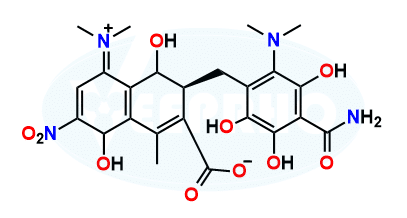 | Tigecycline Impurity 2 | VE0017052 |
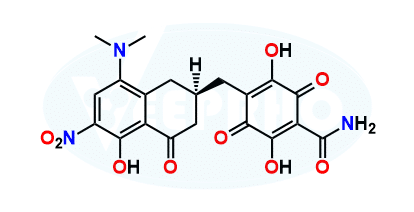 | Tigecycline Impurity 3 | VE0017049 |
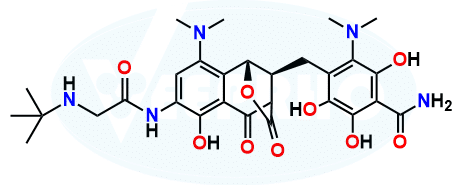 | Tigecycline Impurity 11 | VE0017053 |
Show all related products N-Nitroso Tigecycline impurities (3)