

- 100% accuracy of data
- 24/7 scientific support
- 0% tolerance in quality of product
Stock Locations
- New Jersey, USA
- Czech Republic, EU
* Stock subject to availability.
Documentation
Includes: HPLC, MASS/LC-MS, 1H NMR, FT-IR, Potency, Structure Elucidation Report (SER), and additional analytical data depending on the product.
1309457-19-9
2-Hydroxyalmotriptan
● Under Development
| Catalogue No.: | VE0021434 |
|---|---|
| CAS No.: | 1309457-19-9 |
| Mol. Formula: | C17H25N3O3S |
| Mol. Weight: | 351.47 g/mol |
For laboratory use only: analytical, development and regulatory purposes. Supplied in mg quantities. Not for human or veterinary use.
Request a quote for a set
- Request quote for this set
All USP impurities of Almotriptan
9 productsSee the 9 products
- Almotriptan EP Impurity A VE0025047
- Almotriptan EP Impurity D (Fumarate Salt) VE0025037
CAS 1246860-65-0 - Almotriptan N-Oxide VE0012135
- Almotriptan Related Compound A VL264001
CAS 1018676-02-2 - Almotriptan Related Compound B VL264002
CAS 181178-24-5 - Almotriptan Related Compound C VL264003
CAS 334981-12-3 - Almotriptan Related Compound D VL264004
- Spiro Almotriptan VL264011
CAS 1309457-18-8 - 2-Hydroxyalmotriptan VE0021434
CAS 1309457-19-9
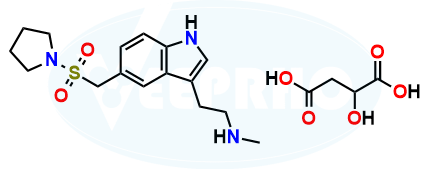


Additional information on CAS 1309457-19-9
| Parent drug | Almotriptan |
|---|---|
| Product type | Impurity standards |
| IUPAC name | 3-(2-(Dimethylamino)ethyl)-5-((pyrrolidin-1-ylsulfonyl)methyl)-1H-indol-2-ol |
| USP name | 2-Hydroxyalmotriptan |
| SMILES | CN(C)CCc1c(O)[nH]c2ccc(CS(=O)(=O)N3CCCC3)cc12 |
| InChIKey | WOKGJBXGULUOGW-UHFFFAOYSA-N |
| CHNS Ratio (%) (calculated) | C 58.10 · H 7.17 · N 11.96 · S 9.12 |
| Description | 2-Hydroxyalmotriptan (CAS 1309457-19-9) is a process-related impurity observed during almotriptan synthesis, characterized by a hydroxy substitution on the indole-propyl side chain. Analytical characterization includes HPLC retention behavior, LC-MS accurate mass confirmation, and NMR for structural assignment, with UV chromophores affecting detection sensitivity. It can arise from incomplete deprotection or oxidative hydroxylation pathways and may impact assay, stability, and impurity profiling if not controlled. Recommended control strategies include validated HPLC methods, reference standard qualification, ICH Q3A/B thresholds, and targeted purification to ensure batch consistency and regulatory compliance. |
Request a Quote
"*" indicates required fields
Other products related to Almotriptan impurities
| Impurity structure | Name of Impurity | Catalogue No. |
|---|---|---|
| Almotriptan EP Impurity A | VE0025047 | |
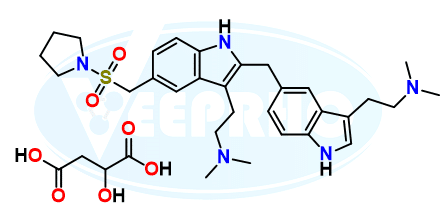 | Almotriptan EP Impurity B Malate | VE0012096 |
| Almotriptan EP Impurity C (2-hydroxysuccinic acid Salt) | VE0025880 | |
| Almotriptan EP Impurity D (Fumarate Salt) | VE0025037 | |
 | Almotriptan EP Impurity F Malate | VE0012097 |
| Almotriptan Related Compound A | VL264001 | |
| Almotriptan Related Compound B | VL264002 | |
| Almotriptan Related Compound C | VL264003 | |
 | Almotriptan Related Compound D | VL264004 |
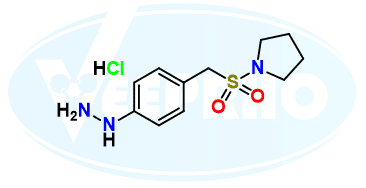 | Almotriptan Hydrazine Precursor HCl | VE0012095 |
| Almotriptan Impurity 1 | VE0012098 | |
| Almotriptan Impurity 4 | VE0012099 |
Show all related products N-Nitroso Almotriptan impurities (4)