
- 100% accuracy of data
- 24/7 scientific support
- 0% tolerance in quality of product
Stock Locations
- New Jersey, USA
- Czech Republic, EU
* Stock subject to availability.
Documentation
Includes: HPLC, MASS/LC-MS, 1H NMR, FT-IR, Potency, Structure Elucidation Report (SER), and additional analytical data depending on the product.
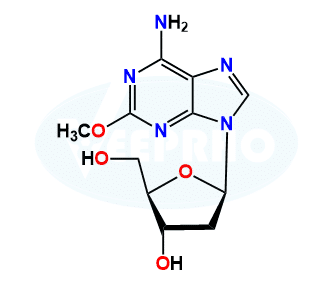
24757-70-8
Cladribine EP Impurity B
● In Stock
| Catalogue No.: | VE0013734 |
|---|---|
| CAS No.: | 24757-70-8 |
| Mol. Formula: | C11H15N5O4 |
| Mol. Weight: | 281.27 g/mol |
For laboratory use only: analytical, development and regulatory purposes. Supplied in mg quantities. Not for human or veterinary use.
Request a quote for a set
- Request quote for this set
All EP impurities of Cladribine
7 productsSee the 7 products
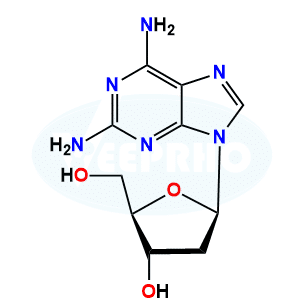
- Cladribine EP Impurity A VE0013733
CAS 4546-70-7 - Cladribine EP Impurity B VE0013734
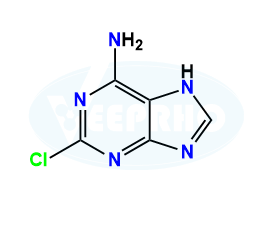
CAS 24757-70-8 - Cladribine EP Impurity C VE0013729
CAS 1839-18-5 - Cladribine EP Impurity D VE0013730
CAS 5542-92-7 - Cladribine EP Impurity E (Free Base) VE0027623
CAS 1831121-84-6 - Cladribine EP Impurity F VE0013731
CAS 619-55-6 - Cladribine EP Impurity G VE0013732
CAS 99-75-2
- Cladribine EP Impurity A VE0013733
Additional information on CAS 24757-70-8
| Parent drug | Cladribine |
|---|---|
| Product type | Impurity standards |
| IUPAC name | 9-(2-deoxy-β- D -erythro-pentofuranosyl)-2-methoxy-9H-purin-6-amine |
| EP name | Cladribine EP Impurity B |
| SMILES | COc1nc(N)c2ncn([C@H]3C[C@H](O)[C@@H](CO)O3)c2n1 |
| InChIKey | HGRICISHTIAZJG-RRKCRQDMSA-N |
| CHNS Ratio (%) (calculated) | C 46.97 · H 5.38 · N 24.90 · S 0.00 |
| References | - |
| Description | Cladribine EP Impurity B, CAS 24757-70-8, is a nucleoside-related process impurity associated with the purine analog framework of cladribine. With molecular formula C11H15N5O4 and molecular weight 281.27 g/mol, it requires structural assignment by high-resolution LC-MS and confirmatory LC-MS/MS, often complemented by NMR when reference material is available. Its appearance is typically linked to synthetic route heterogeneity or deprotection and glycosylation side reactions rather than environmental degradation. In a regulatory context, such impurities are assessed under pharmacopeial impurity specifications and ICH Q3A/Q3B principles, with chromatographic separation often relying on reversed-phase HPLC and orthogonal mass spectrometric detection. |
Request a Quote
"*" indicates required fields