
- 100% accuracy of data
- 24/7 scientific support
- 0% tolerance in quality of product
Stock Locations
- New Jersey, USA
- Czech Republic, EU
* Stock subject to availability.
Documentation
Includes: HPLC, MASS/LC-MS, 1H NMR, FT-IR, Potency, Structure Elucidation Report (SER), and additional analytical data depending on the product.
5542-92-7
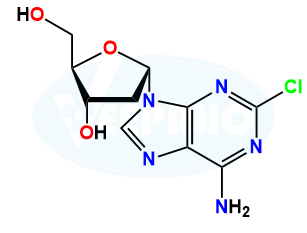
Cladribine EP Impurity D
● In Stock
| Catalogue No.: | VE0013730 |
|---|---|
| CAS No.: | 5542-92-7 |
| Mol. Formula: | C10H12ClN5O3 |
| Mol. Weight: | 285.69 g/mol |
For laboratory use only: analytical, development and regulatory purposes. Supplied in mg quantities. Not for human or veterinary use.
Request a quote for a set
- Request quote for this set
All EP impurities of Cladribine
7 productsSee the 7 products
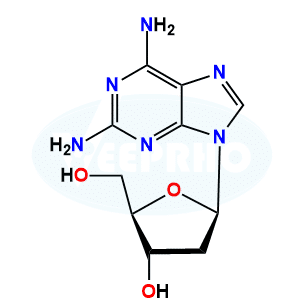
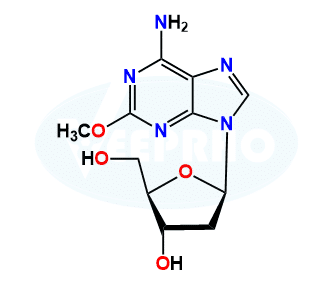
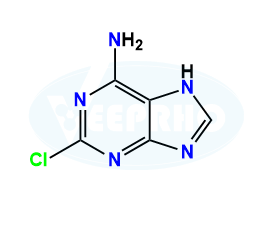
- Cladribine EP Impurity A VE0013733
CAS 4546-70-7 - Cladribine EP Impurity B VE0013734
CAS 24757-70-8 - Cladribine EP Impurity C VE0013729
CAS 1839-18-5 - Cladribine EP Impurity D VE0013730
CAS 5542-92-7 - Cladribine EP Impurity E (Free Base) VE0027623
CAS 1831121-84-6 - Cladribine EP Impurity F VE0013731
CAS 619-55-6 - Cladribine EP Impurity G VE0013732
CAS 99-75-2
- Cladribine EP Impurity A VE0013733
Additional information on CAS 5542-92-7
| Parent drug | Cladribine |
|---|---|
| Product type | Impurity standards |
| IUPAC name | 2-chloro-9-(2-deoxy-α- D -erythro-pentofuranosyl)-9H-purin-6-amine |
| EP name | Cladribine EP Impurity D |
| SMILES | Nc1nc(Cl)nc2c1ncn2[C@@H]1C[C@H](O)[C@@H](CO)O1 |
| InChIKey | PTOAARAWEBMLNO-JKUQZMGJSA-N |
| CHNS Ratio (%) (calculated) | C 42.04 · H 4.23 · N 24.51 · S 0.00 |
| References | - |
| Description | Cladribine EP Impurity D, CAS 5542-92-7, is a chlorinated purine nucleoside related to the cladribine scaffold and may arise as a synthetic or degradative related substance during halogenated nucleoside manufacture. Its molecular formula, C10H12ClN5O3, corresponds to a molecular weight of 285.69 g/mol. The structure is expected to show polar chromatographic behavior, multiple ionization sites, and strong UV response. Trace-level determination commonly requires RP-HPLC coupled with LC-MS/MS or high-resolution MS, with confirmatory characterization by NMR when necessary. In an ICH M7 context, impurity profiling should consider potential structural alerts and route-specific formation. |
Request a Quote
"*" indicates required fields