

- 100% accuracy of data
- 24/7 scientific support
- 0% tolerance in quality of product
Stock Locations
- New Jersey, USA
- Czech Republic, EU
* Stock subject to availability.
Documentation
Includes: HPLC, MASS/LC-MS, 1H NMR, FT-IR, Potency, Structure Elucidation Report (SER), and additional analytical data depending on the product.
620181-05-7
Clindamycin Phosphate EP Impurity L
● In Stock
| Catalogue No.: | VE005873 |
|---|---|
| CAS No.: | 620181-05-7 |
| Mol. Formula: | C18H34ClN2O8PS |
| Mol. Weight: | 504.96 g/mol |
For laboratory use only: analytical, development and regulatory purposes. Supplied in mg quantities. Not for human or veterinary use.
Request a quote for a set
- Request quote for this set
All EP impurities of Clindamycin
18 productsSee the 18 products
- Clindamycin EP Impurity C VE0011459
CAS 16684-06-3 - Clindamycin HCl EP Impurity B VE006944
CAS 18323-43-8 - Clindamycin Hydrochloride EP Impurity B (Hydrochloride Salt) VE0021230
CAS 68225-58-1 - Clindamycin Hydrochloride EP Impurity F (Free Base) VE008211
- Clindamycin Phosphate EP Impurity A VL1030001
CAS 154-21-2 - Clindamycin Phosphate EP Impurity C VL1030003
CAS 28708-34-1 - Clindamycin Phosphate EP Impurity D VE005869
CAS 54887-30-8 - Clindamycin Phosphate EP Impurity E (Free Base) VL1030009
CAS 18323-44-9 - Clindamycin Phosphate EP Impurity E (HCl salt) VL1030007
CAS 21462-39-5 - Clindamycin Phosphate EP Impurity F VL1030010
CAS 27480-30-4 - Clindamycin Phosphate EP Impurity G VE006094
- Clindamycin Phosphate EP Impurity H VE005867
- Clindamycin Phosphate EP Impurity I VE005868
CAS 1309048-48-3 - Clindamycin Phosphate EP Impurity J VE005870
CAS 1309349-64-1 - Clindamycin Phosphate EP Impurity K VL1030005
- Clindamycin Phosphate EP Impurity L VE005873
CAS 620181-05-7 - Clindamycin Phosphate EP Impurity Q VE0010565
- 2'-Cis-Clindamycin VE009162
CAS 1440605-46-8
- Clindamycin EP Impurity C VE0011459
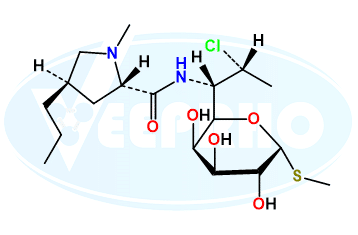

Additional information on CAS 620181-05-7
| Parent drug | Clindamycin |
|---|---|
| Product type | Impurity standards |
| IUPAC name | Methyl 7-chloro-6,7,8-trideoxy-6-[[[(2S,4R)-1-methyl-4-propylpyrrolidin-2-yl] carbonyl]amino]-2-O-phosphono-1-thio-D-erythro-α-D-galacto-octopyranoside |
| EP name | Clindamycin phosphate EP Impurity L / 7-Epi Clindamycin 2-phosphate |
| SMILES | CCC[C@@H]1C[C@@H](C(=O)N[C@@H]([C@H]2O[C@H](SC)[C@H](OP(=O)(O)O)[C@@H](O)[C@H]2O)[C@@H](C)Cl)N(C)C1 |
| InChIKey | UFUVLHLTWXBHGZ-AVENPWRCSA-N |
| CHNS Ratio (%) (calculated) | C 42.81 · H 6.79 · N 5.55 · S 6.35 |
| References | Consultation Documents. apps.who.int/iris/bitstream/handle/10665/331019/DI303-414-476-eng.pdf. Accessed 7 Oct. 2021. ‌Kasten, Mary Jo. “Clindamycin, Metronidazole, and Chloramphenicol.†Mayo Clinic Proceedings, vol. 74, no. 8, Aug. 1999, pp. 825–33, https://doi.org/10.4065/74.8.825. ‌ |
| Description | Clindamycin phosphate EP Impurity L, also designated 7-Epi Clindamycin 2-phosphate, is a stereoisomeric related substance of the lincosamide antibiotic clindamycin phosphate. This impurity reflects epimerization at the 7-position of the clindamycin scaffold and may arise during synthesis or under acidic and thermal stress. It has CAS 620181-05-7, molecular formula C18H34ClN2O8PS, and molecular weight 504.96 g/mol. As a pharmacopeial impurity, its assessment relies on chromatographic resolution coupled with LC-MS/MS confirmation, and in complex matrices may require ion-pair LC or high-resolution MS to distinguish it from the parent drug and closely related diastereomers. |
Request a Quote
"*" indicates required fields
Other products related to Clindamycin impurities
| Impurity structure | Name of Impurity | Catalogue No. |
|---|---|---|
| Clindamycin BP Impurity C | VE006945 | |
| Clindamycin EP Impurity C | VE0011459 | |
| Clindamycin HCl EP Impurity B | VE006944 | |
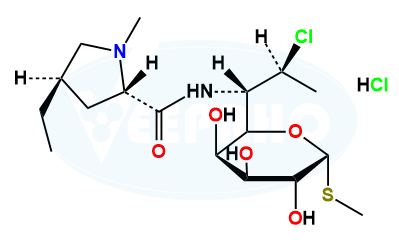 | Clindamycin Hydrochloride EP Impurity B (Hydrochloride Salt) | VE0021230 |
| Clindamycin Hydrochloride EP Impurity F (HCl Salt) | VE0014592 | |
| Clindamycin Phosphate EP Impurity A | VL1030001 | |
| Clindamycin Phosphate EP Impurity C | VL1030003 | |
 | Clindamycin Phosphate EP Impurity D | VE005869 |
| Clindamycin Phosphate EP Impurity E (Free Base) | VL1030009 | |
| Clindamycin Phosphate EP Impurity E (HCl salt) | VL1030007 | |
| Clindamycin Phosphate EP Impurity F | VL1030010 | |
| Clindamycin Phosphate EP Impurity G | VE006094 |