
- 100% accuracy of data
- 24/7 scientific support
- 0% tolerance in quality of product
Mutagenicity assessment (ICH M7)
Treated as a potentially non-mutagenic impurity (ICH M7 Class 4–5).
Computational (in silico) assessmentStock Locations
- New Jersey, USA
- Czech Republic, EU
* Stock subject to availability.
Documentation
Includes: HPLC, MASS/LC-MS, 1H NMR, FT-IR, Potency, Structure Elucidation Report (SER), and additional analytical data depending on the product.
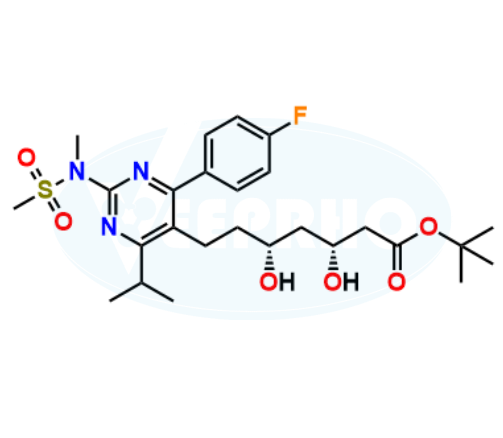
6,7-Dihydro O-Butyl-Rosuvastatin
● In Stock
| Catalogue No.: | VE0026535 |
|---|---|
| CAS No.: | N/A |
| Mol. Formula: | C26H38FN3O6S |
| Mol. Weight: | 539.7 g/mol |
For laboratory use only: analytical, development and regulatory purposes. Supplied in mg quantities. Not for human or veterinary use.
Additional information on 6,7-Dihydro O-Butyl-Rosuvastatin
| Parent drug | Rosuvastatin |
|---|---|
| Product type | Impurity standards |
| IUPAC name | tert-butyl (3R,5R)-7-[4-(4-fluorophenyl)-2-[methyl(methylsulfonyl)amino]-6-propan-2-ylpyrimidin-5-yl]-3,5-dihydroxyheptanoate |
| Other Synonyms | (3R,5R)-t-Butyl 7-(4-(4-Fluorophenyl)-6-isopropyl-2-(N-methylmethylsulfonamido)pyrimidin-5-yl)-3,5-dihydroxyheptanoate |
| SMILES | CC(C)C1=NC(=NC(=C1CC[C@H](C[C@H](CC(=O)OC(C)(C)C)O)O)C2=CC=C(C=C2)F)N(C)S(=O)(=O)C |
| InChI | InChI=1S/C26H38FN3O6S/c1-16(2)23-21(13-12-19(31)14-20(32)15-22(33)36-26(3,4)5)24(17-8-10-18(27)11-9-17)29-25(28-23)30(6)37(7,34)35/h8-11,16,19-20,31-32H,12-15H2,1-7H3/t19-,20-/m1/s1 |
| InChIKey | VAXGNKFGOGWGCI-WOJBJXKFSA-N |
| CHNS Ratio (%) (calculated) | C 57.87 · H 7.10 · N 7.79 · S 5.94 |
| Description | 6,7-Dihydro O-Butyl-Rosuvastatin is a structurally defined process-related impurity characterized as (3R,5R)-t-Butyl 7-(4-(4-Fluorophenyl)-6-isopropyl-2-(N-methylmethylsulfonamido)pyrimidin-5-yl)-3,5-dihydroxyheptanoate. The impurity contains two stereogenic centers, tert-butyl ester and O-butyl moieties and typically originates from incomplete deprotection or inadvertent O-alkylation during esterification steps. Its presence can affect API purity and stability and therefore requires rigorous characterization and control. Recommended analytical approaches include reversed phase HPLC with UV and LC-MS detection for quantitation and monitoring, complemented by 1H/13C NMR and chiral HPLC for structural confirmation. Control strategy follows ICH impurity guidance via synthetic optimization, purification and validated assays. |
Request a Quote
"*" indicates required fields
Other products related to Rosuvastatin impurities
| Impurity structure | Name of Impurity | Catalogue No. |
|---|---|---|
| Rosuvastatin EP Impurity A | VL127008 | |
| Rosuvastatin EP Impurity A (Free Base) | VE0024818 | |
| Rosuvastatin EP Impurity A (Sodium Salt) | VE008146 | |
| Rosuvastatin EP Impurity B (Free Base) | VE0024819 | |
| Rosuvastatin EP Impurity B (Racemic Mixture) | VL127001 | |
| Rosuvastatin EP Impurity C | VL127003 | |
| Rosuvastatin EP Impurity C (Free Base) | VE0011116 | |
| Rosuvastatin EP Impurity C (Sodium Salt) | VE0026666 | |
| Rosuvastatin EP Impurity D | VL127002 | |
| Rosuvastatin EP Impurity E | VL127005 | |
| Rosuvastatin EP Impurity F | VL127004 | |
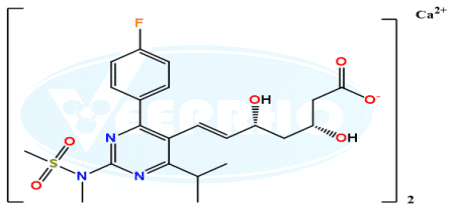 | Rosuvastatin EP Impurity G | VL127009 |
Show all related products N-Nitroso Rosuvastatin impurities (2)