

- 100% accuracy of data
- 24/7 scientific support
- 0% tolerance in quality of product
Mutagenicity assessment (ICH M7)
Treated as a potentially non-mutagenic impurity (ICH M7 Class 4–5).
Computational (in silico) assessmentStock Locations
- New Jersey, USA
- Czech Republic, EUIn stock
* Stock subject to availability.
Documentation
Batch COA on file. The batch COA includes HPLC, MASS/LC-MS, 1H NMR, FT-IR, Potency, and Structure Elucidation Report (SER)..
Rosuvastatin EP Impurity B (Racemic Mixture)
● In Stock
| Catalogue No.: | VL127001 |
|---|---|
| CAS No.: | N/A |
| Mol. Formula: | (C22H27FN3O6S) 2Ca |
| Mol. Weight: | 1001.14 g/mole (481.54g/mole as free) |
For laboratory use only: analytical, development and regulatory purposes. Supplied in mg quantities. Not for human or veterinary use.
Request a quote for a set
- Request quote for this set
All EP impurities of Rosuvastatin
23 productsSee the 23 products
- Rosuvastatin EP Impurity A VL127008
CAS 1714147-47-3 - Rosuvastatin EP Impurity A (Free Base) VE0024818
CAS 1715120-13-0 - Rosuvastatin EP Impurity A (Sodium Salt) VE008146
CAS 1714147-50-8 - Rosuvastatin EP Impurity B (Free Base) VE0024819
CAS 1007912-86-8 - Rosuvastatin EP Impurity B (Racemic Mixture) VL127001
- Rosuvastatin EP Impurity C VL127003
CAS 1422514-05-3 - Rosuvastatin EP Impurity C (Free Base) VE0011116
CAS 1422619-13-3 - Rosuvastatin EP Impurity C (Sodium Salt) VE0026666
CAS 1620823-61-1 - Rosuvastatin EP Impurity D VL127002
CAS 503610-43-3 - Rosuvastatin EP Impurity E VL127005
CAS 2226413-61-0 - Rosuvastatin EP Impurity F VL127004
CAS 289042-12-2 - Rosuvastatin EP Impurity G VL127009
- Rosuvastatin EP Impurity G (Free Base) VE008147
CAS 1242184-42-4 - Rosuvastatin EP Impurity G (Na Salt) VE0026532
- Rosuvastatin EP Impurity H VL127015
CAS 1335110-44-5 - Rosuvastatin EP Impurity I (Sodium Salt) VL127016
- Rosuvastatin EP Impurity J VL127014
- Rosuvastatin EP Impurity K VL127017
- Rosuvastatin EP Impurity L VL127006
CAS 1024064-70-7 - Rosuvastatin EP Impurity M VL127018
- Rosuvastatin EP Impurity M (Free Base) VE006725
CAS 847849-66-5 - Rosuvastatin Ethyl Ester Impurity VL127022
CAS 851443-04-4 - Rosuvastatin FP Impurity B VE006136
- Rosuvastatin EP Impurity A VL127008
- Request quote for this set
All USP impurities of Rosuvastatin
14 productsSee the 14 products
- Rosuvastatin EP Impurity A VL127008
CAS 1714147-47-3 - Rosuvastatin EP Impurity A (Free Base) VE0024818
CAS 1715120-13-0 - Rosuvastatin EP Impurity A (Sodium Salt) VE008146
CAS 1714147-50-8 - Rosuvastatin EP Impurity B (Free Base) VE0024819
CAS 1007912-86-8 - Rosuvastatin EP Impurity B (Racemic Mixture) VL127001
- Rosuvastatin EP Impurity C VL127003
CAS 1422514-05-3 - Rosuvastatin EP Impurity C (Free Base) VE0011116
CAS 1422619-13-3 - Rosuvastatin EP Impurity C (Sodium Salt) VE0026666
CAS 1620823-61-1 - Rosuvastatin EP Impurity D VL127002
CAS 503610-43-3 - Rosuvastatin EP Impurity E VL127005
CAS 2226413-61-0 - Rosuvastatin EP Impurity G VL127009
- Rosuvastatin EP Impurity G (Free Base) VE008147
CAS 1242184-42-4 - Rosuvastatin EP Impurity G (Na Salt) VE0026532
- Rosuvastatin Ethyl Ester Impurity VL127022
CAS 851443-04-4
- Rosuvastatin EP Impurity A VL127008

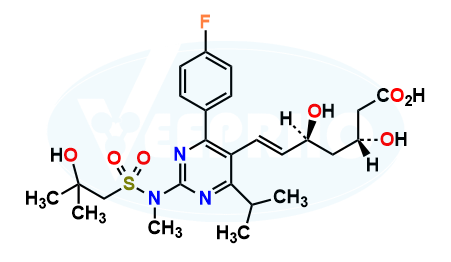
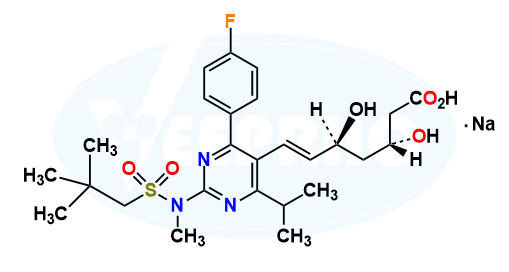
Additional information on Rosuvastatin EP Impurity B (Racemic Mixture)
| Parent drug | Rosuvastatin |
|---|---|
| Product type | Impurity standards |
| IUPAC name | (3RS,5RS,6E)-7-[4-(4-Fluorophenyl)-6-(1-methylethyl)-2-[methyl (methyl sulfonyl)amino]-5-pyrimidinyl]-3,5-dihydroxy- 6-heptenoic acid calcium salt |
| EP name | Rosuvastatin EP Impurity B (Racemic Mixture) |
| USP name | Rosuvastatin Diasteromer |
| SMILES | CC(C)c1nc(N(C)S(C)(=O)=O)nc(-c2ccc(F)cc2)c1/C=C/[C@H](O)C[C@@H](O)CC(=O)O.[Ca+2] |
| InChIKey | XDIJJHVJIZNZGO-HQSWTOJGSA-N |
| Additional characterisation data | QNMR, D2O Exchange, 13C NMR, 13C APT, COSY NMR, NOESY NMR, 15N NMR, HSQC NMR, HMQC NMR, and HMBC NMR. These are available upon request and may be free or subject to additional charges. |
| Description | Rosuvastatin EP Impurity B is the racemic, diastereomeric calcium salt associated with the 3RS,5RS stereochemical configuration of rosuvastatin. With formula (C22H27FN3O6S)2Ca and molecular weight 1001.14 g/mole, corresponding to 481.54 g/mole as the free acid, it represents a stereochemical impurity rather than a covalent degradation product. Such isomeric species may arise during asymmetric synthesis, epimerization, or incomplete stereochemical control in late-stage salt formation. Because separation from the active substance depends on subtle physicochemical differences, quantification typically requires chiral and achiral LC methods, often coupled to LC-MS/MS for confirmatory mass discrimination and impurity profiling under pharmacopeial and ICH impurity control frameworks. |
Request a Quote
"*" indicates required fields
Other products related to Rosuvastatin impurities
| Impurity structure | Name of Impurity | Catalogue No. |
|---|---|---|
| Rosuvastatin EP Impurity A | VL127008 | |
| Rosuvastatin EP Impurity A (Free Base) | VE0024818 | |
| Rosuvastatin EP Impurity A (Sodium Salt) | VE008146 | |
| Rosuvastatin EP Impurity B (Free Base) | VE0024819 | |
| Rosuvastatin EP Impurity C | VL127003 | |
| Rosuvastatin EP Impurity C (Free Base) | VE0011116 | |
| Rosuvastatin EP Impurity C (Sodium Salt) | VE0026666 | |
| Rosuvastatin EP Impurity D | VL127002 | |
| Rosuvastatin EP Impurity E | VL127005 | |
| Rosuvastatin EP Impurity F | VL127004 | |
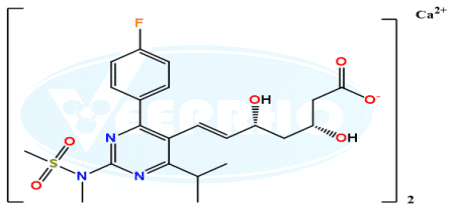 | Rosuvastatin EP Impurity G | VL127009 |
| Rosuvastatin EP Impurity G (Calcium Salt) | VE0026713 |
Show all related products N-Nitroso Rosuvastatin impurities (2)