
- 100% accuracy of data
- 24/7 scientific support
- 0% tolerance in quality of product
Mutagenicity assessment (ICH M7)
Treated as a potentially non-mutagenic impurity (ICH M7 Class 4–5).
Computational (in silico) assessmentStock Locations
- New Jersey, USA
- Czech Republic, EU
* Stock subject to availability.
Documentation
Includes: HPLC, MASS/LC-MS, 1H NMR, FT-IR, Potency, Structure Elucidation Report (SER), and additional analytical data depending on the product.
1714147-50-8
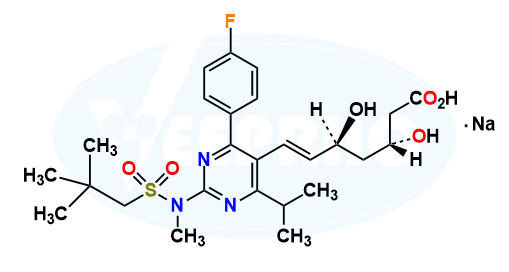
Rosuvastatin EP Impurity A (Sodium Salt)
● In Stock
| Catalogue No.: | VE008146 |
|---|---|
| CAS No.: | 1714147-50-8 |
| Mol. Formula: | C25H33FN3NaO7S |
| Mol. Weight: | 561.6 g/mol |
For laboratory use only: analytical, development and regulatory purposes. Supplied in mg quantities. Not for human or veterinary use.
Request a quote for a set
- Request quote for this set
All EP impurities of Rosuvastatin
23 productsSee the 23 products
- Rosuvastatin EP Impurity A VL127008
CAS 1714147-47-3 - Rosuvastatin EP Impurity A (Free Base) VE0024818
CAS 1715120-13-0 - Rosuvastatin EP Impurity A (Sodium Salt) VE008146
CAS 1714147-50-8 - Rosuvastatin EP Impurity B (Free Base) VE0024819
CAS 1007912-86-8 - Rosuvastatin EP Impurity B (Racemic Mixture) VL127001
- Rosuvastatin EP Impurity C VL127003
CAS 1422514-05-3 - Rosuvastatin EP Impurity C (Free Base) VE0011116
CAS 1422619-13-3 - Rosuvastatin EP Impurity C (Sodium Salt) VE0026666
CAS 1620823-61-1 - Rosuvastatin EP Impurity D VL127002
CAS 503610-43-3 - Rosuvastatin EP Impurity E VL127005
CAS 2226413-61-0 - Rosuvastatin EP Impurity F VL127004
CAS 289042-12-2 - Rosuvastatin EP Impurity G VL127009
- Rosuvastatin EP Impurity G (Free Base) VE008147
CAS 1242184-42-4 - Rosuvastatin EP Impurity G (Na Salt) VE0026532
- Rosuvastatin EP Impurity H VL127015
CAS 1335110-44-5 - Rosuvastatin EP Impurity I (Sodium Salt) VL127016
- Rosuvastatin EP Impurity J VL127014
- Rosuvastatin EP Impurity K VL127017
- Rosuvastatin EP Impurity L VL127006
CAS 1024064-70-7 - Rosuvastatin EP Impurity M VL127018
- Rosuvastatin EP Impurity M (Free Base) VE006725
CAS 847849-66-5 - Rosuvastatin Ethyl Ester Impurity VL127022
CAS 851443-04-4 - Rosuvastatin FP Impurity B VE006136
- Rosuvastatin EP Impurity A VL127008
- Request quote for this set
All USP impurities of Rosuvastatin
14 productsSee the 14 products
- Rosuvastatin EP Impurity A VL127008
CAS 1714147-47-3 - Rosuvastatin EP Impurity A (Free Base) VE0024818
CAS 1715120-13-0 - Rosuvastatin EP Impurity A (Sodium Salt) VE008146
CAS 1714147-50-8 - Rosuvastatin EP Impurity B (Free Base) VE0024819
CAS 1007912-86-8 - Rosuvastatin EP Impurity B (Racemic Mixture) VL127001
- Rosuvastatin EP Impurity C VL127003
CAS 1422514-05-3 - Rosuvastatin EP Impurity C (Free Base) VE0011116
CAS 1422619-13-3 - Rosuvastatin EP Impurity C (Sodium Salt) VE0026666
CAS 1620823-61-1 - Rosuvastatin EP Impurity D VL127002
CAS 503610-43-3 - Rosuvastatin EP Impurity E VL127005
CAS 2226413-61-0 - Rosuvastatin EP Impurity G VL127009
- Rosuvastatin EP Impurity G (Free Base) VE008147
CAS 1242184-42-4 - Rosuvastatin EP Impurity G (Na Salt) VE0026532
- Rosuvastatin Ethyl Ester Impurity VL127022
CAS 851443-04-4
- Rosuvastatin EP Impurity A VL127008

Additional information on CAS 1714147-50-8
| Parent drug | Rosuvastatin |
|---|---|
| Product type | Impurity standards |
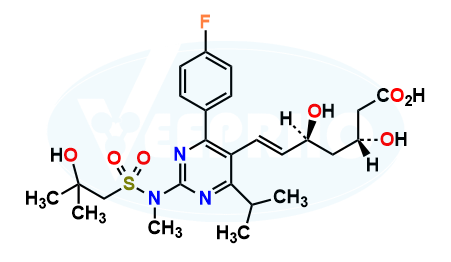
| IUPAC name | (3R,5S,6E)-7-[2-(2,N-dimethyl-2-hydroxypropane-1-sulfonamido)-4-(4-fluorophenyl)-6-(propan-2-yl)pyrimidin-5-yl]-3,5-dihydroxyhept-6-enoic acid sodium salt |
| EP name | Rosuvastatin EP Impurity A |
| USP name | Rosuvastatin Related Compound A |
| SMILES | CC(C)c1nc(N(C)S(=O)(=O)CC(C)(C)C)nc(-c2ccc(F)cc2)c1/C=C/[C@@H](O)C[C@@H](O)CC(=O)O.[Na] |
| InChIKey | AFRLXKVHZPIVMW-ANNPTLPBSA-N |
| CHNS Ratio (%) (calculated) | C 53.47 · H 5.92 · N 7.48 · S 5.71 |
| Description | Rosuvastatin EP Impurity A, also designated Rosuvastatin Related Compound A or Rosuvastatin acetone adduct, is a defined process-related derivative of rosuvastatin sodium with CAS 1714147-50-8. The molecular formula C25H33FN3NaO7S and molecular weight 561.6 g/mol are consistent with addition of acetone to a reactive functionality, forming a stable adduct rather than a simple degradant. Such species may arise during synthesis or exposure to ketonic solvents. Structural confirmation typically requires LC-MS/MS, high-resolution MS, and NMR, with chromatographic separation by RP-HPLC. It is relevant to impurity profiling under compendial and ICH impurity control frameworks. |
Request a Quote
"*" indicates required fields
Other products related to Rosuvastatin impurities
| Impurity structure | Name of Impurity | Catalogue No. |
|---|---|---|
| Rosuvastatin EP Impurity A | VL127008 | |
| Rosuvastatin EP Impurity A (Free Base) | VE0024818 | |
| Rosuvastatin EP Impurity B (Free Base) | VE0024819 | |
| Rosuvastatin EP Impurity B (Racemic Mixture) | VL127001 | |
| Rosuvastatin EP Impurity C | VL127003 | |
| Rosuvastatin EP Impurity C (Free Base) | VE0011116 | |
| Rosuvastatin EP Impurity C (Sodium Salt) | VE0026666 | |
| Rosuvastatin EP Impurity D | VL127002 | |
| Rosuvastatin EP Impurity E | VL127005 | |
| Rosuvastatin EP Impurity F | VL127004 | |
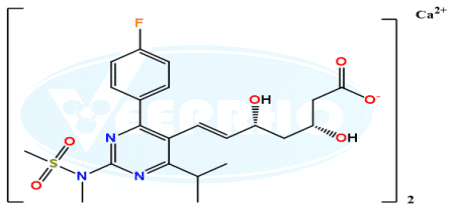 | Rosuvastatin EP Impurity G | VL127009 |
| Rosuvastatin EP Impurity G (Calcium Salt) | VE0026713 |
Show all related products N-Nitroso Rosuvastatin impurities (2)