
- 100% accuracy of data
- 24/7 scientific support
- 0% tolerance in quality of product
Stock Locations
- New Jersey, USA
- Czech Republic, EU
* Stock subject to availability.
Documentation
Includes: HPLC, MASS/LC-MS, 1H NMR, FT-IR, Potency, Structure Elucidation Report (SER), and additional analytical data depending on the product.
183198-49-4
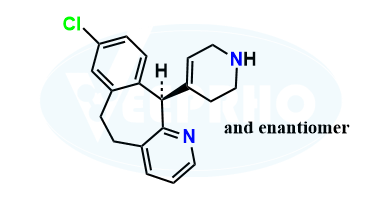
Desloratadine Related Compound B
● In Stock
| Catalogue No.: | VL41005 |
|---|---|
| CAS No.: | 183198-49-4 |
| Mol. Formula: | C19H19ClN2 |
| Mol. Weight: | 310.82 g/mol |
For laboratory use only: analytical, development and regulatory purposes. Supplied in mg quantities. Not for human or veterinary use.
Request a quote for a set
- Request quote for this set
All EP impurities of Desloratadine
5 productsSee the 5 products
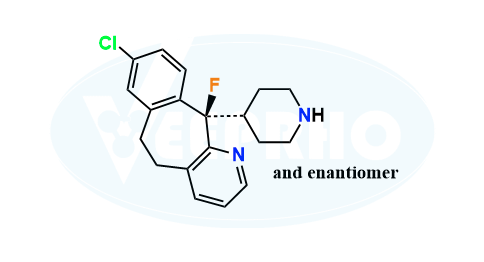
- Desloratadine EP Impurity A (2HCl Salt) VE0016278
- Desloratadine EP Impurity A (Free Base) VL41010
CAS 298220-99-2 - Desloratadine EP Impurity B VE0016274
- Desloratadine EP Impurity C VL41009
CAS 79794-75-5 - Desloratadine Related Compound B VL41005
CAS 183198-49-4
- Request quote for this set
All USP impurities of Desloratadine
5 productsSee the 5 products
- Desloratadine EP Impurity A (Free Base) VL41010
CAS 298220-99-2 - Desloratadine EP Impurity B VE0016274
- Desloratadine Related Compound A VE009921
CAS 117796-50-6 - Desloratadine Related Compound B VL41005
CAS 183198-49-4 - Desloratadine Related Compound F VL41001
CAS 117810-61-4
- Desloratadine EP Impurity A (Free Base) VL41010

Additional information on CAS 183198-49-4
| Parent drug | Desloratadine |
|---|---|
| Product type | Impurity standards |
| IUPAC name | 8-Chloro-6,11-dihydro-11-(1,2,3,6-tetrahydro-4-pyridinyl)-5H-benzo [5,6] cyclohepta[1,2-b] pyridine |
| EP name | Desloratadine EP Impurity B |
| USP name | Desloratadine Related Compound B |
| SMILES | Clc1ccc2c(c1)CCc1cccnc1C2C1=CCNCC1 |
| InChIKey | ADSCCBORDDPTRQ-UHFFFAOYSA-N |
| CHNS Ratio (%) (calculated) | C 73.42 · H 6.16 · N 9.01 · S 0.00 |
| References | El-Enany | Nahed | et al. “Spectrophotometric | Spectrofluorometric and HPLC Determination of Desloratadine in Dosage Forms and Human Plasma.†Chemical and Pharmaceutical Bulletin | vol. 55 | no. 12 | 2007 | pp. 1662–70 | https://doi.org/10.1248/cpb.55.1662. “Pharmacology and Clinical Efficacy of Desloratadine as an Anti-Allergic and Anti-Inflammatory Drug.†Expert Opinion on Investigational Drugs | 2021 | www.tandfonline.com/doi/abs/10.1517/13543784.10.3.547. |
| Description | Desloratadine EP Impurity B, also designated Desloratadine Related Compound B, is a chlorinated tricyclic piperidine-derived process impurity associated with the desloratadine synthetic route and potential oxidative or regioisomeric byproduct formation. CAS 183198-49-4 identifies this defined substance, whose composition corresponds to C19H19ClN2 with a molecular weight of 310.82 g/mol. Its structural similarity to the parent antihistamine requires orthogonal characterization by LC-MS/MS, high-resolution mass spectrometry, and impurity profiling by HPLC with UV or DAD detection, often complemented by NMR for structural confirmation. Although not a nitrosamine, its control is relevant to pharmacopeial specification setting and impurity trend assessment. |
Request a Quote
"*" indicates required fields
Other products related to Desloratadine impurities
| Impurity structure | Name of Impurity | Catalogue No. |
|---|---|---|
 | Desloratadine EP Impurity A (2HCl Salt) | VE0016278 |
| Desloratadine EP Impurity A (Free Base) | VL41010 | |
 | Desloratadine EP Impurity B | VE0016274 |
| Desloratadine EP Impurity C | VL41009 | |
| Desloratadine Related Compound A | VE009921 | |
| Desloratadine Related Compound F | VL41001 | |
| N-Nitroso Desloratadine EP Impurity A (N-Nitroso 11-Fluoro Desloratadine) | VZA000024 | |
| N-Nitroso Desloratadine EP Impurity B (N-Nitroso Iso Desloratadine) | VZA000025 | |
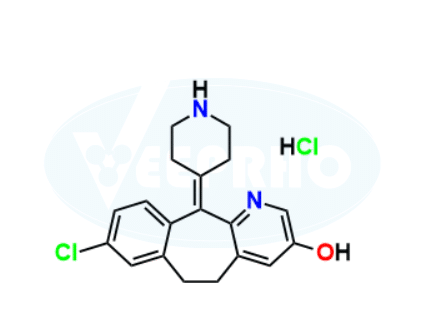 | 3-Hydroxy Desloratadine (HCl Salt) | VE0016280 |
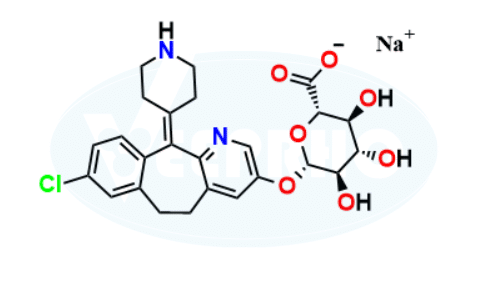 | 3-Hydroxy Desloratadine Glucuronide (Na Salt) | VE0016284 |
| 3-Hydroxy Desloratadine Impurity | VE0016263 | |
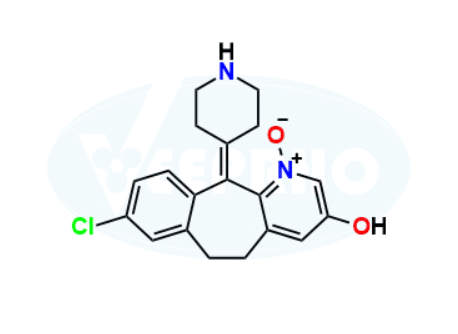 | 3-Hydroxy Desloratadine Pyridine N-oxide | VE0016270 |
Show all related products N-Nitroso Desloratadine impurities (3)